Hugh Edmund Davenport
Happiness for BeginnersHugh Edmund Davenport is a reserved participant in the BCSC wilderness course whose severe hip injury makes him absent from the group’s final ceremony, yet central to its understanding of courage and merit. Known among the hikers as Huey Lewis, he is first defined by how little he speaks; later, his wilderness accident and the award voted to him give that quiet presence public weight. His story reaches its most pointed moment through the reactions of the people who return without him: they celebrate his survival, honor his contribution, and expose how difficult recognition can be for someone who has spent much of the course feeling overlooked.
Identity and Place in the Group
Hugh is notable in the group for his silence. As the hikers’ nicknames take hold, he becomes Huey Lewis because he almost never talks, with Helen as the exception. The nickname turns his reticence into a recognizable identity, but it also marks the limits of what the group knows about him: the evidence gives no account of his history or explains why he speaks to Helen. His distinctiveness lies instead in the contrast between his near-quiet and the easy, increasingly exuberant social life forming around the campers.
That contrast matters in a course where nicknames help make membership visible. Other participants acquire names that reflect an observed habit or role, and Hugh’s name follows the group’s joking shorthand. He is included in the shared vocabulary even while remaining difficult for most of the group to know. The name Huey Lewis is therefore both a sign of communal recognition and a reminder that recognition can begin with a small, comic observation rather than deep familiarity.
Injury and Evacuation
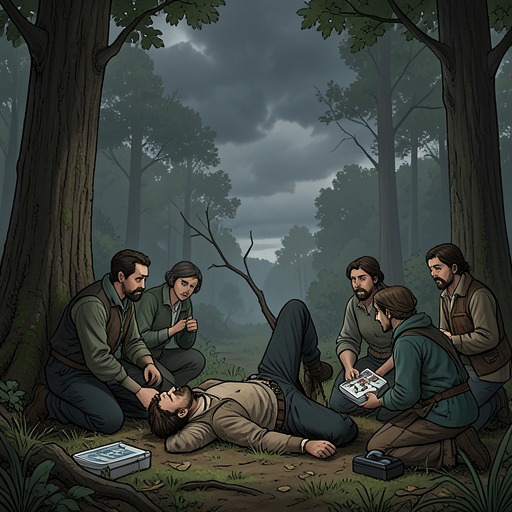
During the wilderness expedition, Hugh suffers a serious accident that requires the group to prepare an evacuation. Jake says he will splint Hugh’s whole body, while Beckett moves the other participants away from the injured man and organizes them into two groups. Three hikers are told to empty their external-frame packs; their belongings are redistributed among the remaining packs, and Beckett dismantles the frames to make a litter for Hugh. The emergency turns ordinary equipment into a means of carrying him out, and the group’s tasks become practical expressions of collective responsibility.
The injury is later identified as both a fractured and dislocated hip. At the course gathering, Beckett tells the group that Hugh is still alive and is expected to make a full recovery, while noting that the injury is likely to be very uncomfortable. Hugh cannot attend the celebration, so anyone wishing to keep in touch must obtain his address from Martha at the front desk. The announcement moves the group from uncertainty about his survival to relief at the prospect of recovery, while making clear that his evacuation has separated him from the shared return and reunion.
Recognition and the Certificate of Merit
At the closing ceremony, Beckett explains that the BCSC Certificates of Merit go to three students chosen for giving their best effort, paying attention, and making the trip better through their presence—not simply for being the biggest or strongest. The students have selected their choices by secret ballot. Hugh’s name is announced among the recipients, and because he is absent, his Certificate must be mailed to Mr. Davenport. The practical arrangement underscores the distance created by his injury: the group can honor him together, but cannot hand him the award in person.
The response is immediate and affectionate. The crowd cheers, and Caveman calls out Hugh’s nickname, Huey Lewis. Helen joins the cheering, but privately feels a sting when Hugh’s name is announced. She had expected Jake and Windy to receive recognition and had hoped that her own growth during the course might also be seen. She wonders whether Hugh received a sympathy vote because he had been through so much; the explanation is Helen’s interpretation, not an established account of the ballots. Windy, seeing Helen’s disappointment, signals that she does not think Helen has been treated fairly, while Helen urges her to enjoy the moment. The exchange shows how Hugh’s honor can be both a sincere celebration of him and a painful surprise for another participant.
Narrative Significance
Hugh’s place in the story is built through absence as much as presence. The evacuation makes his body the focus of organized effort: packs are emptied, frames dismantled, and a litter assembled. At the ceremony, that earlier vulnerability remains in the room, shaping the crowd’s reaction to the news that he survived and to the award made in his name. His recovery is announced before his recognition, so the celebration acknowledges both that he endured a grave injury and that he had mattered to the expedition before it happened.
The award also complicates the course’s language of merit. Beckett describes qualities of effort, attention, and contribution, while Helen tries to understand the result through the possibility of sympathy. The evidence does not settle her suspicion; it leaves the vote secret and Hugh’s particular contributions largely unspecified. What it does establish is the group’s public choice to include him among its three honorees, even when he cannot be present to receive that recognition. Hugh’s quiet characterization, the makeshift litter, the news of his expected recovery, and the mailed certificate together make belonging visible not through a speech from him, but through what the group does and says in his absence.