Hugh's fall and wilderness evacuation
Happiness for BeginnersHugh’s fall and evacuation turn a wilderness-course rule into an emergency and test whether Helen can act when the group is stunned. She initially freezes, uncertain how to respond to a possible head or leg injury, but takes charge of the immediate rescue. The group then builds a litter from pack frames and carries Hugh roughly three miles to a trailhead, where an ambulance can meet them.
The Fall and Helen’s First Response
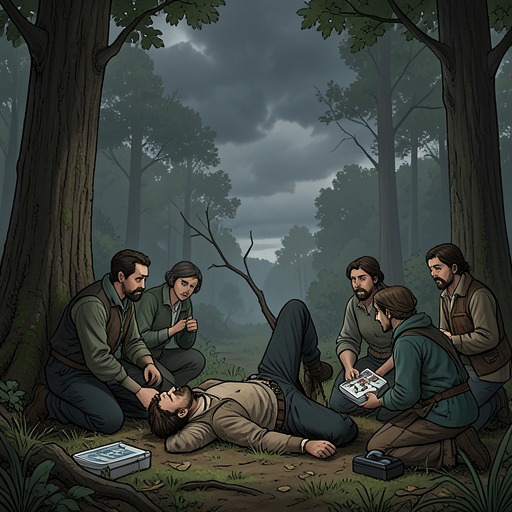
Helen looks up as Hugh steps onto a fallen log. In the fraction of a second before he can swing his other foot forward, the surface crumbles beneath him. He pitches onto a second log, which is sound rather than rotten, and lands across it. His scream shocks the forest into silence; then he falls quiet, collapsed in an upside-down V and pinned beneath his pack. Helen recalls the fall in slowed-down detail, but the scene gives her no time to make sense of it before she has to respond.
She gets her own pack off and tries to recall the first-aid class, then freezes over the competing risks: a head injury should not be moved, but she does not know whether Hugh’s leg is injured or what she should do first. The other women stand motionless, watching. Helen recognizes that somebody has to take charge, and that it appears to be her. She decides to remove Hugh’s pack, unfastening the shoulder straps and reaching beneath his hips for the belt. When he wakes and cries, “No, no! Don’t!”, she continues. The decision is not presented as certainty; it is a choice made in the absence of one.
Moving Hugh and Assessing the Injury
Helen tells two companions to take Hugh’s shoulders while she takes his legs. She points out a clear patch of trail and directs them to turn him over together, counting them in. They lift him while he screams, and the effort is difficult: Hugh is heavy, and adrenaline carries them through the coordinated movement. They lay him as gently as possible on level ground. Halfway through the lift, he stops screaming because he has passed out again.
Once Hugh is on the ground, Helen watches his leg for movement and considers what might be injured. She names a broken leg, hip, or pelvis as possibilities, then presses his rib cage; his scream raises the possibility of broken ribs as well. These are her guesses, not a confirmed diagnosis. She searches her pack for Tylenol, the strongest painkiller available to the group, and reproaches Hugh for stepping on dead trees despite Beckett’s earlier humiliation of her over the fallen-log rule. The exchange links the accident to a course lesson, but the immediate concern is his condition.
Jake, the group’s EMT, later reports that Hugh is pale and clammy, and looks bad. Looking at Beckett, Jake says, “We need to get him out.” Beckett asks whether that means that night; Jake answers that sooner is always better than later. His assessment shifts the response from managing Hugh on the trail to organizing an evacuation.
Building a Litter and Planning the Evacuation
Beckett divides the group’s preparations, telling three people with external aluminum-frame packs to empty them and redistribute their belongings. He dismantles the frames and lashes them together with flat nylon ropes, weaving a surface on which Hugh can lie. A sleeping bag provides padding. Beckett tests the construction by lying on it and judges that, though it is no featherbed, it will do. The improvised equipment makes the group’s packs part of the rescue: they must be emptied, rearranged, and turned into a means of carrying Hugh.
Over breakfast, Jake gives the group a fuller account. Hugh is bruised black from waist to knee, cannot bend his leg, and has one leg that appears longer than the other. Jake suspects a fractured and dislocated hip, though Hugh is conscious. He also reports that Hugh called Helen his hero. Beckett credits her for getting something right. The praise follows her uncertain but consequential decision to act when the others had been still.
Beckett assigns six people to carry the litter while the rest shuttle the backpacks ahead in groups. Helen and Jake are among the litter carriers. Their destination is the nearest trailhead, about three miles away, where an ambulance is expected to take Hugh to the hospital. The plan requires the whole group to move in stages: some bear Hugh’s weight, while others transport the gear that the rescue has displaced.
The Trailhead and Transfer to Paramedics
At the trailhead, neither the BCSC administrator nor the ambulance has arrived. Beckett decides that some of the group will remain with Hugh while the rest go ahead to set up camp and prepare dinner. Jake is to stay because he is the EMT; Beckett also asks Helen to remain because Hugh likes her best. Hugh answers her question with qualified affection: “I don’t really like anybody,” he says, “But I like you better than most.” Even as the group divides to meet practical needs, Helen’s connection with Hugh determines who stays beside him.
When the paramedics arrive, transferring Hugh from the homemade litter to the truck takes a long time. The rescuers have to redo properly the work the group has done. Helen stays close, although they will not let her touch him. Once Hugh is secured on their gurney, she pushes near and gives him a small kiss, telling him to be brave. He answers, “Always,” then looks from Helen to Jake and adds, “You too.” Helen says she would promise to visit him in the hospital when the group returns, but does not think he will still be there. The scene ends with Hugh leaving for professional care and Helen’s concern expressed in a farewell rather than a confirmed medical outcome.
Significance
The rescue changes Helen’s position within the group through action rather than formal authority. She begins by freezing and asking herself what to do; she then makes a decision, recruits help, and directs a difficult lift. Jake’s medical judgment and Beckett’s logistical planning remain essential, but the emergency also depends on Helen’s willingness to move first while the others are still in shock.
The evacuation is collective and improvised. Pack frames, ropes, and a sleeping bag become a litter; gear is redistributed; the group divides between carrying Hugh and shuttling its packs. The ordinary logistics of a wilderness expedition are repurposed around one injured person. At the trailhead, the homemade solution gives way to the paramedics’ equipment, while Helen remains emotionally present even when she can no longer help physically. The fall therefore marks both the limits of the group’s self-sufficiency and the practical solidarity that carries Hugh out of the wilderness.