Jake’s glasses
Happiness for BeginnersJake’s glasses turn an ordinary piece of equipment into a point of danger, dependence, and intimacy during the BCSC wilderness expedition. When Jake loses them beside a creek, Helen finds him distressed and unable to see her; when she retrieves the lenses, his relief gives way to a kiss. One arm has broken, but duct tape makes the glasses serviceable again, and their patched appearance follows Jake onto a difficult bridge and into the story Helen later tells Duncan.
An everyday object made precarious
Before the glasses become the focus of a crisis, Jake is assigned to carry four water bottles and a cookpot down to a creek. Helen later jokes that it is hard to understand why the person with Coke-bottle glasses was given that job. The remark places the glasses in the practical circumstances of the expedition: Jake is navigating rough terrain while relying on them, and the group’s simple water-gathering task becomes more consequential as the light fades and he fails to return.
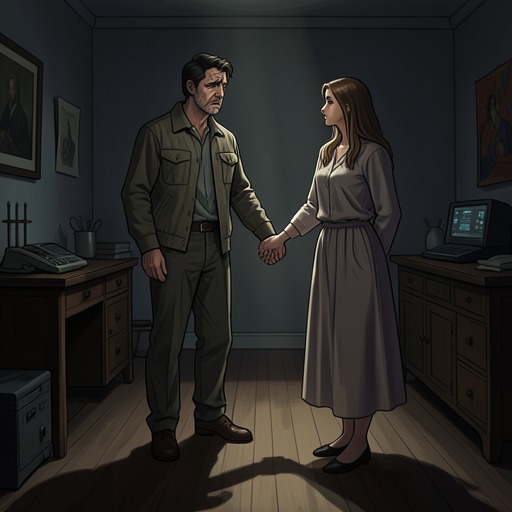
The glasses matter most when they cease to work as an unobtrusive aid. On the steep, uneven path to the water, Helen worries that Jake may have fallen. She finds him on his hands and knees, panting and frantic, his eyes red. He has fallen, but he is conscious; what has left him panicked is that his glasses are missing. He warns Helen not to come closer in case she steps on them. The object’s smallness makes the search difficult, while its importance to Jake turns every misplaced step into a possible loss.
The creek-bank search
Helen moves closer despite Jake’s warning, then joins him in looking. As the light diminishes, his distress sharpens. He says he cannot believe he has lost the glasses, and Helen takes charge, telling him to stay where he is while she crawls over the ground. The scene makes the search a shared physical effort: Jake can do little without the missing lenses, and Helen must move carefully across the rocky bank to find them.
The discovery comes through an accidental gesture rather than a successful sweep of the ground. As Helen shifts onto her hands and knees, she hears a snap and realizes she has been kneeling over the glasses. She picks up two pieces. The lenses are intact; one arm has come off. That distinction matters: the glasses have been damaged, but their most immediately useful parts remain. Jake wipes the lenses on his shirt and puts them back on. His relief is expressed in action as well as speech: he pulls Helen into a full-body hug.
Breakage, repair, and a changed encounter
The recovery does not simply return the scene to its earlier state. The broken arm remains a material consequence of the search, and Helen apologizes as they cross the rocks toward the path. Jake treats the damage as manageable, sliding the detached arm into his pocket and saying duct tape can fix it. The glasses are neither restored to their original condition nor abandoned; they are made usable through an improvised repair.
Between their recovery and that practical reckoning, Jake’s embrace becomes a kiss. Helen describes the shift as sudden: he draws back slightly, brushes his beard past her cheek, and kisses her. The glasses do not cause the kiss, but their loss and recovery place it at the scene’s emotional turning point. Jake has been unable to see Helen clearly; once the lenses are back on, relief becomes closeness. Helen later tells Jake that the kiss is erased, though she acknowledges that it is not. The damaged object thus remains connected to an encounter neither of them can simply undo.
That night, the group eats a poor dinner of rehydrated vegetables, boiled water, flour, and salt, then goes to bed without discussing the kiss. The glasses, meanwhile, have an immediate practical afterlife: their arm is pocketed, and duct tape supplies the repair. The contrast is telling. The equipment receives a concrete fix, while the emotional consequence is left unspoken.
The patched glasses beyond the creek
The repair matters on the return hike. Helen leads the group back to the barn, keeping to the trail and bringing everyone together safely. At the start, they must cross a rickety bridge; its creaking and swaying make the crossing difficult for everyone, but more so for Jake in his duct-taped glasses. The glasses now mark not only the earlier mishap but also the expedition’s continuing physical demands. They are damaged, repaired, and still in use as Jake faces another unstable passage.
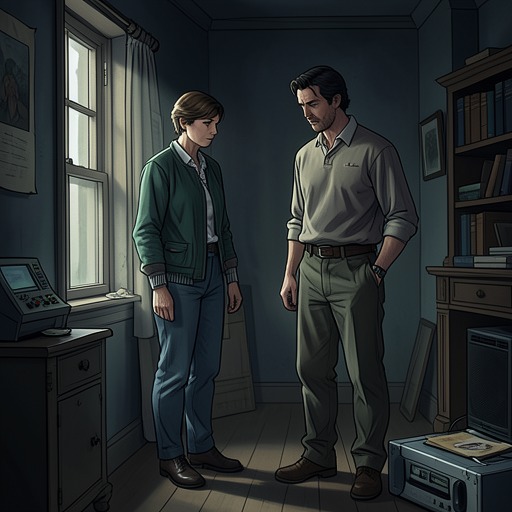
Later, at a party, Jake appears with his glasses fixed. Helen notices that he is clean-shaven, has had his hair cut, and is dressed in a red Mexican guayabera shirt, frayed khakis, and flip-flops. The repaired frames help make him look like the man she remembers from their drive, but the moment also brings a painful contrast: he is directing his attention toward Windy. Helen leaves the room, then steadies herself outside by recalling what she has accomplished on the trip. The glasses are no longer broken, yet their restoration does not resolve the emotional uncertainty associated with Jake.
When Helen later sees Duncan again, she describes the expedition through the same concrete mishap: Jake lost his glasses, she broke them, and they taped them back together. Duncan responds with approval of duct tape. In that brief retelling, the glasses condense a larger episode into a chain of actions—loss, discovery, breakage, repair—that Duncan can readily recognize. Across the expedition, they are at once necessary equipment, a fragile object exposed to rough terrain, and a material trace of Helen and Jake’s closeness.