Jake’s retinitis pigmentosa
Happiness for BeginnersJake’s retinitis pigmentosa is an inherited disorder that progressively destroys his sight, a diagnosis he knows cannot be reversed. Its importance lies not only in the approaching loss of vision but in the way that knowledge reorganizes Jake’s choices: he cancels and then reconsiders a wilderness trip, keeps his condition secret, revises a future built around medicine and family, and at last tells Helen what he has been carrying. The illness is both a bodily reality already affecting him in darkness and a future he has researched in detail but cannot control.
Diagnosis and Early Secrecy
During the trip, Jake climbs a tree and later falls. Helen worries that darkness and his night blindness may have caused him to miss a branch. Jake insists that he slipped, then asks her not to mention the night blindness to anyone. He explains that they are strangers, so she cannot possibly know; he also reveals that he did not pass the medical screening. The exchange makes concealment part of his immediate circumstances: his vision is already relevant to safety, but he asks Helen to treat what she has noticed as something she could not know.
Later, Jake connects the trip’s interrupted plans to the worsening trouble with his eyes. He had signed up, canceled, and signed up again; the cancellation followed difficulties with his vision and a series of examinations and tests. Those examinations established that he has an inherited disorder that cannot be fixed. The disclosure clarifies that the earlier night blindness is not an isolated inconvenience but one part of a progressive condition, and that the trip’s medical clearance had become a real point of conflict between his physical circumstances and his decision to participate.
What the Diagnosis Means
Jake names the disorder as retinitis pigmentosa and explains it in terms of the eye’s rods and cones. Rods, he says, are around the edges of the eyes and serve peripheral vision and sight in dim light; cones process color and detail. In his condition, both kinds of receptors begin to die, one by one, because they produce the wrong kind of protein and stop working. His account is specific and matter-of-fact, but the facts lead to a stark prognosis: most people with the disorder are legally blind by forty, and Jake expects his own sight to disappear much sooner.
He has spent a year using his pre-med-trained mind to search through the information available to him. That research has not yielded a treatment or a plan that can halt the loss. His conclusion is that he can only wait for the light to go out. The contrast between his ability to explain the mechanism and his inability to change its course defines his predicament: knowledge gives him a precise account of what is happening, not mastery over it.
A Future Rewritten
The diagnosis unsettles plans Jake had treated as central to his life. He had wanted to become a doctor, have a large family, and learn to scuba dive. When he explains how certain the prognosis has become, he recalls being unable to breathe or eat and feeling that his whole future was disappearing. His account places the crisis just before Helen appeared at a party with Pickle. By then, the loss had altered his sense of what he could promise himself and whether he could pursue Helen.
His father’s expectations add another pressure. Jake says his father calls him “Doc” and sees in him the person he has always intended him to become: a high-achieving, hardworking valedictorian. The nickname ties Jake’s identity to a future in medicine, precisely the future the diagnosis has put in doubt. Jake describes his father as willing to have only one kind of son; the tension is not simply between illness and ambition, but between Jake’s changing possibilities and an established image of who he should be.
Jake also keeps a list of what he wants to see and do. Some entries are far-flung, while others are intimate and specific: he wants to revisit his childhood home, see the merry-go-round at the park his grandmother took him to, and look through his father’s historic photographs of his great-grandparents, aunts, and uncles in Texas. He also wants to scuba dive, drive a race car, and ride the world’s scariest roller coaster. The list gathers family memory, places, and experiences into a finite set of intentions. It records what matters to him without suggesting that every item can be completed or that the list can undo the diagnosis.
Telling Helen
The condition changes what Jake believes he can ask of Helen. He says that once he knew for sure, he could not breathe or eat, and that he stopped thinking about asking her out. He had assumed she did not like him even with ordinary sight; the diagnosis made the future he had imagined with her feel even less attainable. His concealment therefore extends beyond the trip’s medical screening: he also withholds the diagnosis while struggling with whether a relationship would be fair to begin.
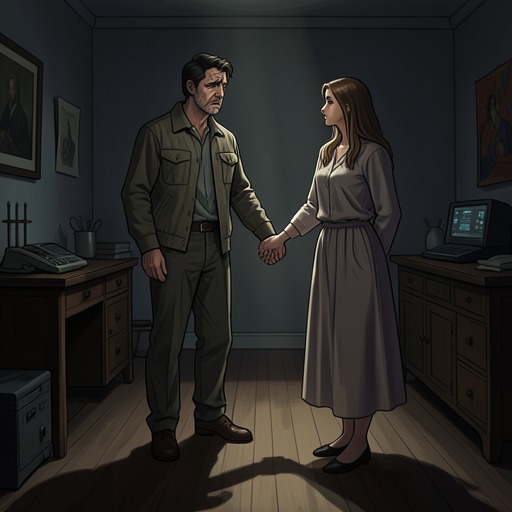
When he finally tells Helen, they are on opposite sides of an elevator. Jake says his eyes will go dark within the next few years, that nothing can change the fact, and that if he were a better person he would leave her alone. He admits that he cannot do so and explains that he has come to be brave and say what he feels. The confession does not offer Helen a remedy or promise a different prognosis; it gives her the truth behind his earlier silence and his hesitation to pursue her. The elevator then drops, interrupting the moment with a physical loss of footing. Against that sudden fall, Jake’s account of approaching darkness remains neither a metaphor detached from his body nor a problem solved by love: it is the concrete condition shaping what he can see, what he expects, and what he has at last chosen to disclose.