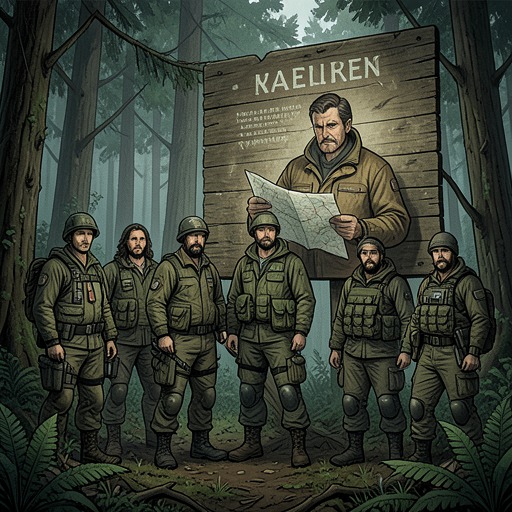
Leave No Trace Principle
Happiness for BeginnersThe Leave No Trace Principle is presented through a small but charged act of enforcement: Beckett finds a scrap of paper in the campsite, discovers that it is Helen's lost goal list, and burns it in front of the group. The episode turns an instruction to respect nature into a public confrontation over responsibility, embarrassment, and what it means to leave a trace. Later, when the hikers reach a litter-strewn trailhead after a week in the wilderness, Helen recognizes the force behind Beckett's severity and finds herself sharing it.
The Principle in Practice
On the morning Beckett is due to leave with the first group of hikers, he spots a white square on the ground. He stops the group, crosses the campsite, and squats to examine it. The paper seems conspicuously out of place, and Helen soon realizes that it is hers: the list of goals she had been carrying in her bra. She had lost it, rather than deliberately thrown it away, but its presence on the ground makes the practical consequence the same. The scene places an environmental rule beside the ordinary possibility of carelessness, and makes the distinction between intention and impact difficult to ignore.
Beckett frames the discovery as part of a repeated lesson. He reminds the group that they have discussed respecting nature and leaving no trace, and complains that they continue to leave detritus behind. The wording makes the rule more than a response to one scrap: in his account, the paper belongs to a pattern of behavior the group has already been taught to avoid. His questions about what he said on the first day and in the first lecture also make the group's memory of the rule part of the confrontation. Mason supplies the warning that littering will not be tolerated; Dosie recalls Beckett's threat to go insane if he saw someone littering.
The Burning of Helen's Goal List
The lost paper is not an anonymous wrapper. It contains Helen's private aspirations: to encounter nature's power and beauty, to feel awe at the world, and to become part of something larger than herself. Beckett reads those lines aloud before anyone claims the list. Some of the men laugh and snort, while Beckett remains serious. Helen is about to identify the paper as hers, but holds still instead; she is grateful that she cut her name off the top before the journey began. Her silence protects her identity in the moment, even as the list's language is exposed to the group.
Beckett then takes out the propane lighter used for the cookstoves and holds it beside the paper, asking once more whether anyone will claim it. No one does. He lights the list and lets it burn almost to his fingers before dropping it, stamping out the flame with his boot, and pocketing the remaining corner. The action is theatrical, but it also follows the logic of his warning: he has said what would happen if he caught someone littering, and now performs that consequence. The gesture's irony rests in the object itself. Helen's written desire to join the natural world has become an unwanted piece of refuse in the campsite; the paper that expresses reverence for nature is the thing Beckett removes by fire.
After telling the hikers, “The world is not your garbage dump, people,” Beckett looks around at the silent group. He warns that he will scorch the earth if the behavior happens again, whistles for the first group, and leads them down the trail. The others wait until the group is out of sight before releasing a collective breath. Hugh's observation that scorching the earth sounds counterproductive gives the scene a dry counterpoint: Beckett's extreme threat is at odds with the environmental ethic he is enforcing. The joke does not erase the rule, but marks the difference between its purpose and his deliberately alarming performance of it.
From Witness to Convert
The importance of the encounter becomes clearer later at a very different trailhead. Unlike the hikers' earlier wilderness drop-off, this one has a bathroom, vending machines, electrical hookups, camper vans, families grilling burgers, and grandmothers in muumuus. After a week in pristine wilderness, Helen is struck by the quantity of rubbish: Twinkie wrappers, beer cans, and empty potato-chip bags. The rule's concern is no longer concentrated in Beckett's dramatic response to a single white square; the accumulated litter across the developed site gives Helen a broader scene of people leaving their waste behind.
Helen recalls thinking that Beckett seemed psychotic when he burned her list. Looking at the trailhead, she understands him differently. Her response shifts from judging his anger to feeling it herself: she wants to set fire to every piece of trash, and possibly every human being as well. That violent exaggeration echoes Beckett's threat, but it also measures how strongly the contrast between a clean wilderness and the littered trailhead has affected her. The principle has moved from a lesson she watches someone enforce to an ethic she can feel from within.
Narrative Significance
The episode binds environmental responsibility to the novel's account of Helen's aspirations without suggesting that good intentions alone are enough. Her list speaks of awe and belonging, yet it has become litter; Beckett's intervention makes that contradiction visible to the group and to Helen herself. The later trailhead scene extends the meaning of the incident through contrast: in the wilderness, one lost sheet provokes a dramatic reprimand, while at the developed site rubbish is everywhere. Helen's changed reaction links the two scenes, showing that the principle's force lies not only in the rule against leaving trash but in the shift from treating such waste as incidental to seeing it as an assault on the place one has entered.