Painted Meadow
Happiness for BeginnersPainted Meadow is a high-country campsite whose beauty gives Helen a rare experience of ease and wonder, while its history and her memories there make it more than an idyllic pause in the BCSC wilderness expedition. The meadow holds two sharply different kinds of significance: it is the site of a massacre of the Shoshone, and, for Helen, a place of rest where she feels close to her dead brother, Nathan. Later, it also becomes linked to the romantic turning point between Helen and Jake.
Setting and History
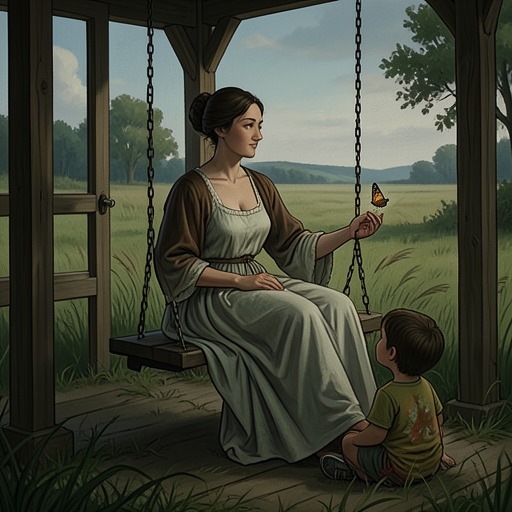
The group reaches the meadow after continuing along the trail, and Beckett announces their arrival. The landscape seems almost composed for a picture: calf-high green grass and wildflowers moving in the breeze, white butterflies, a brilliant blue sky with cottony clouds, and mountain peaks rising around the open ground. The air is cool while the sun feels warm. The hikers stop as they enter, unable to keep walking and take in the view at the same time. Helen agrees that the place looks painted, but Beckett explains that the name has a darker origin.
Painted Meadow was the site of a massacre in which many Shoshone people were killed. Beckett corrects Helen when her first response mistakenly suggests that the Shoshone were responsible: they were the people massacred. That correction changes the meaning of the idyllic landscape without erasing its beauty. The meadow’s name preserves a history of violence beneath the scene of flowers and sunshine, and its apparent calm does not make that past disappear.
Beckett says there is a stream at the meadow’s eastern edge and directs the group to pitch camp there. He also warns that the place is said to be haunted, asking the group to behave themselves. Then he welcomes them to his favorite place in the Absarokas. Helen notices that she genuinely likes him in this moment, a small shift in her response to the guide as the place he loves makes an impression on her too.
Rest and the Meadow’s Everyday Life
For Helen, the first relief is physical. She exchanges her boots for flip-flops and takes off her pack; those simple acts make her feel dramatically lighter. Her blisters have healed, leaving tender new pink skin, and she finds herself strangely optimistic at the sight. Camp still needs to be set up and dinner made, but the prospect of a whole day without obligations makes even those tasks feel easy. She smiles at the others, closes her eyes in the breeze, and studies the magenta, pale-blue, and butter-yellow flowers.
The meadow gives meaning to the hardship that preceded it. Helen feels that the awe she experiences there makes the humiliations, injuries, blisters, and loneliness worthwhile. Cooking dinner and falling asleep both feel blissful. The next morning, the group follows its usual routine of coffee, breakfast, and tidying camp, but there is no further march: the day is a Zero Day, with no required travel. As the morning warms, Helen takes off her sweater and spends the day doing nothing, a freedom she experiences as a pleasure rather than an absence.
The other hikers make different use of the pause. Some of the larger men go exploring; Vegas and Jake practice fly-fishing in the stream. Some of the women collect river water and carry it to the meadow’s driest side to wash their salt-stiffened socks and shirts, wringing them out before leaving them to dry on a rock. Helen watches but does not join in. Instead, she lies in the sun. She considers pressing wildflowers into her journal, including Indian paintbrush, touch-me-not, and coreopsis, and identifying others with a booklet Mason has lent her. She might also help Windy gather dandelions and miner’s lettuce for the solstice dinner, or cheer the boys as they return with three fish, the maximum Beckett allows. For the morning, however, she chooses stillness.
Nathan and Helen’s Memory
Lying on her sun-warmed rock, Helen finds that the meadow’s peace brings her close to Nathan, her lost brother. She imagines him at eight years old, with knobby knees and red sneakers, running through the long grass or heading toward the riverbank to see what the older boys are doing. The imagined scene is not a claim that he is physically present; it is a way of picturing the place through what she knows and remembers of him. Helen feels that he would love the meadow and could almost be there, just out of sight.
The thought brings tears, but the surrounding beauty and tranquility keep her from feeling wholly overtaken by sadness. Helen reflects that she almost never feels tranquil, yet on this warm day she has no choice but to settle into the rest around her. Lying limp across the rock, she remembers a poem she used to read to her first-grade students, The Ballad of the Boneless Chicken. The memory gives the moment a future life: she realizes that reading the poem again will bring back this day and her boneless ease on the rock. Her happiness is not a cure for grief, but the meadow lets memory and contentment occupy the same moment.
Later, Helen tells GiGi about the experience of nearly seeing Nathan, or at least remembering him more clearly than she has in years. GiGi responds with a mixture of happiness and sadness. Helen explains that the memory may help account for whatever GiGi sensed had changed in her: she has found a way, at last, to mend the hole Nathan left in her life. She sees this healing moment as something capable of changing her. GiGi observes that the camping trip she had considered Helen’s worst idea appears to have become something meaningful, and Helen agrees that she tried to make it so.
Romance and Lasting Significance
Painted Meadow later becomes part of the history between Helen and Jake. Helen tells Jake that she saw him and Windy kissing at the trailhead during Hugh’s evacuation, and recalls that Jake had almost proposed marriage to Windy at Painted Meadow. Her blunt recollection identifies the meadow not only with Helen’s solitary emotional recovery but also with Jake’s complicated romantic choices. The same place that holds Helen’s intimate memory of Nathan is bound to a moment when Jake’s relationship with Windy seemed close to becoming a proposal.
The meadow’s importance comes from these layers rather than from scenery alone. Its flower-filled openness offers a rare interval of rest during a demanding wilderness journey, while its name points back to violence and its solitude makes room for Helen’s vivid recollection of her brother. It also remains in the characters’ later accounts of love and near-commitment. Painted Meadow is therefore both a particular landscape and a meeting place for histories that do not resolve into one mood: beauty does not erase massacre, and tranquility does not erase loss, but the experience of being there gives Helen a lasting memory in which grief, relief, and hope can coexist.