Pickle's rescue
Happiness for BeginnersPickle’s rescue is the abrupt reversal that turns Helen’s careful search for an ideal pet into a commitment to one particular, badly injured dog. Abandoned outside her apartment and in need of costly treatment, Pickle becomes Helen’s through a practical act of care: she pays the bill rather than leave the dog to die. The decision brings a damaged animal into her life, not the gentle, predictable companion she had imagined, and its consequences later reach into her relationship with Duncan.
Before the Encounter
For months, Helen had been searching for a dog through Petfinder.com, looking at rescue animals’ pictures, videos, and personality profiles every night. She wanted a fluffy, adorable, sociable, hypoallergenic pet and repeatedly searched among poodle mixes, including labradoodles, cockapoos, golden doodles, malti-poos, and schnoodles. Her search was deliberate enough to include lists of desired traits and filters for color, fur, temperament, age, and how near a foster home was to her apartment.
Helen had already come close to adopting several dogs that matched her ideal: blond, fluffy animals with bright eyes and what she described as smiley mouths. At last she selected a yellow puppy named Lola, made an offer, completed an application, was accepted, and arranged to meet the dog later that week. Pickle entered the story at the point when this carefully prepared adoption seemed settled. Her arrival is not the outcome of Helen’s search criteria but a sudden interruption of them.
Finding Pickle and Choosing Treatment
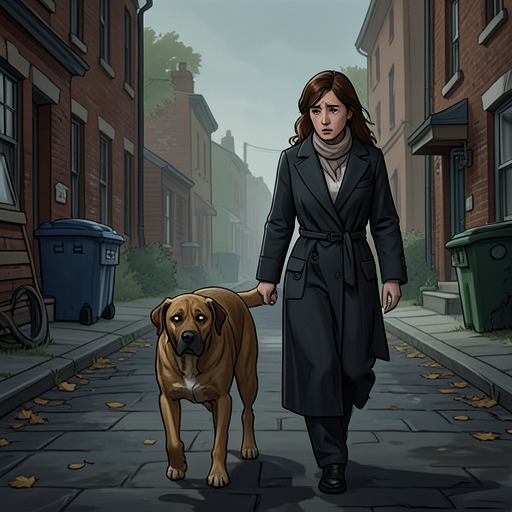
Someone had tied Pickle to a street post on the sidewalk in front of Helen’s building. Her mottled fur and hairless-looking skin tail initially made Helen think she was seeing a possum. Once she recognized Pickle as a dog, the signs of abandonment and mistreatment were unmistakable: her fur was matted, her skin scabbed, and her body covered in fleas. Pickle did not bark at Helen or anyone else. Helen understood her silence as the result of a dog whose fighting spirit had been exhausted.
Helen took Pickle to a veterinary clinic that was open late rather than leave her outside. The examination revealed another injury, a broken leg, and the cost of repairing it was three hundred dollars. Helen asked what would happen if she could not afford the treatment. The veterinarian told her that putting Pickle down would probably be the kindest option. The rescue therefore turns on a concrete choice: an expensive operation or euthanasia, not simply the abstract wish to help an animal.
Helen paid the three hundred dollars. That payment made the rescue an adoption in fact: Pickle was hers. The contrast with Lola is central to the episode. Helen had been preparing to choose a dog according to carefully assembled preferences; instead, she chose to take responsibility for the injured animal already in front of her, whose needs were immediate and whose future depended on treatment.
Recovery and the Reality of Care
Pickle’s physical recovery did not make her an easy companion. As she regained strength, she also regained what Helen described as an abiding hatred of living creatures. Helen could admire the dog’s moxie in theory while finding her, in daily life, a serious nuisance. The change complicates any simple rescue narrative in which kindness is quickly rewarded with affection or obedience: Pickle survives, but the effects of her mistreatment remain visible in her defensive hostility.
When Helen recounts the story to Windy, Windy suggests that Pickle sounds as though she has post-traumatic stress disorder. Helen immediately clarifies that they are talking about a dog. The exchange gives the story a lightly comic turn without undoing the severity of Pickle’s condition. Her aggression is presented alongside the earlier evidence of neglect—scabs, fleas, matted fur, and a broken leg—rather than as a flaw detached from her history. The rescue does not erase that history; it brings Helen into the ongoing work of living with its consequences.
Later Loss and Family Connection
Pickle’s life after the rescue later becomes bound up with Helen and Duncan’s shared grief. In a later veterinary crisis, Duncan reveals that Pickle had not remained at the clinic: although Helen had checked her in, Duncan had checked her out. He explains that the illness involved was lethal if not caught within an hour. The cited account does not name the illness, but it makes Pickle’s absence from veterinary care the painful fact at the center of the revelation.
Duncan’s grief overturns Helen’s assumption that Pickle was simply a horrible dog. He tells Helen that he loved the little rat-faced animal; Helen realizes that he means it, embraces him, and says that she loved Pickle too. For a moment, the dog they had experienced differently gives the siblings something good in common. The original rescue thus extends beyond Helen’s decision to pay for a broken leg: Pickle becomes a lasting relationship and, after her loss, a point of connection between Helen and Duncan.