Rule Against Stepping on Fallen Logs
Happiness for BeginnersThe Rule Against Stepping on Fallen Logs is a BCSC wilderness-safety instruction that requires hikers to cross fallen trunks without walking on top of them. Its importance emerges not through an abstract lesson but through a preventable breach: Hugh repeatedly steps onto logs, Helen notices without correcting him, and Hugh is subsequently injured and evacuated. The rule’s force lies both in its practical warning about rotten wood and in the story’s account of how individual choices—and silence around them—can become entangled in a group’s safety.
Definition and Safety Logic
Beckett’s instruction is clear: hikers are not to step on fallen tree trunks. When the trail is obstructed, the approved alternative is to step over or straddle the trunks rather than climb onto them. The distinction may seem small in the moment, but the hazard is cumulative: Beckett has warned that among enough fallen trees, at least one is likely to be rotten. A trunk that appears to offer a convenient foothold may not support a person’s weight.
The rule belongs to a course defined by unusually serious exposure to danger. BCSC participants sign waivers acknowledging possible life-threatening hazards, and its routes are described as steep, rocky, and remote. That wider context does not make the fallen-log instruction incidental. It makes attention to particular, repeated hazards part of the practical knowledge the course is supposed to teach: survival depends not only on accepting that the wilderness is dangerous, but also on following specific precautions while moving through it.
The Breach on the Trail
The rule comes into focus on a sunny, thinned-out stretch of forest where fallen trees lie across the path. Helen wonders what has killed so many of them. At the back of the hiking line, however, Hugh and Uno are talking about a fanciful wilderness wedding for Jake and Windy. Their conversation turns to what Jake would wear, and Hugh keeps stepping up onto one trunk and then another as he talks.
Uno follows the instruction more carefully, straddling a trunk as she has been told to do. Hugh, by contrast, steps onto successive logs; he even corrects Uno’s imagined choice of tie while continuing to cross them in the forbidden way. Dosie also participates in the wedding conversation, while the trail’s physical danger remains in the background. The ordinary ease of the exchange is part of the scene’s tension: a safety rule is being broken during an apparently casual moment, not in a dramatic confrontation with danger.
Helen sees Hugh stepping on the trunks and sees the others crossing differently. She also jumps over the logs herself. Yet she does not stop Hugh or remind him of the rule. Her later account stresses that she did not believe it was her place to tell him what to do; each person seemed to be making individual choices. Only afterward does she recognize that those choices were connected. Her regret is not simply that Hugh failed to obey Beckett. It is that she witnessed the breach and failed to act when a correction might still have mattered.
Consequences and Enforcement
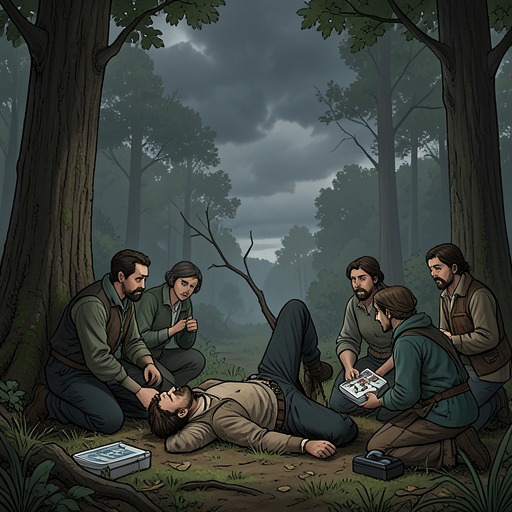
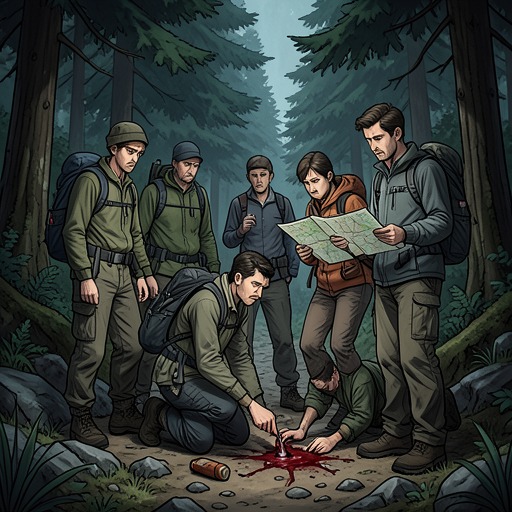
The scene is followed by Hugh’s wilderness accident and evacuation. The story connects the warning about rotten trunks to the danger Hugh has been taking, turning the rule from an instruction that could be treated as overcautious into a concrete matter of bodily safety. Hugh’s injury also changes the group’s experience of the prohibition: after the accident, Beckett asks whether anyone in the party will ever step on a fallen log again. The question registers the lesson as collective, not merely as a reprimand aimed at the person who was hurt.
The consequences continue after the immediate emergency. When the group discusses who should receive an honorary BCSC Certificate, Helen argues that Hugh should not receive one because he knew he was not supposed to step on those logs. Her position separates sympathy for Hugh from approval of his decision: she hopes he is doing well, but resists treating an injury as a reason to erase a known violation. Later, when Hugh’s Certificate is awarded and must be mailed to him, the recognition sits alongside the memory of the accident and the rule he broke.
Narrative Significance
The rule’s meaning expands through the contrast between knowing and enforcing. Hugh knows the instruction but ignores it; Helen knows it too, sees the breach, and stays silent. Her retrospective regret makes the episode a test of responsibility within the group: safety depends not just on a written or spoken rule, but on whether people respond when someone disregards it. The mistake is individual, yet the scene refuses to portray its risks as isolated from everyone else’s conduct.
The fallen logs also give the rule a precise physical form. Crossing over them requires attention to the trail and restraint from treating an obstacle as a useful step. The later question about whether anyone will ever step on one again echoes the original warning in a changed register, after danger has become experience. In this way, the rule links BCSC’s wilderness instruction to the story’s broader concern with choices whose consequences reach beyond the person making them.