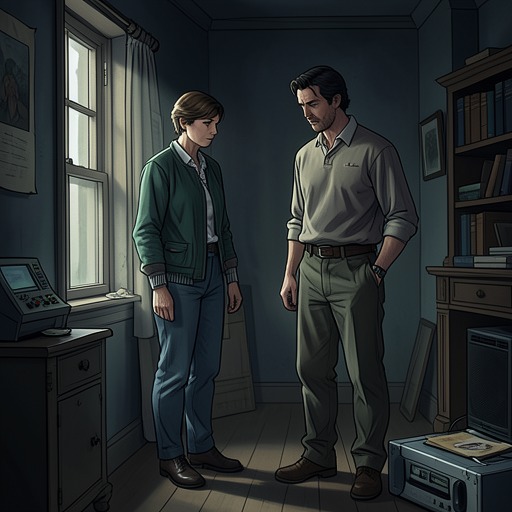
Sight, Darkness, and Seeing
Happiness for BeginnersSight, Darkness, and Seeing is a motif that turns Jake’s progressive vision loss into both a concrete future he cannot prevent and a test of what it means to perceive another person. As Helen learns that Jake will lose his sight, the narrative moves between medical explanation, her fearful imagining of what blindness will change, and scenes in which touch and attention offer forms of recognition that eyesight cannot guarantee. Light remains precious, but seeing becomes more than looking.
Diagnosis and Anticipation
Jake’s disclosure reframes the trip he has joined. He explains that he first canceled his participation because of problems with his eyes, then underwent examinations and tests that identified an inherited vision disorder that could not be fixed. Night blindness is one part of it. He names the condition as retinitis pigmentosa and tells Helen that he expects to lose his sight over the next few years. The measured explanation makes the prospect unmistakable: this is not a temporary difficulty but a progressive loss he already understands as irreversible.
Jake describes the process in bodily terms. The affected cells make the wrong kind of protein and stop working one at a time; many people with the disorder are legally blind by forty, while Jake expects his own decline to be much sooner. He has spent the past year searching through available information with his pre-med-trained mind, but that knowledge offers no treatment or escape. His conclusion is that he can only wait for the light to go out. The scientific account and the stark image of darkness sit together: research can explain what is happening without giving him control over its outcome.
The disclosure also changes how Helen reads Jake’s presence on the expedition. She recognizes that he has carried this knowledge through the same hikes on which the group, including Helen, complained about blisters, misunderstanding, and other comparatively ordinary frustrations. His independence and competence do not cancel the threat; they sharpen the contrast between the capable man she knows and the future she suddenly imagines for him. The motif makes sight loss at once a medical condition and an impending alteration to daily life.
Imagining a Sightless Future
Helen’s immediate response is to picture what Jake may lose in practical as well as emotional terms. She wonders how he will choose clothes, buy groceries, travel from home to work, or find a book to read. Her questions do not establish what his future arrangements will be; they reveal how quickly she measures that future against the visible and navigable world she takes for granted. She fears that blindness will deprive Jake, with his formidable intellect, of ways to keep his mind occupied, and imagines the ordinary tasks of life becoming difficult.
Her thoughts widen from routine to the visual experiences she assumes will disappear: twinkling lights, bonfires, late-afternoon sunshine, shadows, leaves, rain clouds, and smiles. She also imagines Jake never seeing the faces of children or grandchildren, knowing them only by their voices. This catalogue gives the prospect an emotional scale, but it is specifically Helen’s imagining at the moment of disclosure, not a settled account of Jake’s life after vision loss. The distinction matters: the passage registers her fear and grief while leaving his future unresolved.
The scene also sets up a tension between visual beauty and the possibility of connection. Helen’s list makes light, landscape, expression, and faces seem indispensable; later, Jake’s encounter with her face by touch complicates that assumption without denying what he is losing. The motif does not make blindness a simple metaphor for insight. It holds the material consequences of a degenerative condition beside a developing intimacy that can be expressed through other senses.
Touch as Recognition
During a light sprinkle of rain, Jake says he hates that he cannot really see Helen. She answers that he may be able to if he tries, then guides one of his scratched, callused, dirt-caked hands to her face. He uses his other hand as well, feeling her jaw, cheekbones, eyebrows, and nose, and closes his eyes to concentrate. The scene shifts attention away from the image of a face and toward the deliberate act of learning it through touch.
Jake’s response, “There you are,” makes the encounter one of recognition rather than visual recovery. Helen answers, “Here I am.” The exchange does not suggest that his vision has returned or that touching her replaces sight without remainder. Instead, it gives the moment a different form of presence: his hands trace the features that sight would ordinarily locate, while his concentration makes the act personal and intimate. Helen’s breath shudders at the closeness, so the shift in perception also changes the emotional charge between them.
After Helen returns his lenses, Jake puts them on and says, “Oh, God, there you are,” before pulling her into a full-body hug. He then shifts the embrace into a kiss. The kiss is described as anxious, driven, and unlike their earlier, more tentative kiss at the motel; Helen understands it differently because Jake is no longer merely a stranger or her brother’s friend to her. The sequence joins sight to touch, but does not reduce the kiss to a cure for fear. Its force comes from Jake’s vulnerability and from the intimacy the two have built during the trip.
Light at Parting
The motif returns at the expedition’s end, when Jake lingers before putting on his pack. After the group’s prayer, as people hug, cry, and exchange numbers, he stands at the edge of the clearing and takes in the sunrise. Even after the group starts hiking away, he turns back for one more look. The detail gives the light a particular urgency after his disclosure: the narrative has told the reader that his sight will decline, and now shows him attending to what remains visible in the present.
The group soon enters trees beyond the reach of that sunrise and reaches the final trailhead, where the BCSC bus is waiting. The departure makes the moment’s brightness temporary, as well as beautiful. Jake’s repeated backward looks distinguish him within a farewell already marked by tears and embraces: he is reluctant to leave not only the people and place, but also the scene he can still see. The sunrise does not promise that he will keep his sight; its importance lies in his attention to it now.
Across diagnosis, touch, and departure, sight is presented as both a vulnerable physical capacity and a habitual measure of closeness. Helen initially imagines vision loss through all the images and ordinary tasks Jake may lose. The face-touching scene gives their connection a tactile expression, while the final sunrise returns the narrative to the irreducible value of visual experience. The motif holds these meanings together without resolving the medical threat: darkness is coming, but the present still contains light, attention, and recognition.