The Solos
Happiness for BeginnersThe Solos are the culminating test of the BCSC wilderness course, an overnight in which small groups must rely on their own navigation, camping, and survival skills. Beckett makes the assignments according to what participants need rather than whom they want beside them, turning the expedition into both a practical examination and a test of trust. For Helen, the experience brings map-reading out of the classroom and into the wilderness, where a hard first day gives way to a confident return.
Purpose and Preparation
The Solos are introduced as the course’s grand finale, designed to test whether participants can use what they have learned rather than simply follow an instructor. Beckett says the group’s map skills need practice before the examination: until then, they have tended to follow him, or Jake, without navigating independently. He first arranges a day hike in staggered groups along the same trail, sending each group out thirty minutes after the previous one so participants cannot merely trail behind. He also divides the hikers by speed, placing Helen with Uno, Dosie, and Hugh in the slowest group. The exercise makes independent route-finding a stated course objective before the overnight test begins.
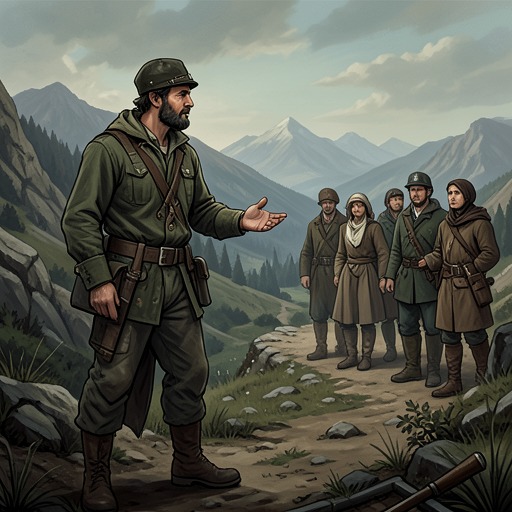
The larger examination will send participants out in three groups of four for twenty-four hours, with no protection beyond their newly acquired skills. Each group must find its way, locate water, pitch and strike camp, and keep making decisions. Beckett presents the stakes in deliberately stark terms, describing the test as “Sink or swim. Kill or be killed. Eat or be eaten.” Yet the examination is preceded by more practice: the class will hike to a point where the range’s trail divides into three roughly equivalent routes, review maps and strategies, and then set off separately. The severe pass called Devil’s Crotch is still ahead when Beckett first explains the plan; the Solos are not simply a sudden plunge into the unknown, but the final stage of instruction built around increasingly independent action.
The course’s practical emphasis has already shaped Helen’s experience. She has taken first-aid notes and used her limited training when Hugh is injured. When the group becomes disoriented, she recognizes from the map and the terrain that they have been going the wrong way. Later, as the group prepares to evacuate Hugh, Beckett has students empty packs with external aluminum frames and redistribute their contents so the frames can be dismantled into a litter. Those episodes are not the Solo itself, but they establish the stakes and skills the final test is meant to consolidate: judgment under pressure, navigation, and the ability to turn equipment into a solution.
Group Selection and Stakes
Before the final week, Beckett asks everyone to list the four people they would most like to have in their Solo group. Helen would like to hike with Windy, but expects Windy and Jake to choose one another; she does not want to spend the expedition absorbed in speculation about their relationship. Instead, Helen writes “Anybody but Jake,” circles it twice, and submits the folded slip. The request reflects how strongly she wants distance from the pair, even as the coming test makes companionship a matter of safety as well as preference.
Three days later, Beckett announces that the submitted wishes will not determine the groups. He says he has paired participants according to the skills they need to survive, not personal affection or crushes. His decision makes the test a controlled challenge rather than a popularity contest: participants must work with an assigned team, including people they might not choose for themselves. Beckett explains privately that Jake is a medic whom he trusts to treat Helen if she is injured, that Helen is the group’s best map reader, and that Jake is nearly blind. He also identifies a personal reason for the pairing: Helen does not believe in herself, while Jake believes in her. The assignment therefore rests on complementary practical abilities and on a confidence Helen has yet to claim for herself.
On the morning of the Solos, Beckett reviews each group’s route on a map. The participants wave goodbye, turn in three directions, and begin their separate hikes, with the hope of reuniting the next afternoon. Helen’s apprehension takes the form of a catalogue of possible dangers, from falling trees, bears, avalanches, and icy rivers to getting lost or simply giving up. The list underscores what the exercise demands: no instructor will be walking beside each group to absorb the consequences of a bad decision.
Helen’s Group in the Field
The first day is hard, in contrast to the easier second day. During the navigation challenge involving Mason, Helen takes out her compass and rotates the map until its north arrow aligns with the compass needle. The simple correction makes the map properly oriented; Mason responds with a long whistle. The moment gives a concrete form to Helen’s ability to read maps: what might seem like an abstract lesson becomes a direct, usable intervention when the group needs it.
The second morning, the campsite shows that the group has spent the night in an area trampled by elk. Flattened ovals mark the grass around the camp, although the animals themselves have moved on. Dosie and Jake name Helen the day’s leader, and Flash does not object. Helen leads the group back along the trail with confidence, keeping everyone together and on route. She credits the correctly oriented map and her map-reading ability, but does not announce the first explanation aloud. Leadership here is not a formal award; it is a responsibility given to her by her companions and confirmed by her actions.
The return still presents a physical obstacle. The group must cross a rickety bridge, which is especially difficult for Jake in his duct-taped glasses. The bridge creaks and sways, but everyone gets across safely. Helen’s group reaches Beckett first. When he asks whether anyone paid attention, he singles out “Calamity Jane,” the nickname she has earned, and Helen answers with a playful finger-gun gesture. The exchange turns her success in navigation into visible recognition by both instructor and group.
Consequences and Significance
The Solos expose how uneven and dangerous the groups’ experiences have been. Every group returns with a near-death story: Cookie’s group reports a bear sighting, a mosquito infestation, and a twisted ankle, while Windy’s group has been swept away in a swollen river crossing, prompting near-drowning, CPR, and hypothermia. The return is therefore not a simple victory lap. Helen’s group has made it back first, but the wider expedition has brought the whole class close to serious harm, and the group’s relief remains shadowed by uncertainty about Hugh.
Once the participants have completed the Solos, there is nothing left to distract them from the course’s ending. Their final night is bittersweet: they talk loudly about the food, television, and showers they want at home, as well as the wilderness hardships they never want to repeat. The boisterous conversation functions as a defense against sadness; the group wants to leave and to stay. Beckett then has them vote by secret ballot for the course’s Certificate winners, asking them to consider how their hiking companions have changed since the first day. The examination thus concludes not only with survival, but with collective recognition of development.
The Solos complete the course’s movement from instruction to application. Beckett’s insistence on experiential learning is borne out in Helen’s progression from worrying about whether she has enough information to taking responsibility in the field, correcting the map, and leading her group home. The test does not remove danger or make every group’s decisions safe. It shows instead that practice can become judgment under pressure—and that Helen’s skills are recognized by others before she fully trusts them herself.