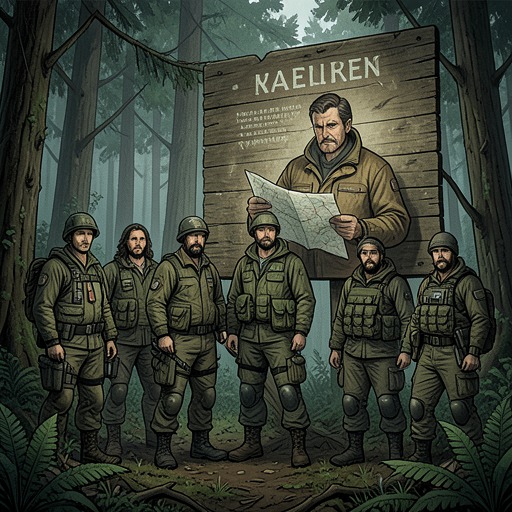
Three-week BCSC wilderness course
Happiness for BeginnersThe Three-week BCSC wilderness course is a demanding summer expedition in which practical lessons become consequential tests of judgment, cooperation, and self-belief. For Helen, the course begins in estrangement: she and Jake maintain a deliberate distance at check-in, and the college-aged participants around her make her feel conspicuously out of place. It ends with her leading others safely back, recognized for her navigation, and understanding that fulfillment may come less from winning what she longs for than from appreciating what is already present.
Entry into the Course and Its Social World
Helen and Jake arrive after a parting that leaves them, for the moment, strangers. At check-in, Jake stands an anonymous distance behind her; at the afternoon orientation he sits at the front while she takes a place near the back. Helen tries to welcome this separation, but the room offers little comfort. The other participants seem to her like variations on one college-age type, with matching party shirts, neon athletic clothes, and carefully similar looks. The course has removed her from ordinary life without yet giving her a sense of belonging in its place.
That belonging begins to form through the group’s nicknames. Windy becomes Heartbreaker, or HB, as the men turn their attention to her into a running points game. The Sisters become Uno and Dosie; other participants acquire names such as Caboose and Cookie, while Mason becomes Flash because he hikes too quickly for the group. Even the usually quiet Hugh is dubbed Huey Lewis. Helen alone remains Helen—or is misnamed Ellen. To her, a nickname signals that others have noticed and recognized a person; her exclusion therefore feels like more than a joke about names. It makes her fear that the group could fail to notice her at all.
The course’s stated method answers uncertainty with practice rather than exhaustive advance instruction. When Helen worries that she feels under-educated and asks what happens if she needs information before she has it, she is told that BCSC uses experiential learning: participants will learn as they go. The promise is not that they will always be prepared in advance, but that they will have to interpret situations and act with the skills they acquire.
Skills Tested Under Pressure
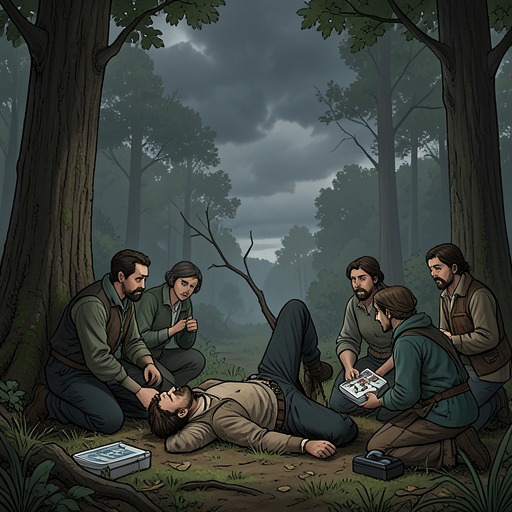
That method becomes real when Hugh is injured after a rotten log gives way beneath his foot. Helen removes her own pack and tries to recall first aid, then freezes over the question of what to do first. The Sisters watch in shock; with no one else taking charge, Helen decides to act. She begins to undo Hugh’s pack, but when her hands reach for the hip belt, he wakes screaming and tells her not to move him. The incident turns a classroom lesson into an immediate responsibility, exposing both the limits of Helen’s training and her willingness to take charge despite uncertainty.
When the group sets out to get help, Helen recognizes that the route does not match the map. She compares the ravine they are descending with the flat stretch they should have been following and uses the three-dimensional understanding she developed in class to see that they have been going the wrong way. Markers are sparse and hard to notice deep in the wilderness, making the mistake more than a classroom exercise. Later, during a separate navigation problem with Mason, Helen pulls out her compass and rotates the map until its north arrow matches the compass. The simple correction makes plain that practical competence depends not only on knowing a technique but on applying it under real conditions.
During the evacuation, Beckett divides the group’s work: participants with external aluminum pack frames empty their packs, redistribute their belongings, and dismantle the frames. He explains that the frames will be used to make a litter for Hugh. The course’s survival skills are thus collective as well as individual: the group must reorganize its equipment and labor around an injured participant.
The course’s tests also change how Helen assesses herself. After Hugh’s injury and the navigation crisis, she recalls three good things: she used her limited first-aid training to help him, applied her map-reading skills in the field, and reached a landmark understanding of her relationship with her brother and of her life more broadly. She does not erase the terror of the accident, her fear of making the wrong choice, or the frustration of being lost. Instead, she holds those difficulties alongside the satisfaction of solving the route problem. The exercise makes room for achievement without pretending the day was easy.
Independent Navigation and Mutual Dependence
Before a later group expedition, Beckett explains why he has paired Helen with Jake. She is headstrong and accident-prone, while Jake is the group’s medic; she is their best map reader, while Jake is nearly blind. Beckett also says that Helen struggles to believe in herself and that Jake believes in her. The assignment joins practical need to personal trust: each brings a capacity the other lacks, and the pairing makes Helen’s skill consequential to both of them.
When the groups set off in three different directions, the plan carries real uncertainty: they hope to meet again the following afternoon, with the dangers of injury, weather, thirst, getting lost, and other mishaps all in view. On a later return hike, Dosie and Jake choose Helen to lead, and Flash accepts the decision. She guides the group confidently, keeps everyone on the trail and together, and helps them cross a rickety bridge that proves especially difficult for Jake in his duct-taped glasses. They are the first group back. Beckett’s joking recognition of Helen as the one who had been paying attention gives the name Calamity Jane a different charge: the participant once left without a nickname is now identified by a group for a capability it has seen in action.
Return, Recognition, and the Course’s Meaning
On the final morning, the participants pack up camp and say goodbye to the wilderness. Beckett leads a minute of silence at sunrise and a farewell prayer that thanks the natural world while lamenting human carelessness and ingratitude. The group applauds when he finishes. The response marks a change from Helen’s early suspicion of Beckett’s manner: by the end, the ritual and its appeal to gratitude have become something the participants can affirm together.
The return to the lodge brings a more ordinary celebration, but its details show how thoroughly the three weeks have altered the group. The banquet is Pizza Hut pizza in an old ballroom overlooking the lake, dressed up by lights strung around the ceiling. The men arrive freshly shaved, except for Beckett’s stringy Yosemite Sam-style beard; after three weeks of sweat, dirt, sand, and grit, the participants are clean, sun-tanned, healthy, and marked by blisters and calluses. Music from the Steve Miller Band plays, and Vegas and Caveman spike the lemonade with vodka. The course’s hardships have given the simple pleasure of getting clean and sharing a meal unusual weight.
At the celebration, Beckett announces BCSC Certificates of Merit for the three finest students in the course, chosen by secret ballot. He says the awards recognize people who give their best, pay attention, and improve the experience simply by being present; the announcement introduces the results but the available account does not identify the recipients. The public ceremony extends the recognition that had accumulated through shared work, including Helen’s eventual leadership and navigational competence.
Helen’s deepest change is not a claim that she has stopped wanting Jake or that every difficulty has been settled. At the banquet, longing for him returns with force. But she can also recognize what the course has given her: she has met a challenge she chose, found things to like in people she initially expected to dislike, and made at least one real friend who helped her look for happiness in a different place. She comes to understand that constant longing prevents satisfaction, while not getting what one wants can direct attention toward what one already has. The course therefore functions both as wilderness training and as a temporary community: its shared risks produce cooperation and recognition, and its return ceremonies allow Helen to carry a changed sense of her own competence and of gratitude back into ordinary life.