Uno
Happiness for BeginnersUno is a member of Helen’s hiking group whose nickname and easy participation in its banter make her part of the group’s swiftly forming social life. She appears in scenes where the hikers turn strangers into companions: first by giving one another names, then by trading romantic gossip and imagining a wedding at Painted Meadow. Her role is not defined by a long personal history in the available scenes, but by the way she joins and helps propel the group’s conversations.
Identity and Place in the Group
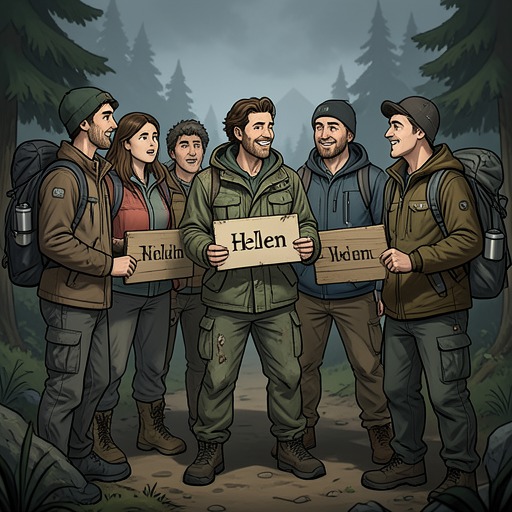
Uno’s name begins as Sister One. The two women known collectively as the Sisters are renamed Sister One and Sister Two, then the more compact Uno and Dosie. The change belongs to a larger burst of group nickname-making: Windy becomes Heartbreaker, Mason becomes Flash, and other hikers receive comic names drawn from their appearance or habits. A nickname functions as a sign that someone has been noticed and included in the group’s shared language.
That social ease throws Helen’s position into relief. Almost everyone else has acquired a nickname, while Helen is called either Helen or, mistakenly, Ellen. The contrast is not evidence that Uno personally excludes Helen; rather, it places Uno within a community whose bonds are forming rapidly while Helen feels unrecognized. Uno’s nickname is one small but concrete marker of the belonging that Helen sees others gaining.
Romantic Gossip About Jake
Uno contributes to the group’s teasing talk about Jake. When Hugh asks what is tragic, Dosie says that Jake is the best kisser in the group, and Uno immediately agrees. Helen, listening, wonders whether all the women have kissed him and what happened on the roof. The exchange does not establish that Uno herself kissed Jake, or explain the roof incident; it establishes that she endorses the group’s reputation of Jake as an exceptional kisser and is comfortable joining the flirtatious conversation around him.
The moment also shows how much of the group’s social life reaches Helen indirectly. The women’s confident assessment prompts questions rather than answers for her, turning their banter into a source of curiosity about Jake. Uno’s brief agreement helps make the claim sound like shared knowledge, while leaving Helen—and the reader—without the full story behind it.
Care and Shared Downtime
During a pause on a rock, the women gather around Helen as she rests in the sun. Their conversation moves through practical and pleasant subjects: no-bake cookies for a party, ways to stretch a tight hamstring, and M&M candies Uno has found forgotten in her daypack. The candy is a small detail, but it belongs to the scene’s shift from Helen’s accustomed solitude toward the pleasure of having company. She finds the women fun to have around before their talk turns toward a more charged subject.
Uno is among the women who make the pause feel communal rather than merely functional. The scene does not assign her a separate act of caretaking or claim a private intimacy between her and Helen; instead, it shows her participating in the ordinary exchanges through which the group spends time together. Her contribution of the rediscovered M&M’s gives the gathering a specific, modest pleasure before the conversation’s wedding plans take over.
The Wedding Plan at Painted Meadow
The women begin planning a wedding for Jake and Windy, whom they call J-Dog and Heartbreaker. Uno says she has it on good authority that Jake will propose to Windy that night, during the summer-solstice party, in the meadow. Her announcement gives the speculation a confident, almost insider quality, although the scene presents it as what Uno reports, not as a proposal that has already occurred.
The proposed setting makes the joke painful for Helen. Painted Meadow is also the place she associates with Nathan and with a brief period of happiness, so she resists the women’s plan to turn it into the scene of Jake and Windy’s imagined engagement. She asks them to use real names, while Uno’s wedding talk continues to treat the event as a festive possibility, even suggesting a Buddhist ceremony because Windy practices Buddhism. The contrast between the group’s buoyant matchmaking and Helen’s private attachment to the meadow gives Uno’s playful certainty a consequence beyond comedy: her plan unintentionally presses on a place Helen considers her own. Uno helps reveal how a landscape can hold different meanings for the people gathered in it, even as the hikers share the same summer-solstice celebration.