Harold
Harold and the Purple CrayonHarold’s journey makes him both traveler and maker of the terrain he must navigate. Carrying The purple crayon, he can draw the places and routes his walk requires, but invention does not guarantee that he knows where he is. His progress from a carefully planned path, through frightening disorientation and increasingly expansive searches, to the remembered position of his bedroom window gives the adventure its central tension: the same imagination that opens a way forward must also help him find a way home.
Identity and Starting Point
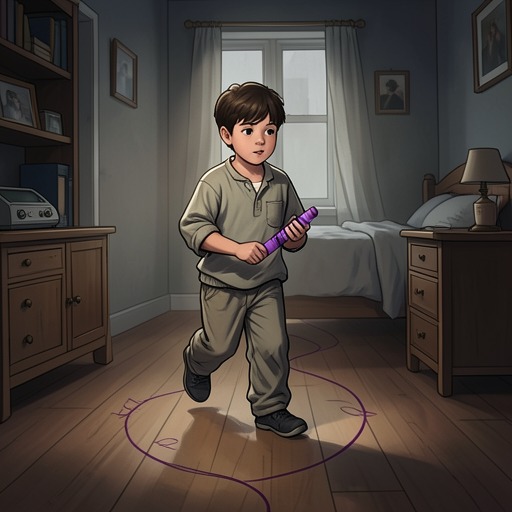
Harold decides one evening to go for a walk in the moonlight. The decision follows a period of thinking it over, giving the excursion a deliberate beginning: he sets out because he has chosen to, rather than because he is already in motion or being led by someone else. The Moon is absent, however, and Harold needs one for the kind of walk he has planned. His response is characteristic of the world of the story: instead of abandoning the idea, he draws what is missing and begins making the conditions for his own adventure.
The purple crayon accompanies Harold as both a drawing tool and a practical means of shaping his surroundings. He makes a long, straight path so that he will not get lost, then sets out along it. The plan establishes his desire for orientation before the journey tests it. Harold is resourceful, but not omniscient: the path can be deliberately drawn and still fail to take him where he expects to go.
A Route That Does Not Keep Him Oriented
At first, Harold’s route appears to answer the problem of direction. Its straightness is a precaution, a visible line meant to make the walk manageable. Yet he does not seem to be getting anywhere on it, and he leaves it for a shortcut. This small reversal matters: the path was designed to prevent confusion, but it does not settle the larger question of where he is going. Harold’s decision to leave it exchanges the reassurance of a clear route for the possibility of quicker progress, and the journey becomes less secure even though he remains able to draw.
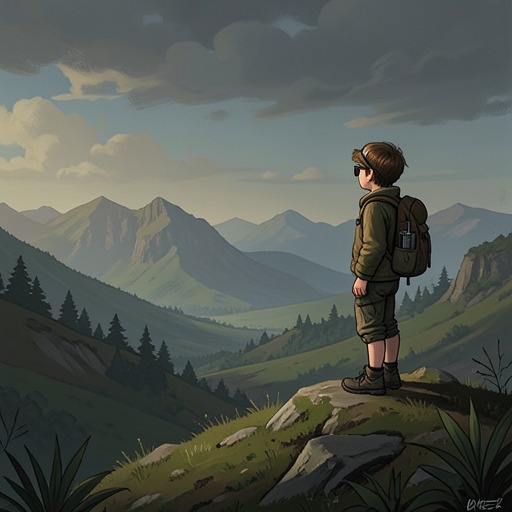
That contrast recurs as Harold tries to orient himself by changing the scale of his surroundings. He looks for a hill to climb so he can see where he is, reasoning that greater height will let him see farther. He therefore turns the hill into a mountain. The move shows how his drawings answer an immediate practical need, but also how readily a modest solution becomes a more ambitious undertaking. A better vantage point promises knowledge; it does not, by itself, supply a destination.
Fear and the Limits of Control
Harold’s drawn world can put him in danger as well as help him travel. In one episode, he becomes frightened, backs away, and feels his hand holding The purple crayon shake. He suddenly realizes what is happening, but by then he is over his head in an ocean. The sequence marks a sharp change in his relation to his own invention: the crayon remains in his hand, yet the situation has moved beyond the calm assurance suggested by his earlier planning.
The moment is important not because it shows Harold giving up his capacity to act, but because it makes the limits of that capacity visible. Drawing allows him to create a way through a problem, while the ocean makes the consequences of a drawing feel immediate and difficult to control. His bodily fear—the retreat and trembling hand—interrupts the confident rhythm of making. Harold’s imagination is not a guarantee against peril; it is the means by which he encounters and responds to a world that can become perilous.
Looking for a Familiar Window
Later, Harold seeks height again because he wants to see where he is. The effort to gain a broad view develops into a search for a particular place: his own home. When he cannot see his window, or even a house, he draws a house with windows. The drawing gives him a recognizable kind of structure to look for, but not yet the specific landmark he needs. A house can be made; identifying the right house is another matter.
Harold enlarges the search by making buildings full of windows and then a whole city full of windows. Their abundance intensifies rather than resolves the problem. None of the windows is his, and he cannot think where it might be. The progression from one house to a city makes the distinction between creating possibilities and finding a particular one especially clear. More windows mean more places to look, but they do not automatically make Harold’s own window recognizable. His difficulty is now not a lack of things to draw, but a lack of a reliable connection between the landscape before him and the home he remembers.
Recognition, Return, and Narrative Significance
As Harold walks along with the Moon, he wishes he were in his room and in bed. His wish turns the direction of the episode from continued exploration toward return, but the decisive change comes when he suddenly remembers where his bedroom window is when there is a moon. The key is not another building or a larger collection of windows. It is the relation between the window and the Moon: Harold recalls that the window is always right around it. A celestial object he had first needed to supply for his moonlit walk becomes the landmark that makes home locatable.
Harold then makes his bed, gets into it, and draws up the covers. The purple crayon drops to the floor, and Harold falls asleep. The ending brings the tools and purposes of the adventure to rest together: the crayon that accompanied his outward journey is no longer in his hand, and the search for the window gives way to the familiar act of going to bed. His return depends on imagination, but not simply on making more scenery. It depends on remembering a stable spatial relation that lets him interpret what he has made.
Harold’s character is therefore defined by an interplay of invention and orientation. He repeatedly acts on the world by drawing, yet his carefully made path fails to keep him moving toward a clear destination, a high vantage point does not itself answer where he is, and a city of windows cannot identify the one he seeks. The ending resolves this pattern through recognition rather than further expansion. The Moon changes from something Harold must create into a directional marker, and his creative freedom becomes most useful when it reconnects him with a remembered home.