Harold falls from the mountain and escapes by balloon
Harold and the Purple CrayonHarold falls from the mountain and escapes by balloon is the episode in which Harold’s attempt to find the window of Harold's bedroom from a great height turns suddenly into a fall. He survives by keeping The purple crayon and using it to make a balloon and basket, but the rescue does not immediately solve the problem that prompted his climb: even from the balloon, he cannot see a house or identify the window he seeks.
The search for a higher vantage
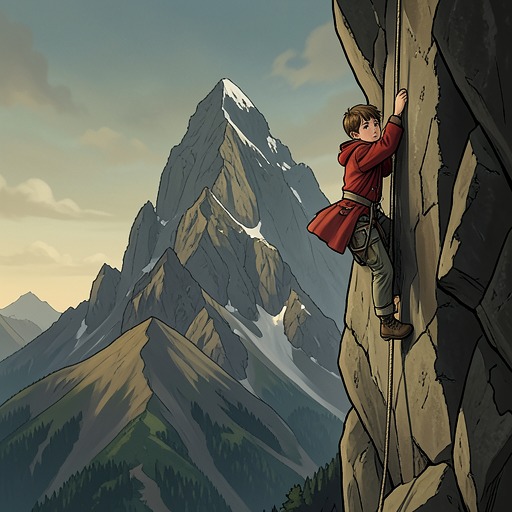
Harold’s decision to climb follows a practical chain of reasoning. He knows that the higher he goes, the farther he can see, and hopes that enough height will let him spot the window of Harold's bedroom. The episode makes that hope the purpose of the mountain: the elevation is not a destination in itself but a means of finding his way back. When Harold decides to turn a hill into a mountain, he enlarges the landscape to match the distance he believes he needs to survey.
That plan also establishes the risk that gives the episode its reversal. Harold looks down from the mountain’s other side, slips, and discovers that there is no other side beneath him—only thin air. The viewpoint he sought has become a precipice. The fall is not caused by a new opponent or an unexpected obstacle in the landscape; it follows directly from the position he has reached while pursuing a view. His effort to improve his bearings instead leaves him without ground at all.
The fall and improvised rescue
As he falls, Harold keeps his wits and The purple crayon. The detail matters because his escape depends on retaining both presence of mind and the instrument with which he can make a way forward. He draws a balloon and grabs on to it, turning the crayon from a tool for enlarging the landscape into an immediate means of survival. The response is swift: rather than wait for the danger to pass, he makes something that can carry him through it.
Harold then adds a basket beneath the balloon, large enough for him to stand in. This second act makes the rescue more than a momentary grip on a floating object. The balloon becomes a conveyance with a place for him inside it, and his posture changes from falling through open air to standing in a basket. The construction answers the immediate physical danger, but it does not guarantee that he will reach the place he wants. Safety and orientation remain separate problems.
A view without recognition
From the balloon Harold has a fine view, yet he still cannot see the window of Harold's bedroom. He cannot even see a house. That failure sharply contrasts the promising premise of the climb: greater height has widened his view without making it useful for finding home. The episode distinguishes seeing farther from recognizing where one belongs. Distance and visibility alone do not give Harold the landmark he needs.
The contrast also limits what the balloon accomplishes. It saves Harold from the fall and gives him a stable vantage, but it does not complete the search. The mountain and the balloon are both attempts to solve the same problem by getting higher; the first ends in a fall, and the second brings a clear view with no house in it. Harold’s predicament therefore persists after the immediate danger has passed, requiring another change of approach rather than simply more elevation.
Landing and narrative significance
Harold next makes a house with windows, then lands the balloon on the grass in the front yard. The order is significant: after looking for a house from above and finding none, he draws one into the scene and brings the balloon down beside it. The narrative moves from a search for an existing landmark to the creation of a house-shaped place where he can land. It does not, in this episode, establish that the house is Harold's bedroom or that the window he sought has been found; the landing resolves the airborne danger without yet confirming that the larger search is over.
The episode’s central reversal is thus both physical and imaginative. Harold’s attempt to gain a commanding view puts him in danger, while the same crayon that shaped the mountain lets him improvise a means of escape. Yet making a rescue is not identical to finding a destination: the balloon succeeds as transport, not as a guide. By ending with a drawn house and a landing in its front yard, the episode turns the problem back toward the ground and prepares the search to continue in a more immediate setting.