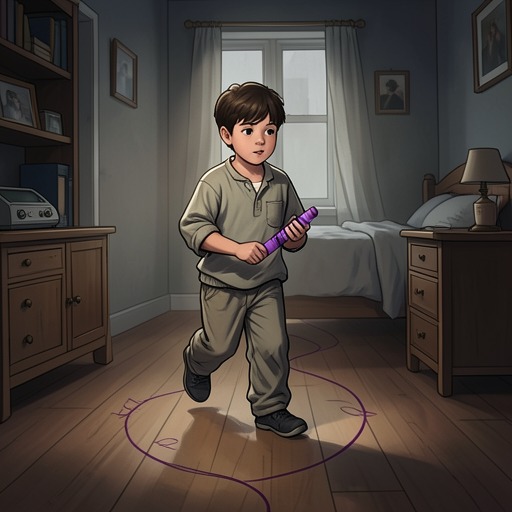
Harold's bedroom
Harold and the Purple CrayonHarold's bedroom is the destination that turns Harold's wandering night journey into a search for home. It is first present as an aim rather than a fully described place: Harold hopes to locate its window from high ground, later cannot identify it among a city's many windows, and finally remembers that it is always around the Moon. The bedroom's importance lies in this changing relation between a familiar private space and the drawn world through which he seeks it.
A Home Defined by Its Window and Bed
The story gives few descriptive details of Harold's bedroom, but establishes two concrete points of access to it. Its window is the feature Harold hopes to see from the top of a mountain; its bed is where he ends the night. The window makes the bedroom a visible destination he can search for from outside, while the bed marks the place where the search is meant to conclude. Together, these details make the room legible through Harold's desire to return rather than through an inventory of its furnishings or appearance.
The bedroom is also associated with the ordinary obligation of going to sleep. Harold is tired and feels that he ought to be getting to bed, and he hopes the mountain's height will let him see his window. His wish to find the room is therefore practical as well as directional: seeing it might tell him where he is and help him get home. The familiarity of the destination contrasts with the uncertainty of the route.
The Bedroom as a Wayfinding Problem
At the beginning of the walk, Harold makes a long, straight path so that he will not get lost. But the path does not seem to take him anywhere, and he leaves it for a shortcut. These early efforts establish a problem that later attaches specifically to the bedroom: a line can be drawn to provide a route, but a route alone does not guarantee that Harold can locate his destination. The story shifts from following a path to seeking a landmark.
Harold's attempt to gain a wider view follows that shift. He knows that the higher he goes, the farther he can see, so he makes a hill into a mountain. From its top, he hopes to see the bedroom window. Height promises a broader view, but the available evidence does not show that this vantage point resolves the search; the bedroom remains something he is trying to locate. The mountain thus represents a more ambitious attempt at orientation, not yet a successful return.
Windows Without Recognition
Later, Harold makes many buildings full of windows and then a whole city full of windows. Their abundance does not help him identify his own: none of them is his window, and he cannot think where it might be. This is a pointed reversal of the earlier hope that one bedroom window, seen from above, would settle his uncertainty. A proliferation of possible landmarks produces no recognition. The difficulty is not a shortage of windows but Harold's inability, at that moment, to connect any one of them with home.
The episode distinguishes seeing a feature from knowing what it means. Harold can make a city in which windows are everywhere, yet visual quantity does not supply the personal relation that would make one window his. The bedroom remains absent from recognition even as its possible sign is multiplied. That impasse makes the remembered location of the window more decisive than any further expansion of the landscape.
The Moon as a Homeward Reference
As Harold walks along with the Moon, wishing he were in his room and in bed, he suddenly remembers where his bedroom window is when there is a moon: it is always right around the Moon. The recollection supplies the relation that his earlier route-making and search among windows could not. Instead of choosing a window from a city, Harold can orient himself by connecting the familiar window to the recurring celestial marker that has accompanied his walk.
This remembered relation gives the Moon a specific navigational role in the story. The bedroom is not merely a far-off endpoint; its window belongs, in Harold's recollection, around the Moon. That recognition turns a feature of the night journey into a clue to home. It also resolves the contrast between Harold's initial concern about getting lost and his later inability to find the right window: the answer arrives not through more paths, greater height, or more buildings, but through remembering how the destination is positioned in relation to the Moon.
Return and Closure
The ending confirms the bedroom as the journey's point of rest. Harold makes his bed, gets into it, and draws up the covers. These actions bring the earlier wish to be in his room and in bed to completion. After the scale of the journey's made landscapes and the unresolved city of windows, the ending narrows to the simple sequence of preparing the bed and settling beneath the covers.
The purple crayon drops to the floor, and Harold falls asleep. Its fall is the last stated action involving the instrument he carried on the walk; the narrative then closes with Harold at rest. The bedroom consequently gathers the story's return into a quiet, physical ending. It has mattered throughout as the place Harold wants to reach, but only at the close does the text show him in bed, no longer searching for its window.