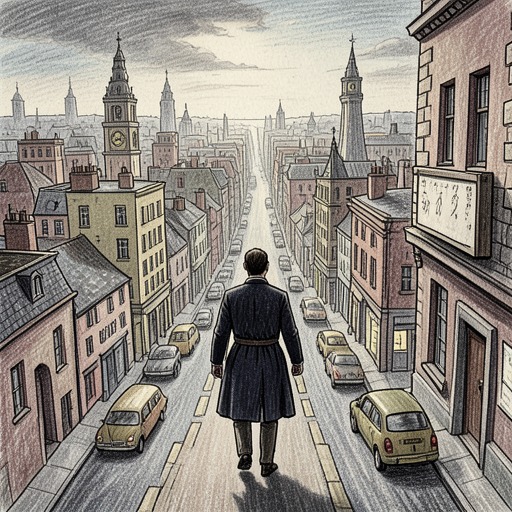
Harold's disorientation
Harold and the Purple CrayonHarold’s disorientation is the central difficulty in his search for home: although he sets out with a path meant to keep him from getting lost, he repeatedly lacks a reliable way to connect where he is with the location of his bedroom. The search moves through failed routes and viewpoints until a remembered relation between the bedroom window and the Moon gives him the orientation that physical landmarks have not supplied.
An Attempt to Prevent Getting Lost
At the start of the walk, there is no Moon, and Harold needs one for a walk in the moonlight. He makes a long, straight path specifically so that he will not get lost, then sets off carrying The purple crayon. The plan treats direction as a problem that can be solved in advance: if the route is clear and continuous, it should lead him onward without confusion. Yet the path does not provide a sense of progress. Harold does not seem to be getting anywhere along it, so the very route designed to prevent disorientation becomes an obstacle he leaves behind in favor of a shortcut.
That early failure establishes a distinction between having a line to follow and knowing where one is in relation to a destination. The path is unambiguous as a drawn route, but it does not tell Harold whether it is bringing him closer to home. His difficulty is not simply that the way is hard to see; a visible, straight way still fails to orient him. The episode begins with confidence in route-making, then exposes the limits of a route without a useful landmark or a confirmed destination.
The Shore and the Search for a View
After sailing long enough, Harold makes land without much trouble and steps onto a beach wondering where he is. Reaching shore ends the immediate journey by boat, but it does not answer the larger question of location. The beach is a place to stand, not a clue that identifies where Harold has arrived or how far he is from his bedroom. His uncertainty therefore persists even after a successful change of terrain.
Harold next looks for a hill so he can see where he is. He reasons that the higher he goes, the farther he can see, and decides to make the hill into a mountain. The purpose of gaining height is specific: from high enough, he hopes to see the window of his bedroom. This is a new strategy for overcoming disorientation. Instead of following a route across the ground, he seeks a broader view that might make the destination recognizable. But the hope depends on being able to identify his own window among whatever lies within sight; height can enlarge the field of view without necessarily making its landmarks meaningful.
Windows Without Recognition
The failure becomes concrete when Harold lands the balloon on the grass in the front yard and finds that none of the windows is his. Even arrival in a domestic-looking place does not settle the question. The windows are present, but their resemblance to the thing he seeks does not let him recognize the right one. He tries to think where his window ought to be, revealing that the search has reached a problem of memory and placement as well as distance.
He then makes buildings full of windows and a whole city full of windows. The expanding abundance does not bring him closer to identification: none of these windows is his, and he cannot think where it might be. The contrast is sharp. The city offers more possible windows than the front yard, but quantity makes no difference when Harold lacks the relation that would distinguish his own window from all the others. The search accumulates visible candidates while the decisive clue remains unavailable.
A policeman also fails to provide a new orientation. He points in the direction Harold is already going; Harold thanks him, but the gesture does not change the course or resolve the search. The encounter briefly supplies another person’s direction, yet it merely confirms the path already underway. Like the straight line and the distant view, an external indication can guide movement without explaining where the destination lies.
The Moon as a Remembered Landmark
As Harold walks along with the Moon, wishing he were in his room and in bed, his disorientation persists alongside a clear desire to be home. The Moon accompanies him, but at first its presence is not enough to make the bedroom findable. The decisive shift occurs when he suddenly remembers where his bedroom window is when there is a Moon: it is always right around the Moon. This memory supplies not a new route but a dependable spatial relation between two things Harold can identify.
The recognition changes the function of the Moon in the search. Earlier, a straight path was meant to keep Harold from getting lost, and later height was supposed to reveal the bedroom window by extending his view. Neither method succeeds on its own. The remembered relation around the Moon instead gives Harold a repeatable point of orientation: the window is not just one among many openings, but the one located in relation to this familiar marker. The ending of the disorientation episode is therefore an act of remembering that reorganizes what Harold can see and where he can look.
Narrative Significance
The episode makes disorientation recur through successive, concrete failures rather than treating it as a single moment of confusion. Harold leaves an ineffective path, reaches land without knowing where he is, seeks height to locate the bedroom, confronts unrecognizable windows, enlarges the search to a city, and receives directions that simply send him onward. Each attempt offers a different kind of clue—route, viewpoint, visible object, or another person’s gesture—but none connects him to home.
The final clue is distinctive because it converts a repeated companion into a directional marker. The Moon has been present during the walk, yet only Harold’s recollection that the window is always around it makes that presence useful for finding his way. The contrast gives the search its resolution at the level of understanding: getting oriented does not require adding more paths or more windows, but recognizing the relation that makes the desired window identifiable.