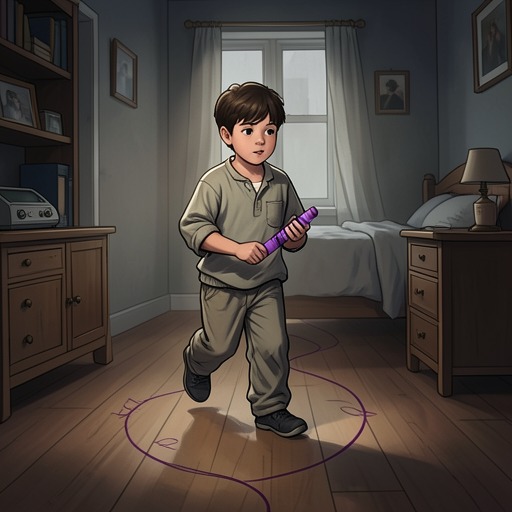
Harold's moonlight walk
Harold and the Purple CrayonHarold’s moonlight walk turns a planned evening outing into a sequence of adventures about losing and recovering one’s bearings. He begins by thinking over whether to go for a walk, then discovers that there is no Moon to provide the moonlight he wants. With The purple crayon, he supplies what the night lacks: first a Moon, then a route. But drawing a path and knowing where it leads prove to be different things. The walk’s central movement is from making a way forward to finding the particular way home.
Departure and the First Route
Harold sets out with a clear practical concern. He draws a long, straight path so he will not get lost, and takes The purple crayon with him. The line promises security through simplicity: a route that does not turn should be easy to follow. Yet Harold does not seem to be getting anywhere along it. The first plan therefore fails on its own terms. A straight path may offer direction, but it does not by itself establish progress or identify a destination.
Harold leaves the path for a short cut, beginning a pattern that shapes the rest of the walk. When he needs a way forward, he can draw one; when that way does not solve the problem, he changes the scene and tries another means of orientation. The ensuing forest and Dragon episode, the fall into the sea and escape by boat, and the mountain climb and escape by balloon turn the outing into a succession of distinct settings and practical challenges. The walk grows not by following the original line but by repeatedly replacing it.
From Detours to a Viewpoint
The mountain episode makes Harold’s effort to find his bearings explicit. He goes looking for a hill to climb so that he can see where he is, reasoning that greater height will let him see farther. He then makes the hill into a mountain. The change enlarges the scale of his chosen solution: if a better view is needed, a higher vantage seems to promise one. But the mountain does not simply provide a secure route home; Harold falls from it and escapes by balloon.
The balloon gives him a fine view, yet seeing widely still does not tell him which window belongs to Harold’s bedroom. After landing, he makes buildings full of windows, then a whole city full of them. The abundance of possible windows sharpens rather than resolves the search: none is his, and he cannot think where it might be. The contrast is between a panorama and recognition. Distance can be surveyed from above, and a city can be filled with plausible destinations, but neither method supplies the particular landmark he needs.
Recognition and Return
As the search continues, Harold walks along with the Moon, wishing he were in his room and in bed. The wish names the goal plainly, but it does not yet provide the location. The change comes when he suddenly remembers where Harold’s bedroom window is when there is a Moon: it is always right around the Moon. What had first been something he had to invent for the walk becomes a directional marker. The Moon does not merely light the outing; its relation to the remembered window makes home findable.
The ending returns the event to the intimate scale of its beginning. Harold makes his bed, gets into it, draws up the covers, and falls asleep. The purple crayon drops to the floor as the tool of invention is set aside. That final gesture closes the journey without another drawn route: after the many paths, escapes, viewpoints, and windows, the decisive aid is a remembered relation between the Moon and home.
Significance of the Walk
The walk’s episodes repeatedly test the difference between creating a place and locating oneself within it. Harold can draw a path, a mountain, a balloon, buildings, and a city, but the ability to make more surroundings does not guarantee that he will recognize his own destination. The failed straight path and the crowded city offer opposite problems—too little guidance and too many possibilities—while the remembered window supplies a precise point of reference.
The event’s circular shape gives its ending force: the Moon is needed at the outset because there is none, and at the close it is the clue that makes the bedroom window recognizable. Harold’s adventure does not end when he has drawn the largest view or the greatest number of windows. It ends when he connects a visible landmark with a remembered place, then exchanges the open-ended walk for bed and sleep.