Harold's mountain climb and fall
Harold and the Purple CrayonHarold's mountain climb and fall is the point at which his attempt to orient himself by gaining height becomes a literal loss of ground. Seeking a view of Harold's bedroom window, Harold turns uncertainty about his position into a mountain he can climb. The ascent seems to offer a practical answer to being lost; instead, its summit opens onto empty air. Harold survives by keeping his wits and The purple crayon, making a balloon to hold on to. The episode links his imaginative power to a real danger: drawing can create a route or a refuge, but it does not automatically tell him where home is.
Background and Objective
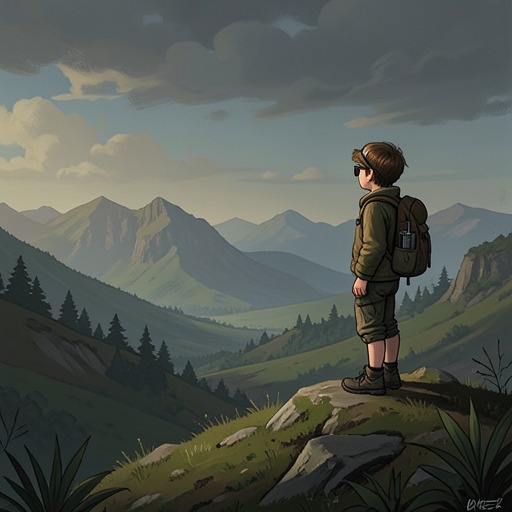
Before the climb, Harold has tried to prevent himself from getting lost by drawing a long, straight path. But he does not seem to get anywhere along it, and he leaves it for a shortcut. Later, after departing from a very hungry moose and a deserving porcupine, he goes looking for a hill to climb so he can see where he is. The sequence makes the climb a response to failed wayfinding: the path gives him a line to follow, but not a useful sense of his location.
Harold's reasoning is explicitly spatial. He knows that the higher up he goes, the farther he can see, and decides to make the hill into a mountain. If he goes high enough, he thinks, he might see the window of Harold's bedroom. The goal is not simply to reach a summit. Height is meant to give him a wider view, and that view is meant to connect the landscape around him with the place he is trying to find. By enlarging the hill into a mountain, he enlarges the scale of his proposed solution.
The Ascent and Reversal
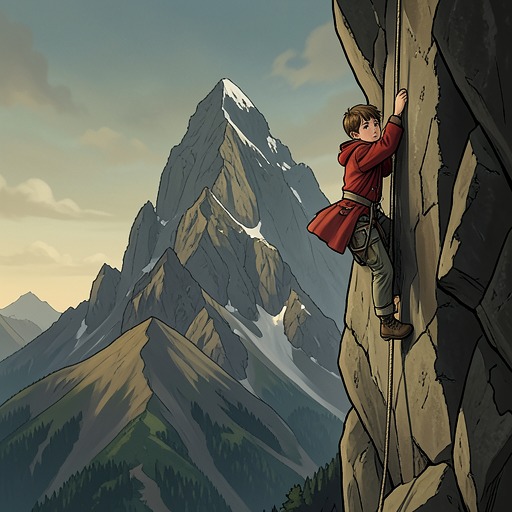
The mountain is not a discovered landmark but a feature Harold makes for the purpose of looking out from it. This matters to the event's reversal: the same act that supplies him with a vantage point also places him above a landscape whose limits he cannot safely read. When he looks down over the other side, he slips. The expected far side is not there; there is no other side of the mountain, and Harold is falling in thin air.
The suddenness of the fall overturns the climb's promise. Harold sought a stable height from which to understand his surroundings, but the view does not resolve his position or provide a safe way down. Instead, the mountain ends in an absence of ground. The episode makes the gap between a planned route and its outcome concrete: a path that goes nowhere gives way to a height that has nowhere to land. The reversal comes at the very moment Harold looks beyond the summit, turning an act of surveying into a crisis of survival.
The Balloon and the Crayon
Harold keeps his wits and The purple crayon. He makes a balloon and grabs on to it; he also makes a basket under the balloon. The response changes the immediate terms of the danger. The climb has left him falling, but the balloon gives him something to hold on to and begins a new means of travel. The crayon is therefore not just what enabled Harold to make the mountain. It remains available when the mountain's apparent support disappears, allowing him to answer the fall with another drawing.
The rescue is a change of form rather than a return to the route he had first chosen. Harold had drawn a straight path to keep from getting lost, then sought a high lookout when that path failed. Now, suspended beneath a balloon, he can continue moving without relying on the mountain's nonexistent far side. The scene does not show the height providing the bedroom window he hoped to see; the immediate consequence is escape from falling, not successful arrival at his destination.
Aftermath and Significance
The later search confirms that surviving the fall and finding home are separate problems. Harold makes many buildings full of windows, then a whole city full of windows, but none is the window of Harold's bedroom. His abundance of possible landmarks does not settle the question of which one is his. The contrast recalls the mountain: making a larger structure, or seeing more windows, is not the same as recognizing the right point of orientation.
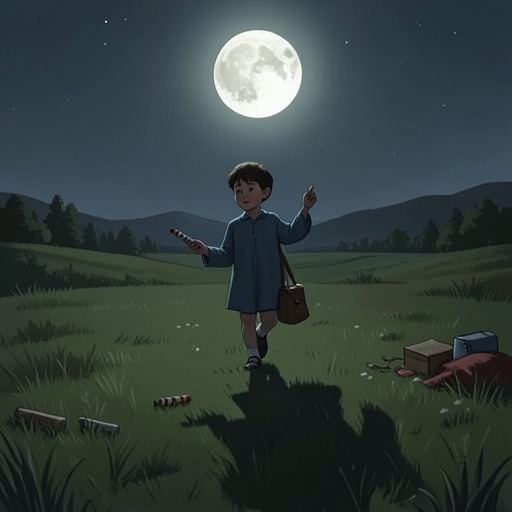
The decisive clue comes through memory. Harold remembers where the window of Harold's bedroom was when there was a Moon: it was always right around the Moon. This later recognition gives the earlier climb a clear place in the larger search. Height had promised distance and a wider view, but even the city of windows could not identify home. The Moon, recalled as a stable relation to his bedroom window, supplies the directional marker that the mountain could not. The episode thus marks both the reach and the limit of Harold's drawing: it can create terrain, a balloon, and a way to continue, while the final orientation depends on remembering how home is positioned in relation to the Moon.