Harold's search for his bedroom window
Harold and the Purple CrayonHarold's search for his bedroom window is a prolonged exercise in finding a way home when familiar landmarks have disappeared. He tries to orient himself by drawing a route, gaining height, and multiplying the windows around him, but none of these efforts locates his own. The decisive turn comes not from a better map or a larger view, but from remembering the connection between his bedroom window and the Moon.
From a Path to a Wider View
The search grows out of Harold's effort to make his walk navigable. With no Moon, he needs one for a walk in the moonlight; he makes a long, straight path so he will not get lost and sets off with The purple crayon. Yet the path does not take him anywhere. He leaves it for a shortcut, and the story establishes an early tension between having a route and actually knowing where that route leads. A line drawn to prevent disorientation can still fail to bring him closer to home.
Harold next treats height as a way to solve the problem. He goes looking for a hill because he knows that the higher he climbs, the farther he can see, and makes the hill into a mountain. The change enlarges the scale of his search: instead of following a line on the ground, he seeks an overview from above. This is a practical attempt to turn distance into knowledge. But even a wide view is not the same as recognizing the destination, a distinction that becomes explicit when he later rises in a balloon.
The Balloon and the Proliferation of Windows
Harold makes a balloon and grabs on to it, then adds a basket large enough to stand in. The basket makes the improvised vehicle a place from which he can look, not merely something to cling to as he rises. From the balloon he has a fine view, but cannot see his window; he cannot even see a house. The elevated vantage point offers breadth without the particular landmark he needs. More visibility, by itself, does not restore orientation.
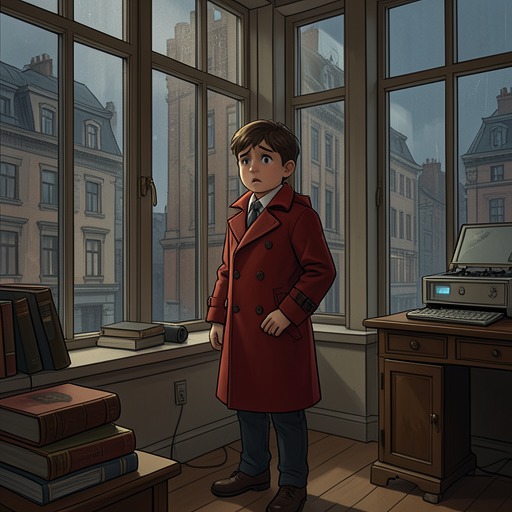
He responds by making a house with windows and landing the balloon on the grass in the front yard. The construction brings the search down from the open view to a recognizably domestic setting, but the apparent solution fails: none of the windows is his. He tries to think where his window ought to be. The difficulty is not a shortage of windows, but the absence of a remembered position that would let him distinguish the right one from all the others.
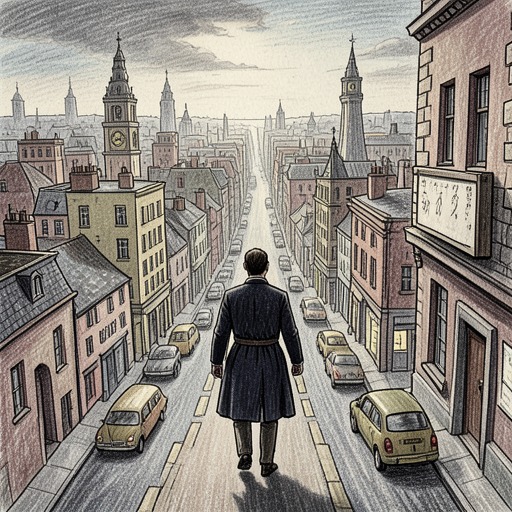
That distinction becomes more pronounced as Harold expands the search. He makes a big building full of windows, then lots of buildings and a whole city full of them. The scale swells from one house to an entire urban landscape, yet the result repeats the same failure: none of the windows is his, and he cannot think where it might be. Each addition increases the number of possible destinations without supplying a clue that identifies his own. The repeated mismatch makes the search feel less like a shortage of places to look than a loss of the relation that once made one window meaningful.
Asking for Directions
After the expanding search fails, Harold decides to ask a policeman. The policeman points the way Harold was already going anyway, and Harold thanks him. The encounter provides external confirmation of his direction, but it does not uncover a new route or identify the window. Harold was already moving the right way; what he lacked was the landmark by which he could recognize his destination. The polite exchange therefore offers limited practical help while clarifying the nature of the problem: forward movement and correct orientation are not identical.
The sequence contrasts different kinds of guidance. Harold first depends on a path he has made, then on a view from above, then on the visual abundance of houses and city buildings, and finally on another person's directions. None resolves the search. The policeman's pointing can affirm a course, but only Harold can supply the personal memory that turns that course into a way home.
The Moon as a Remembered Landmark
The change comes when Harold suddenly remembers where his bedroom window was when there was a Moon. He recalls that it was always right around the Moon. The window's position is thus not recovered by inspecting the many windows he has made; it returns through a remembered spatial relationship. What had seemed a search across an enlarging landscape becomes legible through one recurring landmark.
This recollection also recasts the earlier absence of the Moon. At the outset, Harold needs a Moon for his moonlight walk, and the straight path is meant to keep him from getting lost. Later, the remembered Moon supplies the orientation that the path, height, and multiplying buildings could not. It functions not simply as something to look at, but as the reference point that locates Harold's bedroom window. The resolution depends on recognizing a connection rather than constructing another place: once Harold remembers that the window was always around the Moon, he has the crucial clue his search had been missing.