Harold's ocean escape and voyage
Harold and the Purple CrayonHarold's ocean escape and voyage is the turning point at which Harold's attempt to find his way becomes an open-water adventure. After leaving a straight path that was getting him nowhere, he finds himself over his head in an ocean; fear gives way to quick improvisation, and a trim little boat carries him onward beneath a Moon that sails with him. The episode makes disorientation both a real danger and a condition Harold can answer through invention.
From a failed path to open water
At the outset of the larger walk, there is no Moon, although Harold needs one for a walk in the moonlight. He draws a long, straight path so he will not get lost, then sets off carrying The purple crayon. The route seems reassuring in its simplicity, but it does not take him anywhere. Harold leaves it for a shortcut, and the change in direction leads not to an easier way forward but to the ocean.
That reversal gives the episode its sharp change of scale. A route drawn to prevent disorientation has failed; the shortcut leaves Harold in water so deep that he is over his head. The ocean is not presented as a destination he planned to reach. It is the consequence of a path that has ceased to serve its purpose, turning a problem of finding the way into an immediate problem of survival.
Fear and a quick response
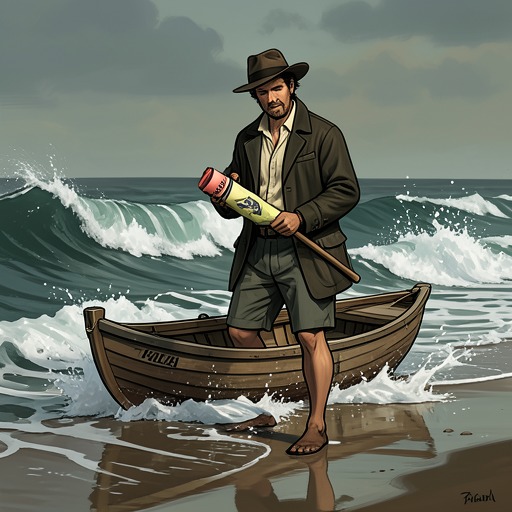
The danger registers in Harold's body before it is resolved: the situation frightens him, he backs away, and the hand holding The purple crayon shakes. He then suddenly realizes what is happening, but recognition arrives only once he is already over his head in the ocean. The sequence makes the moment of understanding consequential rather than preventive; knowing the predicament does not remove it.
Harold comes up thinking fast. In no time, he is climbing aboard a trim little boat, and he quickly sets sail. The account moves briskly from fear to action, without describing a prolonged struggle or an outside rescuer. The boat supplies a means to continue, and Harold's immediate response changes his position from being submerged in danger to being underway. The contrast between his shaking hand and rapid decision-making marks the episode's central reversal.
The Moon at sea
Once Harold sails, the Moon sails along with him. Its presence links the ocean voyage to the reason he began his walk: he had needed a Moon for moonlight, and now it accompanies him through an unplanned stretch of the journey. The Moon is more than scenery in the episode's pattern of getting lost and finding direction. Later, when Harold cannot identify his bedroom window among a city full of windows, he remembers that it is always around the Moon. That later recognition gives the Moon's companionship at sea a wider significance as a recurring point of orientation.
The voyage also sits within a longer effort to work out where he is. After sailing long enough, Harold goes on to look for a hill, reasoning that a higher vantage will let him see farther; he makes the hill into a mountain. Much later, even a whole city of windows does not reveal which one is his. Against those failed or incomplete attempts to orient himself, the Moon persists as a landmark that can connect the wandering journey to home.
Narrative significance
The episode's compact sequence—failed path, shortcut, ocean, boat, onward sailing—shows how quickly Harold's circumstances can change. The same journey that began with a safeguard against getting lost produces a situation in which he must improvise, and the response does not erase the uncertainty: he sails on, and only after sailing long enough does the story move to his next attempt to establish where he is.
The episode also brings the narrative's imaginative method into focus. Harold's world is not a fixed landscape that simply guides him; its paths and dangers alter the course of his walk, while his quick thinking makes continued movement possible. The Moon's quiet persistence provides continuity across that instability. At sea, it accompanies him; later, it helps him remember where his bedroom window lies. The voyage is therefore both an escape from immediate danger and one stage in the larger search for a way home.