The purple crayon
Harold and the Purple CrayonThe purple crayon is the hand-held tool that accompanies Harold through his walk and its dangers, linking deliberate preparation with vulnerability and, finally, the end of the adventure. Its significance emerges through a simple sequence of actions: Harold takes it with him, holds on to it when frightened and falling, and drops it only when he gets into bed and goes to sleep.
A Tool Carried into the Walk
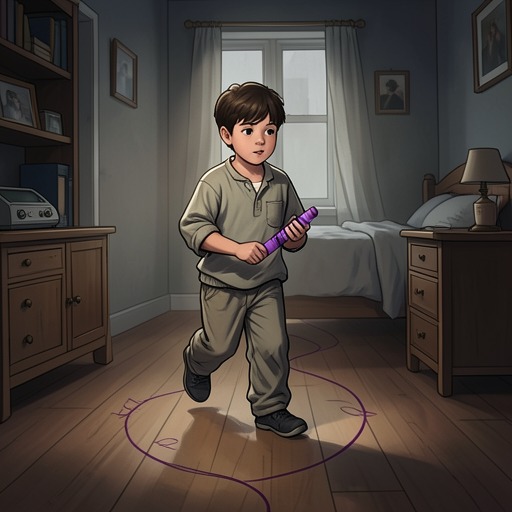
Before setting off, Harold makes a long, straight path so he will not get lost. The account then emphasizes that he takes his big purple crayon with him on the walk. The two details place the crayon beside an early act of planning: Harold is not simply heading out, but preparing a route and carrying the tool associated with his drawing. The path has an explicit purpose, keeping him from losing his way; the crayon's presence makes it part of the equipment he brings into the adventure.
That opening establishes an important relation between object and character. The crayon is not described as something left behind or used only at home. It travels with Harold, close enough to be held in his hand when the journey becomes frightening. Its practical role in the episode is therefore also a physical one: it remains available because he has brought it along.
Fear Made Visible in the Hand
The crayon's presence becomes especially vivid when Harold encounters a terribly frightening dragon. He backs away, and the hand holding the purple crayon shakes. The scene gives fear a concrete, visible expression rather than leaving it as an abstract description of Harold's feelings: the object is still in his grasp, but the hand that holds it is unsteady.
This moment complicates any simple idea of the crayon as a guarantee of control. Harold carries it, yet the dragon frightens him; the crayon does not prevent his recoil. At the same time, the shaking hand shows that the object stays with him through the encounter. The narration connects danger, bodily response, and the carried tool in one compact image, making the crayon a measure of Harold's exposure as well as a resource associated with his journey.
Kept During the Fall
Later, Harold reaches a mountain with no other side and finds himself falling in thin air. In the midst of that immediate danger, the narration says that he luckily keeps both his wits and his purple crayon. The pairing matters: his composure and the object are the two things singled out as retained while the ground and the mountain's far side offer no way forward.
The passage does not say that the crayon itself stops the fall, so its importance here lies first in the fact that Harold still has it. Earlier, it was the hand holding it that revealed his fear; during the fall, its continued possession is stated alongside his ability to keep his wits. The shift is from a visibly shaking grip to a tool he has managed not to lose in a crisis. In both moments, the crayon's place in the scene helps register Harold's changing circumstances without making it a substitute for his own response.
Released at the End
The crayon's final recorded appearance comes after Harold gets into bed and draws up the covers. It drops onto the floor, and Harold drops off to sleep. The order gives the object a quiet ending: it has accompanied him through the walk and its threatening episodes, but it is no longer in his hand once he is safely in bed.
The crayon is not described as being put away carefully or carried into another scene. It falls to the floor as the action settles into sleep. That small physical consequence marks a clear contrast with the earlier scenes, where Harold's grip on it was part of the action: first he takes it along, then it shakes in his hand, and later he keeps it during the fall. At bedtime, the hand releases it without ceremony.
Narrative Function
Across these appearances, the purple crayon links agency to physical vulnerability. The long, straight path belongs to Harold's effort not to get lost, while the dragon and the fall show that planning and carrying a tool do not make the journey free of fear or danger. The crayon remains present through those changes, but the evidence does not make it a magical protection from every threat; Harold still has to back away from the dragon and keep his wits as he falls.
Its movement through the story also gives the object a modest but distinct arc of its own. It begins as something deliberately brought along, becomes part of the image of fear in Harold's trembling hand, is retained during a fall, and ends on the bedroom floor. The final drop is a small change in the object's position with a larger narrative effect: the adventure's carried tool is set aside as Harold returns to bed and sleep.