Order of Suspension
Harry Potter and the Chamber of SecretsThe Order of Suspension is a formal instrument of the Hogwarts Board of Governors, wielded by Lucius Malfoy as a political weapon to remove Albus Dumbledore from his post as headmaster during the crisis of the Chamber of Secrets. It appears at a moment of maximum institutional vulnerability, when the school has been shaken by a series of attacks on Muggle-born students and the Ministry of Magic has already taken the gamekeeper Rubeus Hagrid into custody. The order is not a neutral administrative document but the culmination of a campaign by Malfoy, a school governor, to exploit the panic for his own ends, and its presentation marks the lowest point of the year for Hogwarts, stripping the castle of its most powerful protector just as the threat reaches its peak.
Nature and Legal Standing
The Order of Suspension is a parchment bearing the signatures of all twelve members of the Hogwarts Board of Governors, the body that holds formal authority over the appointment and removal of the headmaster. When Lucius Malfoy presents it to Dumbledore in Hagrid's hut, he describes it as an "Order of Suspension" and notes that "you'll find all twelve signatures on it," emphasizing that the decision is collective and therefore carries the full weight of the school's governing body. The document operates within the established legal framework of the wizarding world, which is elsewhere in the book shown to be a system of formal rules and decrees, such as the Decree for the Reasonable Restriction of Underage Sorcery and the International Confederation of Warlocks' Statute of Secrecy, both cited in the official warning Harry receives from the Improper Use of Magic Office. Unlike those statutes, which are invoked to regulate individual behavior, the Order of Suspension is a political instrument, used not to enforce a law but to remove a powerful figure from office. Its legitimacy rests entirely on the signatures, and Malfoy's ability to secure all twelve is presented as the result of threats and blackmail, as Hagrid immediately accuses: "An' how many did yeh have ter threaten an' blackmail before they agreed, Malfoy, eh?" The order thus exposes the gap between legal form and political practice, a theme that runs through the book's treatment of wizarding institutions.
The Context of Its Presentation
The Order of Suspension is delivered at a moment of acute crisis, shortly after the double attack on Justin Finch-Fletchley and Nearly Headless Nick, and on the same night that Cornelius Fudge, the Minister of Magic, arrives to take Hagrid into custody. The scene unfolds in Hagrid's hut, where Harry and Ron are hidden under the Invisibility Cloak, having come to question Hagrid about the Chamber of Secrets. Dumbledore has just defended Hagrid, declaring that "Hagrid has my full confidence," but Fudge, under pressure from the Ministry and the governors, insists on taking him "for a short stretch" as a precaution. It is into this charged atmosphere that Lucius Malfoy strides, swathed in a long black traveling cloak, smiling "a cold and satisfied smile." He announces that he has come to deliver the order, and his language is openly contemptuous of Dumbledore's leadership: "How many attacks have there been now? Two more this afternoon, wasn't it? At this rate, there'll be no Muggle-borns left at Hogwarts, and we all know what an awful loss that would be to the school." The order is thus presented not as a response to any specific failure but as a political move timed to exploit the fear and chaos, with Malfoy using the attacks as justification for removing a headmaster he has long opposed.
Dumbledore's Response and Its Consequences
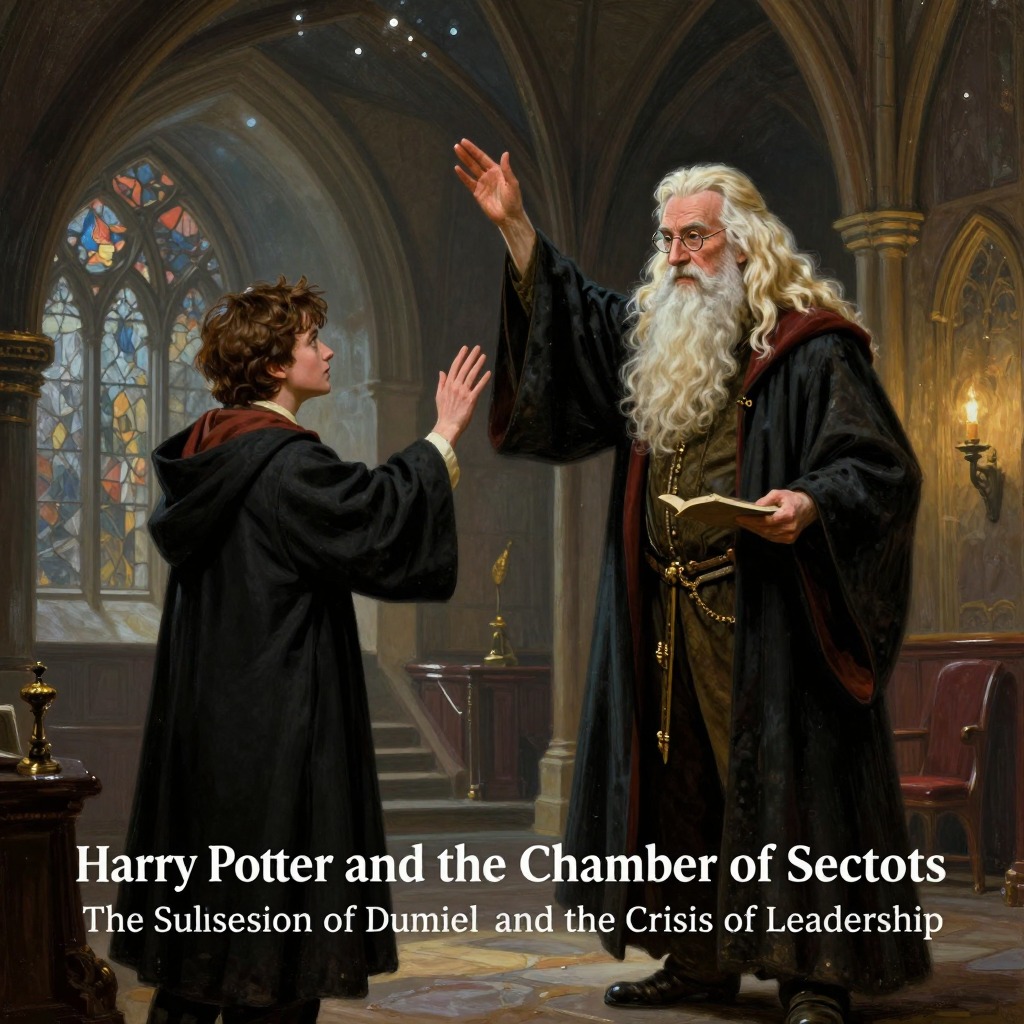
Dumbledore's reaction to the Order of Suspension is one of calm defiance. He accepts the order without protest, telling Malfoy, "If the governors want my removal, Lucius, I shall of course step aside," but he immediately qualifies this with a statement that transforms the meaning of the suspension: "However, you will find that I will only truly have left this school when none here are loyal to me… Help will always be given at Hogwarts to those who ask for it." This declaration, delivered slowly and clearly so that none can miss a word, reframes the suspension as a test of loyalty rather than a loss of authority. Harry, hidden in the corner, is almost sure that Dumbledore's eyes flicker toward him as he speaks, suggesting that the headmaster is aware of his presence and is addressing his words to him as much as to Malfoy. The immediate consequence of the order is that Dumbledore leaves the castle, and the school is left under the temporary authority of Minerva McGonagall, who is described as "only filling in." The suspension plunges Hogwarts into deeper fear, as Ron observes: "We're in trouble now… No Dumbledore. They might as well close the school tonight. There'll be an attack a day with him gone." The order thus achieves its immediate political goal, but it also sets the stage for Dumbledore's eventual vindication, as the other eleven governors, having heard that Arthur Weasley's daughter has been killed, contact him and beg him to return, with several admitting that Malfoy had threatened to curse their families to secure their signatures in the first place.
Significance and Aftermath
The Order of Suspension is significant not only as a plot device but as a demonstration of how power operates in the wizarding world. It shows that the formal structures of governance, represented by the Board of Governors, can be manipulated by a wealthy and influential figure like Lucius Malfoy, who uses threats and blackmail to bend them to his will. The document also serves to isolate Harry and Ron, who must now confront the Chamber of Secrets without the protection of Dumbledore, and it deepens the sense of peril that drives them to take increasingly desperate measures. The order's eventual reversal, when the governors recall Dumbledore, underscores the theme of loyalty that runs through the book: Dumbledore's power is not derived from his official position but from the trust and devotion he inspires, a point made explicit in his parting words. The Order of Suspension thus functions as a symbol of institutional corruption and of the resilience of true authority, and its brief reign marks the darkest period of the year before the final confrontation in the Chamber of Secrets.