Sword of Godric Gryffindor
Harry Potter and the Chamber of SecretsThe Sword of Godric Gryffindor is a gleaming silver blade, its handle glittering with rubies the size of eggs, that materializes from the Sorting Hat at the moment of Harry Potter's greatest need in the Chamber of Secrets. It is not merely a weapon but a symbol of the founder's legacy, a test of worthiness, and the instrument by which Harry both slays the Basilisk and destroys Tom Riddle's diary, thereby saving Ginny Weasley and proving his own allegiance to Gryffindor. Its appearance is the climax of the novel's central conflict, transforming a desperate fight into a triumph of courage and loyalty.
Origins and Legendary Significance
The sword is inextricably linked to Godric Gryffindor, one of the four founders of Hogwarts School of Witchcraft and Wizardry, who lived over a thousand years ago. According to the history recounted by Professor Binns, Gryffindor and his fellow founders—Helga Hufflepuff, Rowena Ravenclaw, and Salazar Slytherin—built the castle together, but a rift grew when Slytherin insisted on restricting magical education to pure-blood families. Gryffindor's opposition to this elitism is reflected in the sword's later role: it is a weapon that serves not the pure-blood heir but the brave and the loyal. The sword's presence in the Sorting Hat, an artifact also associated with Gryffindor, suggests a deliberate design by the founder to provide his true heirs with a means of defense in times of crisis. The hat itself, which normally sorts students into houses, becomes a vessel for the sword, indicating that the blade is reserved for those who embody Gryffindor's values of courage and chivalry, regardless of their blood status.
Appearance in the Chamber of Secrets
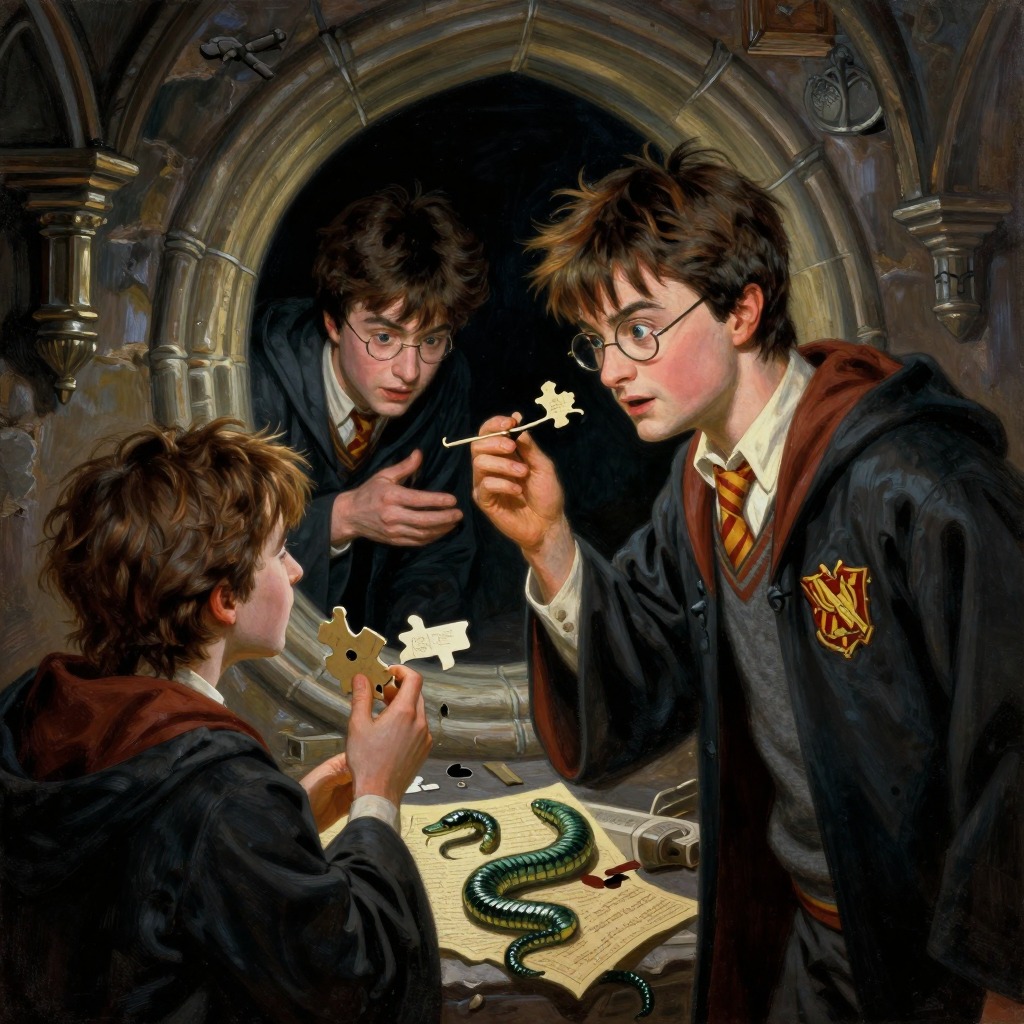
The sword first appears during Harry's confrontation with the Basilisk in the Chamber of Secrets. After Tom Riddle, the memory of Lord Voldemort, commands the serpent to kill Harry, the phoenix Fawkes distracts the creature, blinding it with his beak. In the chaos, the Basilisk's tail sweeps the Sorting Hat into Harry's arms. Desperate and with no other weapon, Harry rammed the hat onto his head and threw himself flat on the floor, thinking, "Help me — help me — Please help me." In response, the hat contracts as though an invisible hand is squeezing it, and something hard and heavy thuds onto Harry's head. Reaching up, he finds a gleaming silver sword inside the hat, its handle glittering with rubies the size of eggs. This is the Sword of Godric Gryffindor, delivered by the hat itself, a direct answer to Harry's plea for aid. The sword's appearance is not random; it is a response to Harry's courage and his willingness to face the monster alone, even at the cost of his own life.
The Battle with the Basilisk
Armed with the sword, Harry engages the Basilisk in a desperate duel. The serpent, though blinded by Fawkes, is still deadly, its fangs long as sabers and its body thick as an oak trunk. Harry, his eyes screwed tight to avoid the creature's lethal stare, dodges its lunges and finally drives the sword to the hilt into the roof of the serpent's mouth. The blade pierces the Basilisk's skull, and the creature keels over, twitching, and falls to the floor. However, in the process, one of the Basilisk's fangs sinks into Harry's arm, splintering as the serpent dies. The wound is poisoned, and Harry believes he is dying. It is only the tears of Fawkes, which have healing powers, that save him. The sword, however, remains embedded in the Basilisk's mouth, and Harry retrieves it, pulling it free with a huge tug. The sword's role in the battle is not merely to kill the monster but to demonstrate that Harry, though a second-year student, can overcome a creature that has terrorized the school for fifty years, armed only with courage and the tools that Gryffindor provides.
Proof of Gryffindor's True Heir
After the battle, Harry presents the sword to Albus Dumbledore, along with the Sorting Hat and the destroyed diary. Dumbledore examines the blood-stained blade and hands it back to Harry, telling him to look more closely at it. Harry turns it over, and the rubies blaze in the firelight. Below the hilt, he sees the name engraved: Godric Gryffindor. Dumbledore explains, "Only a true Gryffindor could have pulled that out of the hat, Harry." This revelation is crucial because Harry has been plagued by doubts about his identity, especially after the Sorting Hat told him he would have done well in Slytherin and because he can speak Parseltongue, a trait associated with Salazar Slytherin. The sword's appearance and the name engraved on it serve as tangible proof that Harry belongs in Gryffindor, not because of his abilities, but because of his choices. Dumbledore's words, "It is our choices, Harry, that show what we truly are, far more than our abilities," are embodied in the sword, which chose to appear for Harry because he asked for help and was willing to sacrifice himself for Ginny. The sword thus becomes a symbol of Harry's moral integrity and his rejection of the path that Tom Riddle took.
Symbolism and Thematic Significance
The Sword of Godric Gryffindor is more than a magical weapon; it is a symbol of the values that define Gryffindor House and the wizarding world's hope. Its appearance from the Sorting Hat, an object associated with the founders and the sorting of students, suggests that true worth is not determined by blood or lineage but by one's actions and character. The sword's ruby-encrusted handle and gleaming silver blade evoke the chivalric ideals of medieval knights, connecting Harry's quest to a broader tradition of heroism. Furthermore, the sword's role in destroying the diary—Harry uses the Basilisk's fang, not the sword, to pierce the diary, but the sword's presence enables the victory—highlights the theme of choice versus destiny. Harry could have been Slytherin's heir, but he chose to be Gryffindor's champion. The sword, therefore, is a testament to the power of individual agency in a world where blood purity and inherited power are often valued. It also serves as a contrast to the diary, which represents the corrupting influence of the past and the desire for immortality; the sword, by contrast, is a living legacy that aids the worthy in the present. In the end, the sword is not just a relic but a living symbol of Gryffindor's enduring spirit, passed down through the ages to those who prove themselves brave, loyal, and true.