Draco Malfoy
Harry Potter and the Half-Blood PrinceDraco Malfoy enters his sixth year at Hogwarts carrying a burden that sets him apart from the sneering bully of previous years. He has been given a mission by Lord Voldemort: to kill Albus Dumbledore. This task, intended as punishment for his father Lucius's failures, transforms Malfoy from a privileged antagonist into a desperate, isolated figure. The weight of his assignment is visible in his appearance; he looks paler and thinner than before, with dark shadows under his eyes and a grayish tinge to his skin, a physical manifestation of the psychological strain he endures throughout the term.
The Mission and Its Burdens
Malfoy's mission is the engine of the year's plot. He is tasked with repairing a broken Vanishing Cabinet in the Room of Requirement, creating a secret passage between Hogwarts and Borgin and Burkes in Knockturn Alley. This plan, which he devises after hearing about a student who got lost in the cabinet the previous year, is his primary focus. He spends countless hours in the Room of Requirement, working on the cabinet and using Polyjuice Potion to transform Crabbe and Goyle into lookouts, disguising them as young girls to avoid detection. His desperation leads him to attempt cruder methods of assassination: he curses a necklace and passes it to Katie Bell through the Imperiused Madam Rosmerta, hoping it will reach Dumbledore, and he poisons a bottle of mead intended for the headmaster. Both attempts fail, harming innocent people instead. The pressure of his task is immense; he is caught crying alone in a bathroom, confessing to Moaning Myrtle that he cannot do it and that Voldemort will kill him if he fails.
Relationships and Conflict
Malfoy's relationships are defined by his secret mission. He keeps his plans hidden from his usual cronies, Crabbe and Goyle, using them only as pawns. His interactions with Severus Snape are fraught with tension; Snape, having made an Unbreakable Vow to Narcissa Malfoy to protect Draco, attempts to guide him, but Malfoy resists, accusing Snape of wanting to steal his glory. He is openly contemptuous of Harry Potter, whom he attacks physically and verbally, but his focus is elsewhere. The encounter in Madam Malkin's robe shop reveals his new, brittle arrogance, as he threatens Harry with his mother's protection, but it also shows his vulnerability when he flinches at the touch of his left arm, where the Dark Mark is branded. His relationship with his mother, Narcissa, is one of desperate love; she seeks Snape's help to save him, a plea that leads to the Unbreakable Vow.
The Astronomy Tower and Its Aftermath
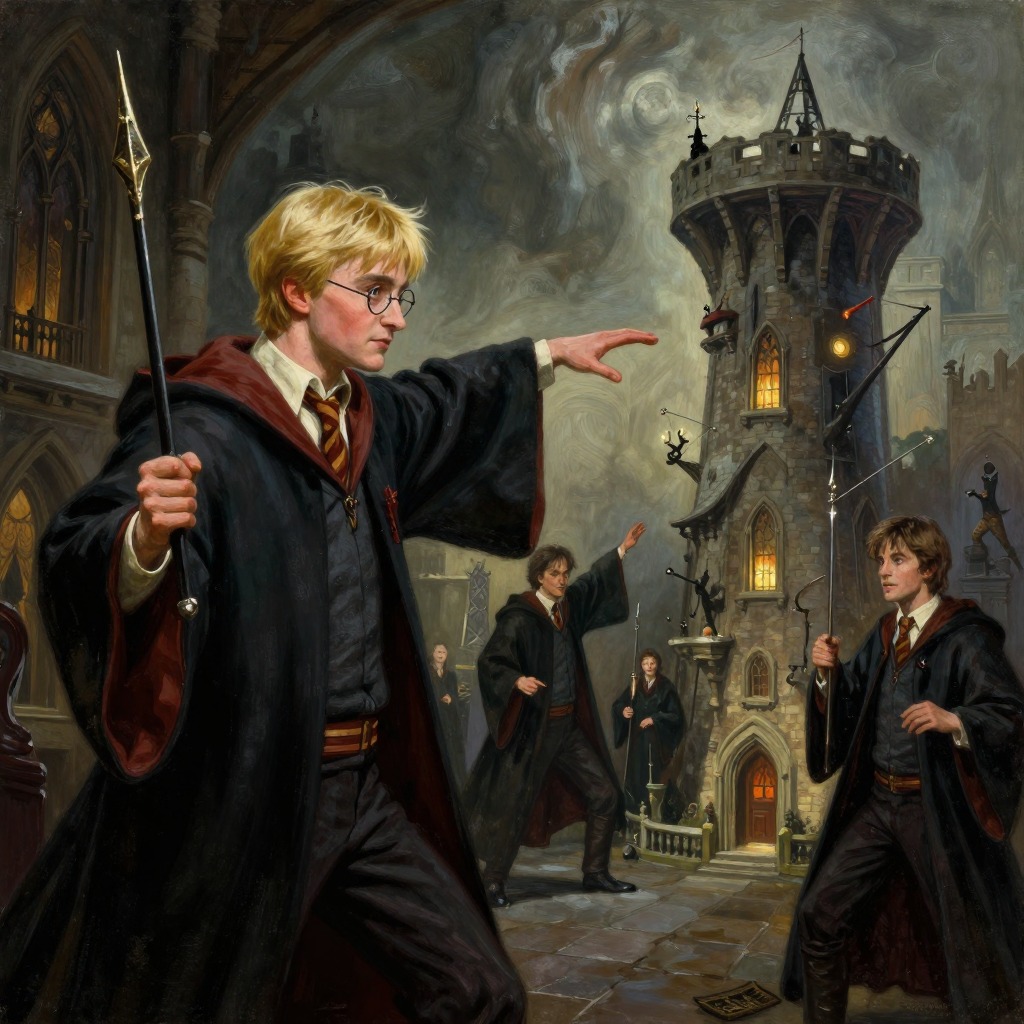
The climax of Malfoy's arc occurs on the Astronomy Tower. He disarms Dumbledore, but when faced with the actual act of killing, he hesitates. He lowers his wand, unable to commit murder. This moment of paralysis is crucial; it reveals that despite his posturing and his allegiance to the Dark Arts, he is not a killer. His plan is usurped by Severus Snape, who performs the Killing Curse on Dumbledore's orders. In the aftermath, Malfoy flees with Snape and the other Death Eaters, but his role is diminished. He is no longer the central agent of Voldemort's plan but a pawn who has been used and discarded. Harry, reflecting on the event, feels a flicker of pity for Malfoy, recognizing the fear that drove him.
Change and Ending
By the end of the novel, Malfoy is a changed figure. The swaggering bully of the Hogwarts Express is gone, replaced by a haunted young man who has been forced to confront the reality of the Dark Lord's demands. He has failed in his mission, but he has also failed to become a murderer. His final appearance at Dumbledore's funeral is marked by absence; he is not seen among the Slytherins, and his usual companions, Crabbe and Goyle, look oddly lonely without him. Harry wonders where Malfoy is and what Voldemort is making him do under threat of killing him and his parents. The narrative leaves him in a state of unresolved peril, a victim of the very ideology he once embraced.
Thematic Significance
Malfoy's story arc serves as a powerful exploration of the costs of allegiance to evil. He is a cautionary tale about the seduction of power and the inevitable terror that follows when one is forced to live up to its demands. His inability to kill Dumbledore underscores a central theme of the novel: that the capacity for love and mercy, even in a corrupted soul, can create a chasm between intention and action. He is a shadow to Harry's hero, a boy who chose the wrong side and must now live with the consequences, highlighting the novel's moral complexity and the idea that redemption is possible only for those who seek it.