
Young Edmund Jordan’s Consolidation
HarvestThis flow traces Young Edmund Jordan’s arrival, assertion of authority, use of accusations, and pursuit of a profitable estate.
increasing Bearing strength in each event
 decreasing
Bearing strength in each eventdecreasingA Legal Heir Arrives

A Legal Heir Arrives
Inheritance made present
Young Edmund Jordan arrives with servants and finds a damaged estate, a dead man, and a cousin who has lost control of events. His status is conveyed through dress, attendants, and expectation.
He is the blood heir to property Charles Kent believed he governed.
Power shifts in public
The villagers witness Charles Kent defer to the newcomer. Their familiar order now depends on an authority they did not choose.
A Search for Blood

A Search for Blood
Suspicion becomes procedure
Young Edmund Jordan orders a search of homes and barns for bloodied clothes after Willowjack is killed. The villagers are confined while his men enter their private spaces.
The investigation makes every resident a possible suspect.
Authority through intrusion
The search establishes that the new ruler can inspect households as well as land. His method of order is not persuasion but the exercise of unequal power.
A Scapegoat Suspect
A Scapegoat Suspect
A convenient story
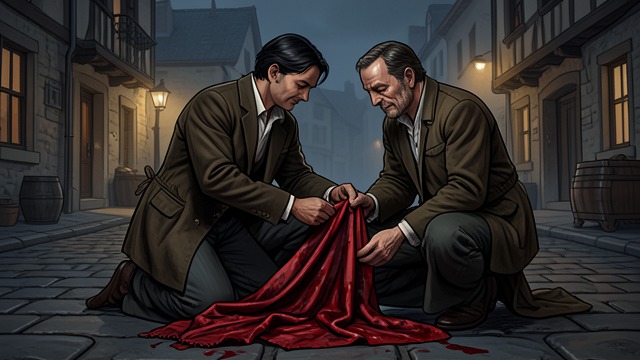
Young Edmund Jordan finds Mistress Beldam’s bloodstained shawl and presses Charles Kent for its owner. Charles Kent claims it belonged to Lucy Kent and invents a passing thief to protect Mistress Beldam.
The story allows the heir to preserve his public image without pursuing a local culprit.
Selective justice
Young Edmund Jordan then turns attention to Young Beldam, whose threats can be treated as sedition. He uses procedure to consolidate power while avoiding the more disruptive truth.
Witchcraft as Leverage
Witchcraft as Leverage
A useful accusation
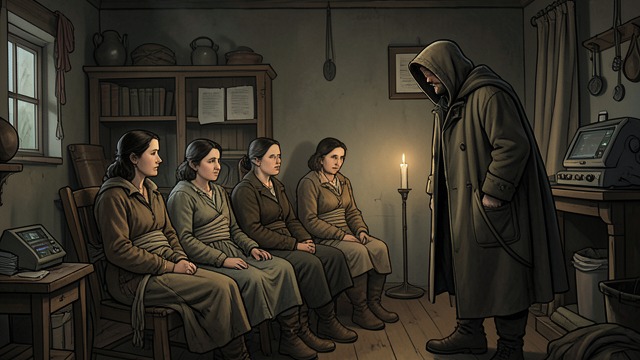
Baynham announces suspicions of witchcraft, and Young Edmund Jordan’s men interrogate Kitty Gosse, Anne Rogers, and Lizzie Carr. The accusation gives them permission to use coercion while presenting it as lawful investigation.
Philip Earle becomes the desired target after the captives name him.
Political diversion
The charge displaces attention from enclosure, estate violence, and the owner’s interests. It creates fear while giving the ruler a story of disorder to suppress.
Profit After Departure

Profit After Departure
A cleared estate
When residents flee after the attack on Jordan’s Groom, Young Edmund Jordan treats the abandoned village as an opportunity to start over. He plans sheep, boundaries, and hired labor.
He allows the captives to be released beyond the estate rather than pursuing a costly trial.
Progress without consent
His plan advances because the people who held customary rights have been dispersed. The language of reform masks a transfer of land and power.
The afternoon after the older stranger dies
The morning after Willowjack’s death
During the search, after the shawl is found
The night Kitty Gosse and the others are detained
The morning the Jordan party leaves
