
Customary Justice Against Formal Law
HarvestThis flow follows the displacement of local practices by the heir’s claim to legal and judicial authority.
increasing Bearing strength in each event
 decreasing
Bearing strength in each eventdecreasingRules of the Commons

Rules of the Commons
Custom governs use
The villagers rely on inherited habits governing pasture, gleaning, harvest labor, and shared produce. They lack written deeds, but their work gives them a powerful sense of possession.
They regard these rights as the foundation of survival.
A fragile legitimacy
Their customs are meaningful within the community but offer little defense against a distant legal claim. The coming conflict pits lived practice against documents.
The Stranger’s Right to Stay
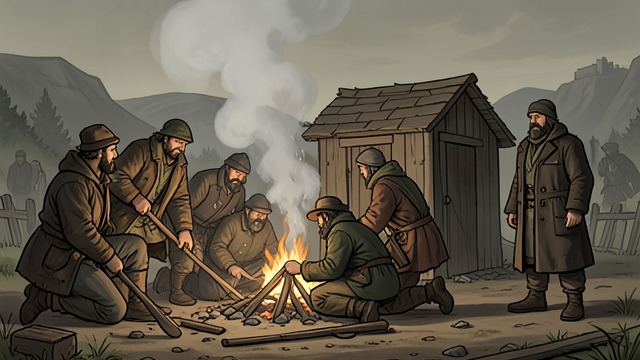
The Stranger’s Right to Stay
A hearth as a claim
The newcomers build a dwelling and light a fire on common ground, invoking a custom that can establish settlement. Their smoke signals both need and a claim to remain.
The villagers resent the rule because they fear losing a share of already scarce resources.
Competing customs
A practice that could welcome the newcomers becomes a justification for hostility. Local belonging is asserted against a right that might apply to outsiders.
A Local Sentence
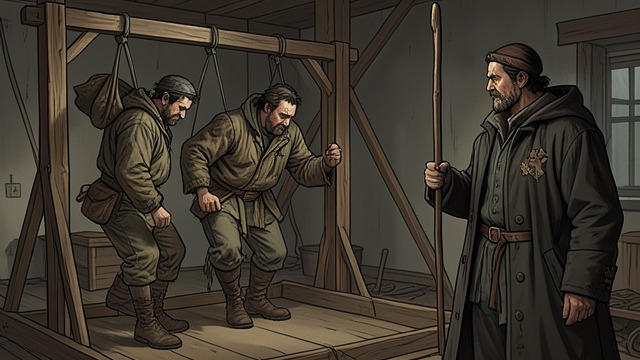
A Local Sentence
Charles Kent’s judgment
Charles Kent sentences the two men to a week in the pillory for eating a bird. He acts as the local authority and believes he is imposing a restrained punishment.
The sentence follows village practice more than an impersonal legal process.
Custom’s limits
The punishment is neither humane nor adequately supervised. The eventual death exposes the danger of relying on authority without safeguards or appeal.
A Magistrate Without Consent
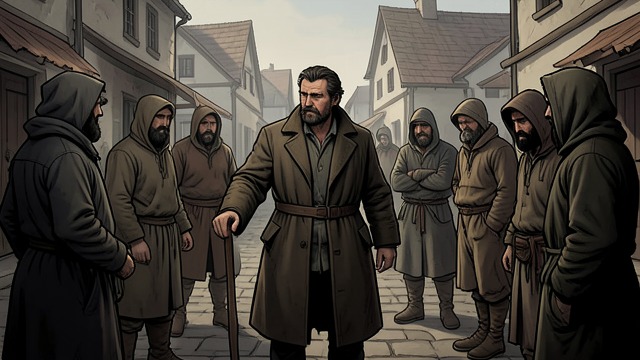
A Magistrate Without Consent
Power claimed
Young Edmund Jordan declares himself the effective magistrate and threatens formal consequences. He orders searches, detentions, and interrogations that exceed the village’s customary authority.
His legal status is reinforced by servants and inherited property.
Justice becomes coercion
Formal process is not shown as more reliable than local custom. It is powerful, but its procedures serve the owner’s interests and permit violence against captives.
Law Leaves an Empty Village
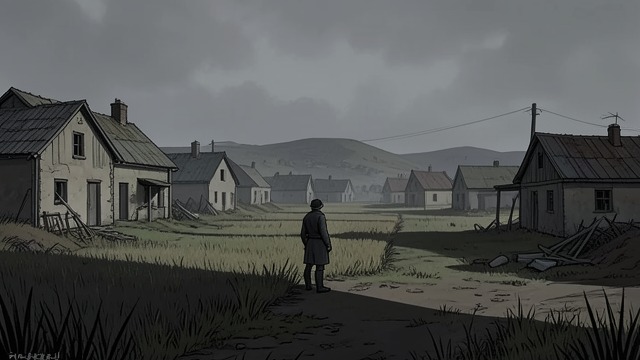
Law Leaves an Empty Village
Threat overtakes community
The villagers expect punishment for the attack and leave their homes. No shared process remains to negotiate with the heir or defend customary rights.
The estate’s law gains control without winning the residents’ agreement.
Authority without a people
Young Edmund Jordan inherits an empty landscape ready for enclosure. The conflict ends not through a just settlement but through the dispersal of those who used the land.
Before the estate survey is revealed
At the opening, before the crowd reaches the den
The first morning after the newcomers arrive
After Young Edmund Jordan arrives
After the attack on Jordan’s Groom
