
Enough Versus More
HarvestThis flow traces the ideological conflict between a community organized around sufficiency and an owner committed to expansion and profit.
increasing Bearing strength in each event
 decreasing
Bearing strength in each eventdecreasingThe Economy of Enough
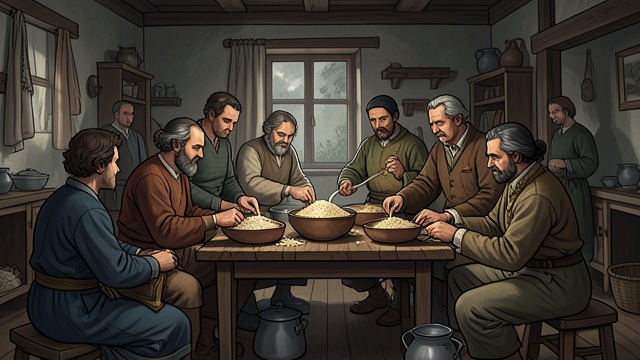
The Economy of Enough
Shared sufficiency
The villagers divide grain, meat, and other produce according to customary household shares. Their aim is to survive the year rather than maximize profit.
A poor harvest threatens everyone, but the arrangement keeps resources within the community.
A different measure
This economy may be narrow and precarious, yet it has its own idea of value. Its measure is whether people and animals are fed.
Kent’s Gentle Promise
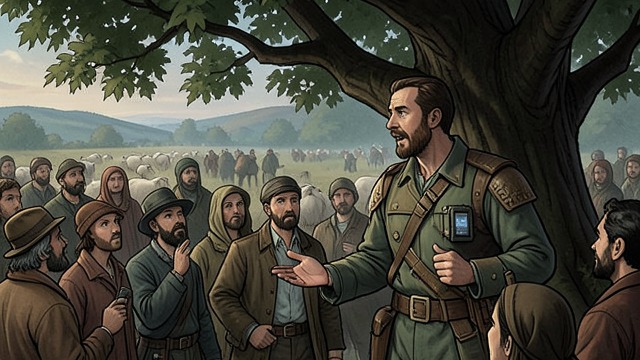
Kent’s Gentle Promise
Reform made attractive
Charles Kent describes a future of sheep and weaving as a way to lessen hard agricultural labor. His language presents a different economy as a shared benefit.
The speech comforts a fed and slightly drunken audience.
The missing price
The promise avoids the likely loss of common rights and farm work. Its appeal depends on postponing the question of who owns the benefits.
Jordan’s More
Jordan’s More
Profit as purpose
Young Edmund Jordan speaks of Progress, Enterprise, and increased returns. He regards the village’s economy of Enough as irrational because it produces little coin.
He promises to convert fields and woods into a wool-producing estate.
People as costs
The reform’s benefits depend on selecting only the hands required. The remaining residents become an expense to be reduced rather than a community to be sustained.
Departure as Resistance
Departure as Resistance
Refusing the new order
Families leave rather than accept a future in which their customary access to land depends on an owner’s employment. Their departure is forced by danger but also refuses the status of expendable labor.
They carry livestock and household goods when they can.
The paradox of freedom
Leaving protects some people while destroying their settled lives. The estate’s promised productivity begins with the removal of those who made it productive.
One Day of Wheat
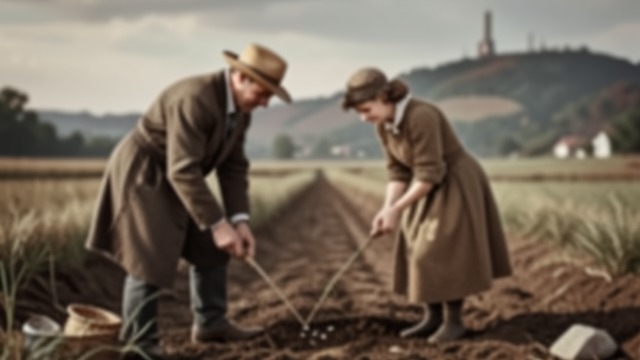
One Day of Wheat
A modest refusal
Walter Thirsk and Young Beldam plow and sow a narrow strip for winter wheat. The action is small beside the estate’s planned transformation but insists on another crop and another year.
Walter Thirsk calls the seed a farewell gift and an act of resistance.
Sufficiency survives briefly
The field cannot defeat the wool economy, but it preserves the logic of planting for nourishment rather than profit. The novel leaves that seed to grow beyond its characters’ control.
During the opening harvest
At the harvest feast
During the heir’s first private meeting at the manor
The afternoon villagers leave
The day before the estate fires
