
Maps, Names, and Control
HarvestThis flow explores how mapping and naming can reveal a landscape while also making it easier to possess and transform.
increasing Bearing strength in each event
 decreasing
Bearing strength in each eventdecreasingWorkaday Names
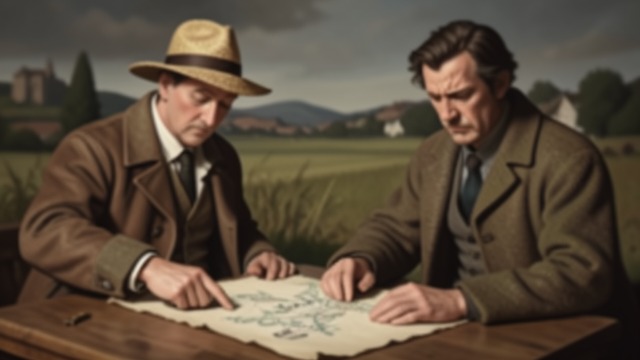
Workaday Names
Names from use
Walter Thirsk gives Philip Earle plain names such as East Field, Hazel Wood, and Turbary. The names describe direction, family, or practical purpose rather than abstract beauty.
For the villagers, knowing a place means knowing what can be done there.
Naming as knowledge
Philip Earle prefers names that can be recorded and displayed. Their exchange reveals competing ways to know the same land.
The Marsh Renamed

The Marsh Renamed
A name made beautiful
Philip Earle calls the village’s foul, useful marsh Blossom Marsh. The new name reflects the flowers he notices rather than the waste and labor Walter Thirsk associates with the place.
Walter Thirsk accepts the name for the chart.
Selective attention
The renaming is affectionate but incomplete. A place can be made attractive by emphasizing what a visitor sees and leaving out what residents must endure.
A Village Without a Name

A Village Without a Name
Identity left unwritten
Walter Thirsk explains that the settlement has no distinctive name beyond The Village. Legal papers identify the estate through former owners rather than its inhabitants.
The people who live there are present in speech but nearly absent from official naming.
Ownership’s vocabulary
The contrast shows how documents can record property while overlooking community. What is unnamed can still be inhabited, loved, and defended.
The Maps of Hereafter

The Maps of Hereafter
Two landscapes drawn
Philip Earle shows Walter Thirsk a map of the existing estate and one of its planned sheep fields. The second is colorful and orderly, but its divisions erase the face Walter Thirsk recognized.
The charts present future change as a visible pattern.
The authority of representation
The map does not merely describe what will happen; it helps make the plan actionable. A drawn boundary can become a wall, a hedge, and a rule.
An Unmarked Sheet
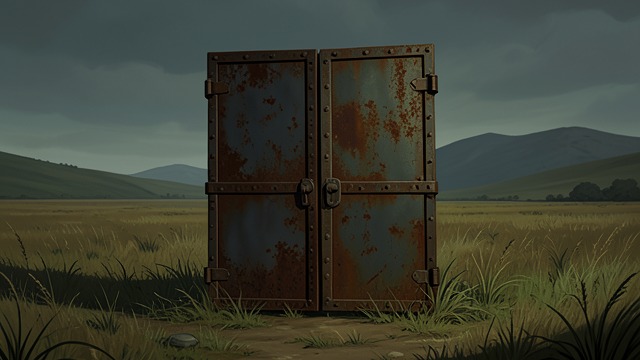
An Unmarked Sheet
A remnant kept
Walter Thirsk carries away the piece of calfskin vellum he prepared for Philip Earle. He has burned the surveyor’s charts and the man who made them in the manor fire.
The surviving sheet contains no map and no imposed labels.
Possibility without a plan
The blank vellum could be filled with another account of the world. Walter Thirsk leaves with the capacity to describe, but no settled authority over what the description will mean.
During Walter Thirsk’s walk with Philip Earle
At their visit to the low ground
Later in the same boundary walk
During the afternoon charting session
At the final boundary crossing
