
Fire, Blame, and Retribution
HarvestThis flow traces fire from a deceptive prank to a recurring instrument of claim, punishment, and destruction.
increasing Bearing strength in each event
 decreasing
Bearing strength in each eventdecreasingSmoke as a Claim
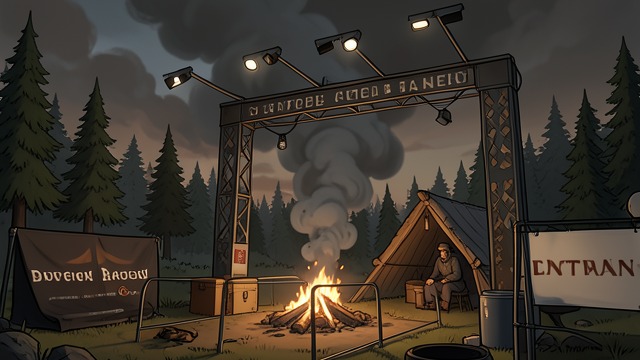
Smoke as a Claim
A hearth announces presence
The newcomers’ fire sends smoke above the woods, signaling that they have built a shelter and intend to stay. In local custom, a home and hearth can establish a claim to common ground.
The smoke is both practical heat and public declaration.
A contested welcome
The villagers interpret the claim as a demand on scarce land. From the opening scene, fire links survival to a conflict over belonging.
The Prank’s Flame
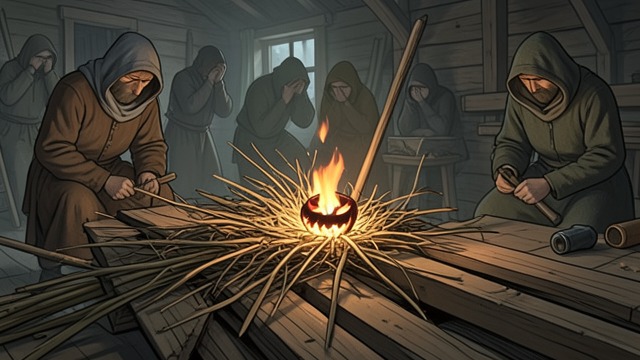
The Prank’s Flame
Fire travels unintentionally
Christopher and Thomas Derby and Brooker Higgs use the Moonball to smoke Doves from their loft. The ember catches the nesting material and spreads through the farm buildings.
The young men have sought to punish birds, not burn the estate.
Blame travels deliberately
They hide their responsibility by pointing toward newcomers. Fire’s damage is accidental, but the injustice that follows depends on conscious concealment.
The Father’s Unburied Body
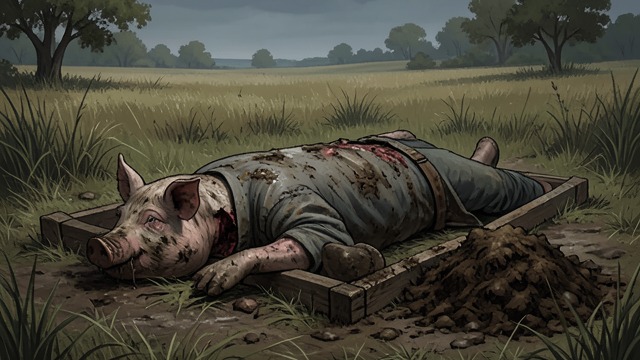
The Father’s Unburied Body
Death after confinement
Mistress Beldam’s father dies in the pillory, and pigs damage his body. The village’s punishment makes a human death look like an animal carcass abandoned in a waste place.
No proper burial can restore the dignity denied to him.
Retribution begins
The loss shapes the family’s later violence. The village’s fire is followed by a moral fire of grief and retaliation.
The Village Set Alight
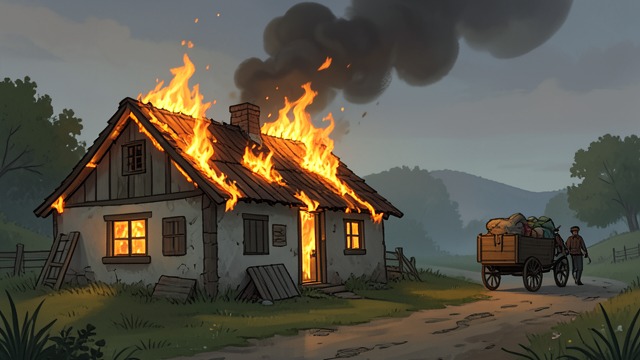
The Village Set Alight
Retaliation made visible
Mistress Beldam sets fire to deserted cottages while Young Beldam dismantles the pillory. They take goods from homes and the manor before loading their cart.
The flames answer the violence they experienced, but consume places used by people who have fled.
Retribution broadens harm
The fire does not distinguish between the powerful and the vulnerable. It turns a family’s escape into the ruin of a whole settlement.
Ash at the Manor
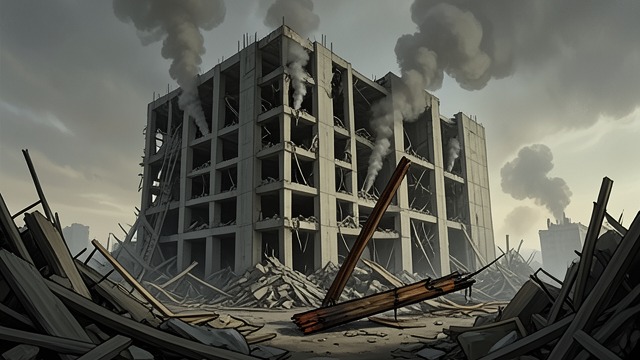
Ash at the Manor
A final decision
Walter Thirsk finds Philip Earle dead and chooses to ignite the manor rather than leave it as a monument to the coming order. Documents and maps become kindling.
The blaze consumes the place where power had been recorded and negotiated.
Fire cannot settle accounts
The manor’s destruction is not a clean act of justice. It leaves the dead unburied, the village gone, and Walter Thirsk with a responsibility he cannot explain.
Before dawn on the opening day
The same dawn, after the harvest night
The day after the pillory sentence
During the ending, after the winter-wheat sowing
Immediately after Philip Earle’s body is found
