
From Common Fields to Sheep Country
HarvestThis flow follows the transformation of a subsistence community into an enclosed estate designed for wool production.
increasing Bearing strength in each event
 decreasing
Bearing strength in each eventdecreasingA Subsistence Harvest
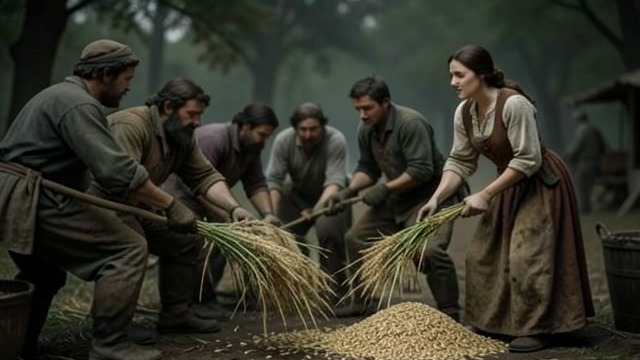
A Subsistence Harvest
Shared work
The Village gathers to cut barley, divide labor, and prepare food for the coming year. Its members rely on customary shares, common grazing, and gleaning rather than a market economy.
The work is exhausting, but its shared rhythms bind households to land and one another.
A fragile sufficiency
The crop is only adequate, and the declining population makes every worker matter. This fragile arrangement is already vulnerable to a landowner’s decision.
The First Survey
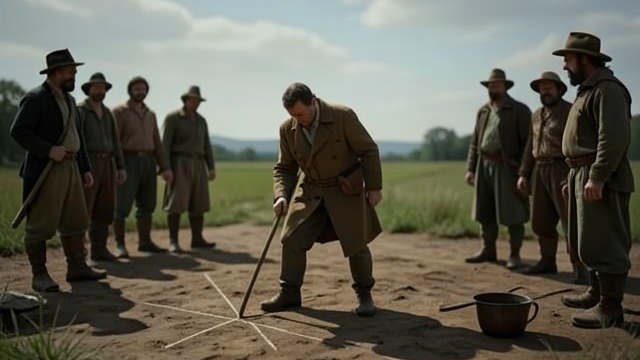
The First Survey
Land made legible
Philip Earle measures fields, homes, woods, and population for Charles Kent. His charts make the inhabited landscape appear as lines and geometric shapes.
The villagers cannot tell whether the survey is merely descriptive or a step toward changing their lives.
A concealed purpose
The map is connected to a legal claim and a planned conversion of the estate. What looks like neutral measurement becomes an instrument of land power.
A Dream of Wool
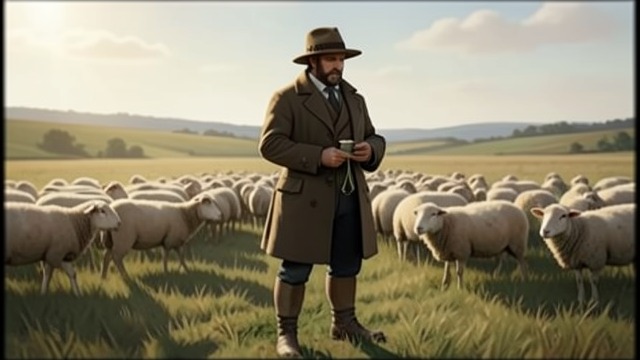
A Dream of Wool
Gentle persuasion
Charles Kent describes a future of shepherding and weaving, presenting the change as a dream that could free the villagers from uncertain harvests.
He emphasizes comfort and steadier returns, while avoiding the blunt fact that Sheep will replace crops and common uses of land.
A buried cost
The appealing vision disguises enclosure and displacement. The villagers hear the promise of ease before they understand what livelihoods will disappear.
The Heir’s Program
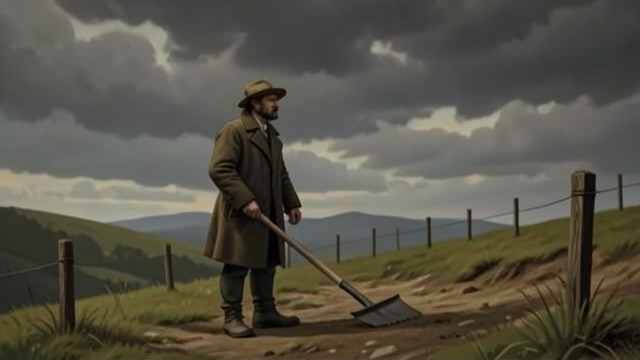
The Heir’s Program
Law and profit
Young Edmund Jordan explains that the inheritance requires him to reorganize the estate. Baynham will prepare land for Sheep, clear woods, and build boundaries.
The scheme promises work for some, but makes employment conditional on the new owner’s needs.
A new hierarchy
The language of improvement converts customary users into replaceable labor. What the village calls shared land, the heir treats as property awaiting profit.
A Seed Against Enclosure
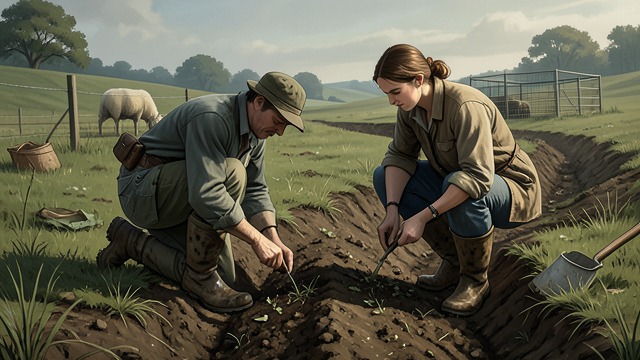
A Seed Against Enclosure
Reclaiming the plow
Walter Thirsk and Young Beldam plow one narrow strip and sow winter wheat. The gesture renews the agricultural cycle that the planned sheep economy would end.
Their work does not undo the owner’s claim or restore the villagers’ homes.
An uncertain inheritance
Walter Thirsk leaves the seed in the ground as a promise rather than a solution. The land may still produce life after the old social order has disappeared.
The harvest’s final day, before dawn
During the final harvest day
At the harvest feast, the first evening
After Young Edmund Jordan arrives
Near the ending, after the estate is emptied
