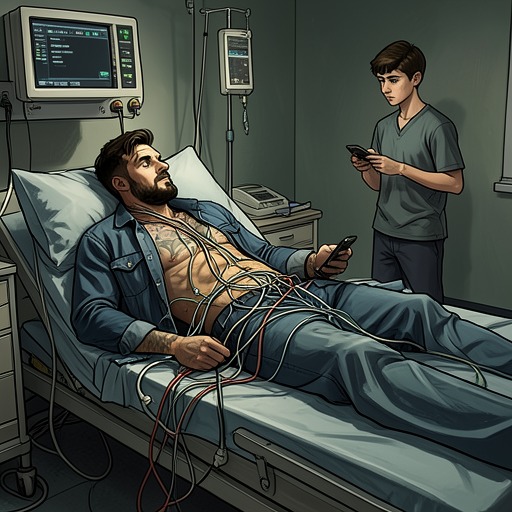
Crew develops strep infection and scarlet fever
Hayden's TimbreCrew develops strep infection and scarlet fever in an episode that transforms a routine family moment into an urgent test of Hayden Devillier’s responsibilities as a young single father. Crew’s sudden physical collapse exposes how quickly parental confidence can give way to fear, while the medical crisis confirms that Hayden’s decisions are organized around protecting the child who has always depended on him.
Background and Vulnerability
Hayden never intended to become a father so young, but Crew’s birth made parenthood the central fact of his life. He was eighteen when Crew was born, and Crew’s mother abandoned him, signed over all rights, and never called to check on him. Hayden therefore describes himself as all Crew has, relying on the example of his own mother and grandparents while learning to parent without an instruction manual. The illness becomes especially frightening against this background: Crew is not simply a sick child but Hayden’s sole parental responsibility and the person around whom he has built his life.
Crew had already developed asthma at about four years old, and his allergy to cats made Hayden conscious of how dangerous his absence might be. Although the asthma did not make Crew sick constantly, Hayden had stopped traveling freely with Assured Distraction because being away from Crew could prevent him from responding quickly. The later fever and rash thus reactivate an established fear: a physical condition may deteriorate before Hayden can reach his son.
The Sudden Medical Crisis
The episode begins with Crew apparently preparing to leave, but he is unsteady on his feet, his eyes seem ready to roll back, and his skin is burning with fever. Hayden catches him before he falls and recognizes that Crew is worse than he had been earlier. Crew says he feels sick and is about to vomit; before the words are fully out, he throws up over both of them. Hayden takes him to the bathroom, helps him clean up, and concludes that the problem is more serious than a virus.
The danger becomes more visible when Hayden removes Crew’s ruined shirt and discovers a strange raised red rash across his skin. Neither Hayden nor Peri Powell knows what it is. Hayden carries the weakened boy downstairs after putting a clean shirt on him, arranges a garbage bag in the truck, and prepares to take him to the emergency room. Nanny, consulted because of her experience with children, suspects scarlet fever and asks whether the doctor performed a strep test. Hayden reports that the earlier test was negative, leaving the family briefly caught between an alarming physical symptom and an inconclusive diagnosis.
At the hospital, the doctor takes one look at Crew and orders another strep test, expecting it to be positive. The result leads to antibiotics. The doctor explains that the rash could become dangerous if untreated, although catching it quickly gives Crew a better chance of avoiding serious complications. The illness therefore moves through a clear progression: weakness, vomiting, high fever, an unexplained rash, recognition of scarlet fever, and immediate treatment.
Hayden’s Protective Response
Hayden’s reaction is driven by alarm rather than detachment. He physically steadies Crew, presses the boy’s forehead to his cheek to assess the fever, carries him when he is too weak to walk, and stays beside him through the emergency-room examination. His actions are practical, but they also reveal the intimacy of their relationship: Hayden knows Crew’s condition through touch, notices the change in his strength, and responds before the child can fully explain what is happening.
The crisis also clarifies Hayden’s broader protective pattern. When Timbre Simons once rode a bus alone at night, he reacted with furious fear because he imagined the possibility of a weapon, abduction, or a driver failing to notice that she had been forced away. He later apologizes for yelling and admits that the thought of what could have happened scared him to death. His response to Crew’s illness follows the same structure, but with an even more immediate dependence: fear erupts into action, and action becomes care rather than punishment.
Hayden’s protectiveness is not limited to illness. He objects when Crew repeats locker-room profanity about Tucker Powell, insisting that such language remain in the locker room. Even while managing an adult conflict in the Powell family, he maintains a boundary around what Crew should hear. The medical emergency intensifies this already established pattern of placing Crew’s safety, health, and moral development ahead of convenience.
Family and Relational Stakes
Peri becomes part of the emergency as soon as Hayden calls for help. She brings a washcloth, helps lower Crew’s fever, follows Hayden and Crew outside, and accepts the task of telling Timbre what has happened while Hayden drives. Hayden knows he cannot care for both Crew and Timbre in that moment, and his decision to rely on Peri shows the practical form of the Powell family’s support network.
That support matters because Hayden’s fatherhood is both deeply personal and structurally demanding. He loves Crew completely, but he also knows that the boy’s approaching adolescence will bring more difficult years. The illness arrives as a concentrated reminder that parenting is an ongoing responsibility rather than a finished achievement: Hayden may have managed well so far, yet he must remain prepared for new threats, new symptoms, and the longer work of raising Crew.
Crew’s biological history also heightens the stakes of later threats against him. Krissy Thompson and Ella Sullivan use Crew as leverage when they kidnap Timbre. Ella threatens to scar Crew’s forehead if Timbre returns or contacts the family, while Krissy later produces a gun and demands access to her son. These threats are terrifying partly because Hayden’s life has repeatedly taught him that Crew’s safety cannot be treated casually. The earlier illness establishes the child as physically vulnerable and Hayden as fiercely responsible for him; the kidnapping plot turns that vulnerability into a weapon used by others.
Narrative Significance
Crew’s illness is more than a medical interruption. It converts Hayden’s abstract knowledge of parental responsibility into a scene of bodily immediacy: fever, vomiting, weakness, rash, carrying, driving, testing, and antibiotics. The crisis also provides a contrast with the later violence surrounding Krissy and Ella. In the illness episode, danger is met through observation, assistance, medical expertise, and timely treatment. In the kidnapping and armed standoff, danger is manufactured through surveillance, threats, knives, and guns.
The episode consequently defines care as an active discipline. Hayden’s fear does not disappear, but it is redirected into checking Crew’s condition, seeking help, transporting him to the hospital, and following the doctor’s instructions. Crew’s recovery is not narrated as a triumph over an abstract villain; the immediate victory is that a frightening condition is recognized and treated before it worsens. In that sense, the episode reinforces the family’s central ethic: love is measured by attention to vulnerability, and parental priority means acting before danger becomes irreversible.