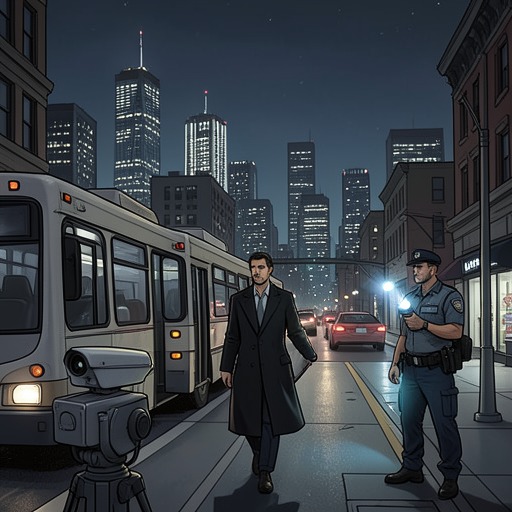
Hayden follows Timbre to investigate her residence
Hayden's TimbreHayden follows Timbre to investigate her residence after a late shift, an action that exposes both his growing attachment and the limits of his protective approach. Unable to learn where she lives from Timbre, Ford Turner, or her friend, he chooses surveillance: he waits in darkness, follows her car, and studies the hidden place she enters. The discovery does not resolve his concern so much as transform it into a more urgent mystery about Timbre’s precarious life.
Motive and Circumstances
Hayden’s decision follows a late-night encounter in which he notices the time on his truck clock—1:30 a.m.—and realizes that Timbre will soon finish work. He hopes to learn where she is living because she has refused to discuss it and the people around her will not provide the information. His stated concern is safety, but the method is deliberate and intrusive: rather than wait for her to trust him, he decides to obtain the information himself.
The setting intensifies that concern. The parking lot is nearly empty, and Hayden watches Timbre and Jenna leave the bar when only two cars remain. He thinks they are laughing and talking without paying attention to their surroundings, particularly dangerous behavior in the early hours beside a bar. He assumes Ford Turner normally walks them to their cars, but on this night Hayden sees no such protection. His fear therefore becomes the immediate justification for an act that also reveals his inability to tolerate uncertainty about Timbre’s circumstances.
The Pursuit Through Austin
Hayden parks on the street beneath the overhang of an oak tree, using the darkness to remain unseen. When Timbre and Jenna get into Jenna’s car, Jenna drives away and Hayden follows at a safe distance. The pursuit crosses under I-35 and continues through several turns on the East side of Austin, giving the sequence the shape of a quiet investigation rather than an open romantic approach.
Jenna eventually stops before a plain, largely windowless, single-story building with a parking lot and no sign. Timbre enters only after pressing a button and being admitted by a large man. Hayden’s immediate reaction is confusion: the building resembles an office rather than a home, no one lingers near the doorway, and nothing identifies its purpose. Jenna waits until Timbre has gone inside and the man waves before driving away, confirming that the building is Timbre’s destination but not necessarily Jenna’s residence.
Hayden then pulls into the lot himself. Four cars are unattended, yet the building offers no explanation of who lives or works there. He cannot even find a street address on it, so he parks across the street and uses the numbers on the neighboring house to establish the location. The unmarked structure and missing address preserve the mystery while converting his suspicion into a research task: he intends to find out what kind of place Timbre has entered and why she moved there from her garage apartment across town.
The Unanswered Mystery
The investigation produces a concrete location but no satisfying answer. Hayden learns that Timbre does not live with Jenna, but he still does not know whether the building is an apartment, a shelter, or something else. The absence of a sign becomes important evidence in itself. A place that should be legible remains hidden, and Timbre’s housing situation is presented through Hayden’s incomplete, increasingly anxious reconstruction rather than through an explanation voluntarily offered by Timbre.
That delayed knowledge shapes the romance. In the following bar encounter, Hayden spots Timbre at a table with her friend and recognizes that the evening may be his only chance to ask about her living situation. His online searches have produced nothing, and the mysterious building has become a private secret he cannot solve from a distance. He eventually approaches her and asks to take her home, partly because he wants closeness and partly because he wants access to information she has withheld. The pursuit thus moves from physical following to conversational pressure.
Protection and Control
Hayden’s concern is not empty or baseless. Later, when Timbre describes riding a bus alone in the middle of the night, he reacts with alarm, warning that strangers could have forced her off with a gun or knife without the driver knowing. He pulls her into his arms after yelling, apologizes, and explains that the thought of what might have happened frightened him. On another occasion, he is distressed to learn that she walked to a bus stop on Mountain Grove and traveled along a busy road to reach the Powell family home, which he considers dangerous because of traffic and the possibility of abduction.
These responses clarify the emotional source of the earlier surveillance while also exposing its contradiction. Hayden repeatedly interprets Timbre’s independent movements as risks requiring his intervention. His protective impulse can produce tenderness and remorse, but it can also substitute his judgment for hers. The residence investigation is therefore a formative example of the book’s recurring tension between care and control: Hayden wants to keep Timbre safe, yet he begins by taking information she has deliberately chosen not to give him.
Foreshadowing and Narrative Significance
The episode’s hidden building foreshadows the severity of Timbre’s vulnerability. Later, Krissy Thompson and Ella Sullivan restrain Timbre, threaten her with a knife, and discuss marking her face. Krissy insists that Timbre be removed so she can reclaim her family, while Ella threatens Crew Devillier directly, proposing to carve a mark across the child’s forehead if Timbre returns or warns anyone. The later armed confrontation at the Powell family home confirms that the danger Hayden fears is not merely imagined: Krissy and Ella arrive with a gun and use Crew as leverage, insisting that he remain within Krissy’s sight.
Against that later violence, Hayden’s shadowed pursuit appears both troubling and revealing. He is not yet responding to a known kidnapping or armed threat; he is acting on incomplete information, suspicion, and attachment. Nevertheless, the unmarked building, the late hour, the unsafe travel, and Timbre’s refusal to explain her situation all establish the story’s central atmosphere of concealed danger. The action changes Hayden’s relationship to Timbre’s housing from casual curiosity into a continuing protective concern, while preserving the gap between what he believes he must do for her and what she has actually consented to share.