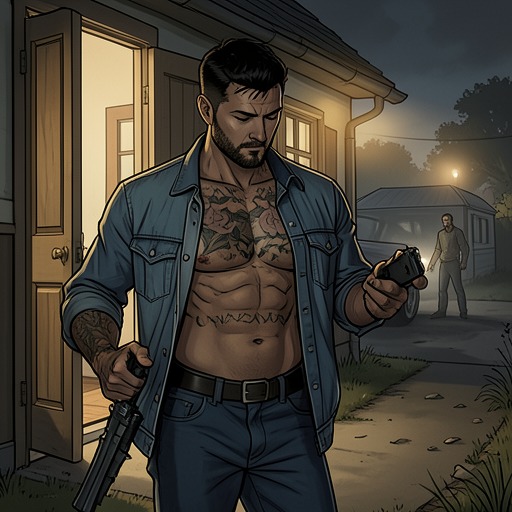
Powell house armed standoff
Hayden's TimbrePowell house armed standoff is the armed confrontation in which Krissy Thompson and Ella attempt to reclaim control over Crew Devillier by holding the Powell household at gunpoint. The standoff transforms Krissy’s demand for a relationship with her son into an immediate threat to the child’s safety, while Hayden Devillier’s protective response exposes the conflict between formal parental rights and the family’s urgent need for physical security.
Causes and Background
The confrontation follows a pattern of coercive danger surrounding Timbre Simons and the Powell family. Hayden repeatedly reacts to situations in which Timbre travels alone at night, warning that strangers could force her from a bus or abduct her without the driver noticing. He also becomes alarmed when she rides a bus alone to Mountain Grove and walks beside a busy road. These earlier warnings establish his protective vigilance, but the standoff gives that fear a concrete form: Krissy and Ella do not merely threaten an adult; they use Crew as leverage.
Krissy’s objective is to restore access to Crew and recover what she calls her family, despite having previously signed away her parental rights after leaving the hospital. Hayden states that the papers were filed with his attorney and that Krissy was no longer entitled to concern herself with Crew. Krissy counters that she signed while suffering from postpartum depression and claims that her lawyer told her the documents might not be enforceable. The dispute therefore combines an unresolved biological relationship with a legal disagreement, but the women’s actions move the conflict outside ordinary legal negotiation.
Hostage Situation and Threats
Before the armed standoff at the Powell house, Ella has already shown a willingness to use physical intimidation against Timbre. With Timbre’s hands tied behind her back, Ella places a knife against her cheek and threatens to scar her face so badly that no man or woman will want her. Krissy rejects that particular form of injury, not because the women have abandoned violence, but because her stated aim is to remove Timbre from the picture so that Krissy can have her family back. Ella then escalates the threat by proposing that they carve a mark into Crew’s forehead, and she warns Timbre that any attempt to return or contact the family will make the child bear the injury permanently.
At the Powell house, Krissy orders Crew to sit beside her and insists that he is never leaving her sight again. Hayden positions his arms behind him to keep Crew from moving toward the women and explains that Krissy is frightening a child who does not know her. Krissy refuses to let Crew retreat to his room. Ella moves closer and lowers the gun toward the floor, but the weapon remains an active threat rather than a gesture of reassurance. Krissy openly declares that the gun was brought because the family would resist and that it gives the women control of the situation. Her demand is not simply to speak with Crew; it is to compel his physical submission under armed threat.
Defensive Maneuver and Resolution
The standoff’s central defensive action is Hayden’s effort to keep Crew behind his body while preventing the confrontation from becoming immediately lethal. He tries to keep Krissy talking, complimenting her appearance and asking where she has been, while secretly watching for an opportunity to intervene. Mason appears behind Ella, visible only to Hayden, and signals that he is preparing to act. Hayden understands that the hidden intervention depends on silence and follows the signal rather than provoking the armed women.
When the back door suddenly booms open, several men in black clothes rush into the room. Hayden immediately covers Crew with his own body, wrapping himself around the child in case bullets are fired. The gesture makes the standoff’s hierarchy of priorities unmistakable: whatever the legal or biological claims surrounding Crew, Hayden treats the child’s life as the first obligation and his own body as the available shield. The evidence does not describe the subsequent gunfire or identify the men’s full operation, but it establishes that their sudden entrance breaks the women’s control of the room.
Police, Evidence, and Family Authority
The household calls the police as soon as the other children have been loaded into an SUV. The family has alarms and a gate, but security has been kept to a minimum for the children’s sake; their celebrity status nevertheless helps bring police quickly. Officers search Timbre’s pool house while others remain with Peri Powell, showing the coexistence of private family protection and formal law enforcement.
The investigation then converts suspicion into evidence. Timbre’s clothes and shoes remain in the pool house, as do her phone, still plugged in, and her opened birth-control packet. Hayden concludes that she could not have left voluntarily, especially barefoot in chilly weather, and identifies the central fact as her abduction. Police later find prints that match Krissy Thompson. The fingerprint match links the armed confrontation and Timbre’s disappearance, replacing the family’s fear with a concrete suspect.
The legal conflict over Crew remains embedded in the confrontation. Hayden invokes Krissy’s signed surrender of parental rights, while Krissy attempts to reopen the question through her claim that postpartum depression affected the agreement. Ryan Powell offers financial help and a chance for Krissy to establish herself elsewhere, but he draws a firm boundary around Hayden and Crew: money may address her circumstances, but it cannot authorize her to take them. Informal family protection, legal documents, police evidence, and armed intervention thus operate simultaneously, with no single system able to contain the danger on its own.
Aftermath and Wider Significance
The standoff is followed by the discovery that Timbre is alive at the police station in Amarillo. She had called 911 when the bus stopped and reported a kidnapping, after which police brought her in for questioning. Ryan arranges for the family’s plane to retrieve her, turning her return into a coordinated family rescue rather than leaving her to travel alone again. Her survival clarifies that the threats against her were part of a broader campaign of control connected to Krissy and Ella.
The event also reveals the personal secret at the heart of the family crisis. When police identify Krissy as the owner of the fingerprints, Hayden, Peri Powell, Ryan, and Crew recognize the name, but Crew does not yet know that Krissy is his mother. Hayden had deliberately withheld that information, fearing the harm associated with her absence and history. The armed confrontation makes that hidden biological relationship impossible to keep separate from the present: Krissy’s claim to Crew is grounded in birth, while Hayden’s authority is grounded in years of care, protection, and the rights she previously relinquished.
As a dramatic event, the standoff shifts the value at stake from disputed belonging to immediate life-and-death danger. Krissy begins by demanding recognition as Crew’s mother, but the gun changes the meaning of that demand: family becomes coercion, and access becomes captivity. Hayden’s sheltering body, Mason’s concealed intervention, the police investigation, and Timbre’s recovery collectively restore the possibility of safety, while the fingerprint evidence and Crew’s emerging awareness ensure that the family conflict cannot return to its earlier state of concealment.