The Bar
Hayden's TimbreThe Bar is the Austin venue that gives Timbre Simons her first workable foothold after homelessness and unemployment. With its distinctive décor, informal hiring practices, and demanding weekend shifts, it functions at once as a place of employment, a social crossroads, and a pressure chamber for the developing relationship between Timbre Simons and Hayden Devillier. The bar’s importance lies in this doubleness: it helps Timbre regain economic independence while making her vulnerable to the attention of intoxicated men and bringing her into contact with the people who will reshape her future.
Setting and Atmosphere
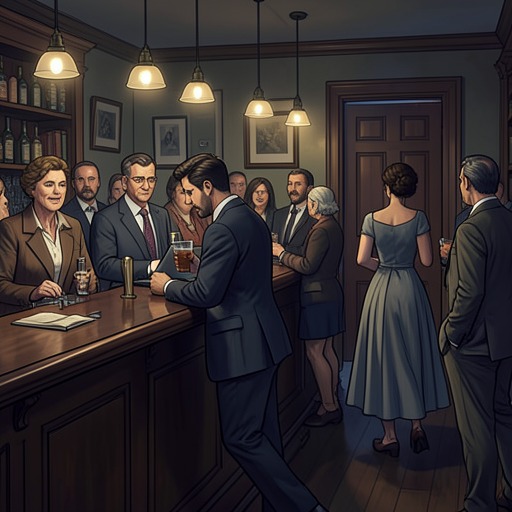
The Bar is introduced as a dark establishment with a funky, distinctive atmosphere. Its walls and fixtures are crowded with traces of former patrons: signed T-shirts, flags, and dollar bills occupy unusual places, making the décor seem to preserve the venue’s accumulated memories. Rather than presenting the bar as a neutral workplace, the narrative gives it an attitude and a recognizable social character, one that Timbre immediately likes. The space is informal, lived-in, and marked by the people who have passed through it.
Timbre first visits The Bar in the middle of the afternoon, when only a few patrons are drinking. She arrives after speaking with Jenna about applying for a job and identifies herself to Ford Turner, who is behind the counter. The bus route running directly in front of the shelter makes the workplace accessible without a car, an important practical detail for someone without stable housing or reliable transportation. Before leaving the shelter, Timbre prepares as carefully as her limited resources permit, wearing her only remaining pair of nice jeans and a shirt that needs ironing. The bar therefore enters the story not merely as a setting but as a material test: a place where a presentable appearance, transportation, and immediate availability all affect whether economic recovery is possible.
Employment and Economic Recovery
Ford offers Timbre a trial opportunity because The Bar is short one waitress. She can begin that night, return around five to be trained by Jenna, and receive the job if the evening goes well. The arrangement is direct and conditional: Ford asks her to arrive on time, do the work, and avoid quitting after a week or two. Timbre accepts immediately, understanding that a successful shift will mean money in her pocket the following morning, a change from her recent circumstances. Her response captures the practical force of the job: employment is not an abstract improvement but an immediate alteration in what she can afford and how securely she can face the next day.
The Bar becomes the first stable source of income available to Timbre in the evidence surrounding her arrival. It also supplies a routine and a workplace identity while she is living in a women’s homeless shelter. Later, she gives Ford notice rather than simply disappearing, allowing him time to find and train a replacement. Ford treats that courtesy as unusual among his waitresses, which underscores both the instability of service work and Timbre’s determination to leave responsibly. Her departure is connected to a better opportunity: she is moving into office work through 13 Recordings, where she will earn money, may return to school, and hopes eventually to use the degree she has not yet been able to put to work. The Bar is thus a transitional institution, valuable not because it solves every problem, but because it carries Timbre from immediate survival toward a more sustainable future.
Timbre’s Labor and Exposure
Timbre’s work at The Bar requires her to move through a crowd composed mostly of men. Hayden Devillier observes that she handles the room gracefully, but his admiration is inseparable from his concern. He knows that drunk men hit on her throughout the night and that she laughs off their comments even though she dislikes the way they look at and speak to her. The workplace grants her wages while exposing her to a gendered form of scrutiny that she cannot simply avoid; the same customers who provide the bar’s revenue also create the conditions under which her labor becomes emotionally and physically uncomfortable.
That exposure affects how Timbre manages public contact. When Hayden visits, she does not want overt public displays of affection because she fears that the other men will interpret even a hug as permission for further familiarity. Hayden can briefly pull her into his arms when she comes to the bar, but her caution sets a boundary around their relationship and around her working body. The Bar therefore becomes a place where private intimacy must be negotiated against public perception. Timbre’s restraint is not coyness or indifference; it is a workplace survival strategy shaped by the behavior of the male patrons.
Social Crossroads and Romantic Plot
The Bar is also where Timbre becomes known to Hayden’s wider circle. Hayden tells Ryan Powell that he encountered her there while Assured Distraction was present with Carter and him. Ryan remembers her as the young reddish-blonde waitress who had refused to wait on the group when they were seated near the pool tables, interpreting her frightened silence as part of the aftermath of their own intimidating behavior. The recollection reveals how quickly a vulnerable worker can become an object of group memory, and it gives Hayden’s later interest in Timbre a concrete origin in the bar’s social environment.
The venue’s schedule complicates the romance. Timbre earns the most money on Friday and Saturday nights, precisely when Hayden would ordinarily have the greatest opportunity to see her. Weeknight dates are also difficult because of Hayden’s work and Crew Devillier’s schedule. Hayden describes the relationship as nearly impossible to plan before it has properly begun, while Peri Powell responds that Crew is always welcome at the Powell family home. The Bar’s labor demands therefore create an external obstacle rather than a simple emotional refusal: affection develops within the limits imposed by shifts, childcare, and the need to maximize income.
Hayden eventually returns to The Bar after being absent for a time, finding Ford behind the counter preparing a beer. Ford says that the rest of Assured Distraction had visited a few nights earlier and assumes Hayden has come because Timbre is there. The exchange places the bar at the intersection of Hayden’s family life, professional music work, and romantic attention. Hayden has been occupied helping another band with its recording, but he remains aware of Timbre’s movements and knows that the evening is her final night at the venue.
Departure and Continuing Significance
On Timbre’s last night, Ford explains that she is leaving for office work and may eventually return to school. He also notes that she gave notice and is training a young replacement waitress. His comments contrast the limited assistance he could offer through a bar job with the larger support now available through Hayden and the Powell family. Ford recognizes that she needs care, while Hayden reacts uneasily to the implication that someone else might claim that role. The conversation makes The Bar’s limits visible even as it confirms its earlier usefulness.
Hayden arrives prepared to end Timbre’s dependence on the shelter. He has obtained the form needed to collect her belongings and tells her that he will pick up her things after work because he does not want her to sleep there another night. The Bar is the place where this transition is announced and coordinated: Timbre finishes a shift, maintains her professional obligations, and then leaves not only the workplace but the shelter life connected to it. Her exit is therefore both practical and symbolic, marking movement from precarious survival toward employment, housing, and a relationship in which help is becoming possible.
Even after Timbre leaves, The Bar remains part of the network through which Hayden tries to locate her during the later investigation into her disappearance. He identifies it as the place on Congress where she used to work and names Jenna, who still works there, and Ford, her former boss, as among the few people who might know something about her. The venue’s continuing relevance comes from its role as an archive of Timbre’s recent life: it preserves her employment history, her friendship with Jenna, and the last stable social contacts Hayden can identify. The Bar is consequently more than a backdrop. It is the first institution to admit Timbre into a paying role, the setting that exposes the cost of that role, the meeting point where her relationship with Hayden becomes visible, and one of the few places capable of connecting her past to the search for her future.