The Bar Anti-Harassment Policy
Hayden's TimbreThe Bar Anti-Harassment Policy is the workplace rule that makes staff safety an explicit condition of life at The Bar. Articulated by Ford Turner and reinforced through the behavior expected of regular customers, it recognizes that the bar’s atmosphere can expose women employees to wandering eyes, unwanted touching, and customers who mistake access to the room for access to the workers. Its decisive significance lies in the boundary it draws: harassment is not treated as an inevitable feature of bar culture but as conduct management must stop.
Definition and Setting
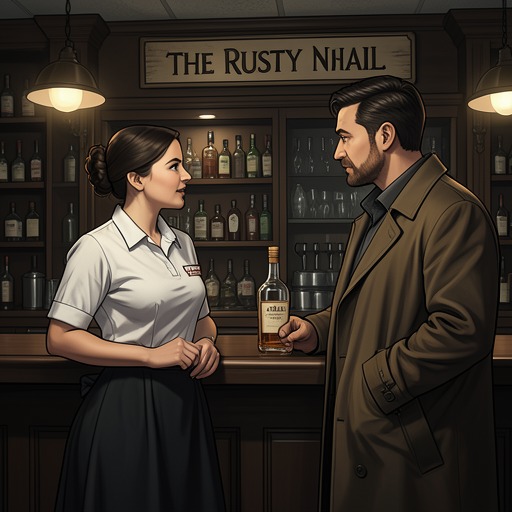
The policy emerges when Timbre Simons prepares to work at The Bar with Jenna. Timbre is warned that the Monday-through-Thursday business is not a family restaurant but a Congress bar where mostly men drink beer, shoot pool, and talk crudely. The warning is concrete rather than abstract: older male customers may stare, try to pinch her, or “cop a feel.” Timbre’s unease shows the immediate stakes of the policy. She has worked in a restaurant with a family atmosphere and is unsure how she will respond to a workplace where sexual intrusion is part of the anticipated risk.
The policy’s operating mechanism is equally direct. Customers who become too aggressive are to be reported to Ford, who will “set them straight.” Regulars already know the rule, while new customers learn it quickly. Ford’s authority therefore works through both anticipation and enforcement: the possibility of intervention disciplines conduct before an incident escalates, and the bar’s established patrons help transmit the norm to newcomers. The policy does not erase the gendered vulnerability of the setting, but it refuses to naturalize it.
Ford’s Enforcement and Timbre’s Boundary
Ford makes the policy explicit after learning that a man associated with Assured Distraction approached Timbre privately and frightened her. Timbre carefully distinguishes discomfort from direct harassment: the man wanted to know when she had begun working at The Bar, and although she refused to answer his other questions, she says he did not say anything wrong. Ford nevertheless insists that he will not tolerate customers giving his staff trouble and asks her to tell him if anyone crosses the line.
This exchange gives the rule an important procedural quality. Ford does not require Timbre to prove that an encounter meets a narrow definition of harassment before offering protection. He treats her report of being frightened as sufficient reason to remain alert, while Timbre retains the authority to describe what happened in her own terms. The policy thus combines managerial responsibility with a limited respect for the employee’s judgment: Ford claims responsibility for the environment, but he does not force Timbre to label the encounter more severely than she believes the evidence warrants.
The contrast between the bar’s formal protection and the dangers surrounding Timbre becomes sharper when she travels alone at night. Hayden Devillier reacts furiously after learning that she rode a bus in the middle of the night, warning that men could have forced her off with a gun or knife without the driver noticing. He then recognizes that yelling will not solve the problem, pulls her from the truck, holds her tightly, and apologizes, explaining that the possibilities had scared him. Later, when she takes a bus from Mountain Grove and walks beside a busy road, he again focuses on the possibility that someone could stop and abduct her. These scenes are not applications of Ford’s workplace rule, but they reveal the same underlying conflict between women’s mobility and the threats imposed by predatory strangers. Ford answers that conflict through a workplace policy; Hayden answers it through personal surveillance, warnings, and protective intervention.
Protection Versus Control
The policy’s ethical force becomes clearer beside the coercive conduct of Krissy Thompson and Ella Sullivan. Timbre is bound, threatened with a knife, and told that her face could be disfigured. When Ella proposes carving a mark into Crew Devillier’s forehead so Timbre will remember the threat and never return or warn the family, Timbre pleads that Crew is an innocent child who did not ask to be born. The threat turns a child into an instrument of control, precisely the kind of intimidation that the bar policy is designed to prevent in a less extreme form.
The later armed confrontation at the Powell family home extends that pattern. Krissy Thompson demands that Crew come sit beside her, refuses to let him leave her sight, and produces a gun when Hayden Devillier and the Powell family resist. Ford’s policy depends on authority being used to protect vulnerable staff; Krissy and Ella use authority, fear, weapons, and threats to remove another person’s ability to choose. The juxtaposition prevents “protection” from becoming a simple moral category. A rule can establish a legitimate duty of care, while an individual’s claim to protect someone can become controlling when it overrides that person’s agency.
The Bar Anti-Harassment Policy therefore occupies a narrow but significant middle ground. It acknowledges the real danger of unwanted touching and intimidation without granting customers ownership over employees or granting managers unlimited authority over their private lives. Timbre’s questions, hesitation, and measured account of the encounter with the stranger keep her voice within the policy’s operation. Her safety matters, but so does her right to determine what happened and how it should be named.
Boundaries and the Cost of Safety
The policy also exposes the uneven burden of avoiding danger. Timbre must anticipate wandering hands at work, calculate whether a late bus is safe, and replace worn shoes because standing through a shift has become physically demanding. Her decision to take public transportation is treated by Hayden Devillier as an avoidable risk, yet the surrounding circumstances show why mobility is necessary: she is working, traveling between places, and trying to manage ordinary tasks without surrendering independence. The policy protects her only inside The Bar; beyond its doors, the responsibility for safety shifts back onto Timbre and the people who care about her.
That limitation creates a tension between institutional protection and personal control. Ford Turner offers a clear reporting channel and promises intervention when customers cross the line. Hayden Devillier responds to danger with anger before recognizing that fear has driven him into an unhelpful form of control. In both cases, safety is presented as relational rather than purely individual, but the scenes distinguish accountable protection from commands that disregard the protected person’s autonomy.
Narrative Significance
The Bar Anti-Harassment Policy establishes The Bar as a workplace with enforceable social boundaries rather than a setting where sexual aggression is excused as ordinary male behavior. Its language is blunt, and its enforcement depends on Ford Turner’s willingness to confront customers, yet its function is serious: regulars understand that staff are not available for touching, intimidation, or private intrusion. The policy gives the bar a protective identity even while acknowledging that the surrounding world remains dangerous.
Its significance expands through contrast. The unwanted attention anticipated at The Bar, the stranger who unsettles Timbre, the nighttime bus journeys, the knife held to her cheek, the threat against Crew Devillier, and the gun displayed at the Powell family home form a progression from normalized boundary violations to overt coercive violence. The policy cannot solve every danger in that progression, but it supplies the ethical principle by which the dangers can be judged: access is not consent, fear is not cooperation, and authority should be used to stop intimidation rather than impose it. Timbre’s safety is consequently framed not as a favor granted by Ford Turner or Hayden Devillier, but as a condition that responsible relationships and institutions must actively defend.