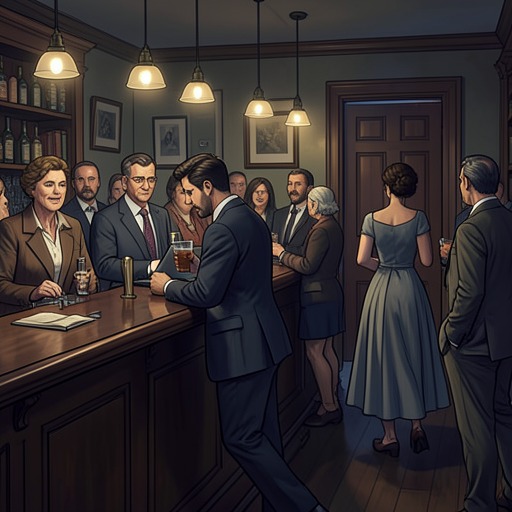
Timbre applies for and starts a bar job
Hayden's TimbreTimbre applies for and starts a bar job at the moment when economic collapse has reduced her choices to immediate survival. After losing her office position, watching her roommate Caylor leave for Los Angeles, and selling her car to pay the last of her monthly bills, she is living in a shelter with only one month of cell service remaining. The bar therefore matters as more than a workplace: it is the first available route back toward cash, mobility, and the possibility of leaving the shelter.
Circumstances and Introduction
Timbre learns about the opening through Jenna, a woman she meets at the shelter who has saved enough money as a cocktail waitress to obtain her own apartment. Jenna works at a place on Congress and explains that the base wage is only the usual two seventy-five an hour, while tips provide the meaningful income. The prospect immediately attracts Timbre because her previous retail work has not been enough to restore her financial stability. She asks whether the bar is hiring, sounding desperate even to herself, and Jenna offers to put in a good word.
The opportunity carries an uncomfortable gendered bargain from the outset. Jenna tells Timbre that her appearance could earn substantial tips, while Timbre recognizes that being paid partly for the commercial display of her body feels disturbingly close to prostitution. Ford Turner, the manager, confirms that the job requires shorts and a tight bar T-shirt. He even permits employees to tie, split, or cut the shirt because, in his view, more exposed skin means better tips. Timbre understands that this is not a career she would choose under ordinary conditions, but bills have converted the sexualized uniform into a condition of employment.
Hiring and First Shift
Timbre visits The Bar in the middle of the afternoon, when only a few patrons are present. Its dark, distinctive atmosphere, decorated with signed T-shirts, flags, and dollar bills, gives the establishment a history and attitude that she finds appealing. She introduces herself to Ford Turner and describes her previous restaurant experience, including waitressing, food handling, bussing, and dishwashing, while acknowledging that she has never worked in a bar.
Ford hires her on a trial basis because another cocktail waitress has quit the previous night. He warns that the work becomes fast-paced in the evening, especially on Friday and Saturday nights when a band plays. Timbre agrees to begin that night. Ford asks her to return around five, with Jenna there to train her, and says that if the evening goes well, the job is hers. Leaving with two new bar T-shirts, Timbre feels that the day has improved immediately: the position promises money in her pocket the next morning as well as a small paycheck twice a month.
Jenna drives her to work and offers a frank warning about the bar’s patrons. The old men may have wandering eyes and hands, and although Ford will intervene if anyone becomes too aggressive, customers may still attempt to touch her whenever they get the chance. The warning establishes the workplace as protected but not entirely safe. Ford’s authority supplies a boundary against overt harassment, while the ordinary service environment continues to treat female employees’ bodies as part of the available customer experience.
Timbre’s first shift tests the bargain she has accepted. After the crowd grows, Jenna assigns her a new section and tells her to concentrate on customers rather than the band members. Timbre takes orders, delivers them, and keeps up with the steady flow of patrons. By last call, her feet are painfully exhausted, and she is already thinking that new Chucks or better shoes must be among her first purchases. The work produces income, but it also extracts time, bodily stamina, and the continuous performance of attentiveness.
Work, Attention, and Social Exposure
The bar places Timbre among several forms of labor at once. She must learn the practical tasks of carrying orders, clearing tables, recycling empties, and managing a section, but she must also regulate how she appears to customers. The required clothing, the pressure to expose more skin for tips, and the threat of unwanted touching make her body part of the job’s economic mechanism. Her financial emergency limits her ability to refuse those terms, so the employment represents both agency and coercion: she actively seeks the work, yet the conditions are shaped by what poverty leaves available.
The workplace also introduces Timbre to a different social and emotional environment. Jenna becomes a supportive coworker, offering transportation and practical information, while Ford presents himself as both manager and enforcer of the bar’s rules. Timbre must remain professional even when she feels self-conscious under Ford’s appraisal or unsettled by the prospect of customers touching her. Her ability to continue depends not only on physical endurance but on managing embarrassment, fear, gratitude, and the need to appear ready for every demand.
The band’s presence adds another layer of attention to the first shift. Timbre is distracted by Assured Distraction and becomes unable to take the group’s order, prompting Jenna to move her to another area. Ford and Jenna later tease her about having been overwhelmed by the musicians, and the incident connects the bar job to the relationship that will become central to her life. The workplace is thus simultaneously a source of wages and the setting in which professional necessity, public scrutiny, and romantic possibility first collide.
Transition to 13 Recordings
The bar job does not become Timbre’s final answer to economic insecurity. Her connection with Hayden Devillier leads to an interview at 13 Recordings, where Peri Powell and Cash offer her a position immediately. Hayden encourages her before the interview, and his confidence helps her approach the meeting as someone capable of more than merely enduring the next shift. The offer marks a change in the kind of labor available to her: from serving drinks under a sexualized dress code to using organizational and administrative abilities in a professional music-industry setting.
At 13 Recordings, Timbre learns the computer systems quickly, although matching names to faces proves harder. Johnna, the employee leaving the position, spends the day teaching her the people and routines of the office, introducing important contacts and explaining enough background to keep Timbre from embarrassing herself. Peri checks on her at the end of the long Monday and asks whether she is ready to go home, framing the new position within a more structured working day. Timbre’s employment trajectory therefore moves from emergency income to a role with training, institutional knowledge, and the prospect of greater stability.
The contrast between Timbre’s work and Hayden Devillier’s schedule also reveals how employment and family responsibilities intersect. While Timbre is building a new career, Hayden is working late on music for Assured Distraction’s new album and tries to leave the studio in time to attend Crew Devillier’s football practice. Their parallel labor is not identical, but both are measured against obligations beyond the workplace. Timbre’s bar job begins as an individual struggle for housing and income; its later consequences place her within a network where work, romance, music, and family are increasingly inseparable.
Significance and Consequences
Timbre’s bar employment is a crucial transitional action rather than a stable destination. It interrupts the downward spiral caused by dismissal, depleted savings, and homelessness by giving her immediate wages and a reason to imagine a future outside the shelter. At the same time, the job makes visible the unequal conditions under which that recovery begins: low base pay, dependence on tips, compulsory sexual display, customer entitlement, and exhaustion are treated as ordinary features of the position.
The episode also gives Timbre a form of practical self-reliance without presenting independence as simple or cost-free. Jenna’s referral and ride demonstrate that accepting help is part of survival, while Timbre’s willingness to show up, learn the work, and endure the first crowded night demonstrates her own persistence. Her movement from The Bar to 13 Recordings does not erase the hardship that brought her there. Instead, the bar becomes the first concrete rung in a rebuilding process, and the place where her economic crisis begins to open into friendship, romance, professional opportunity, and a more secure chosen community.