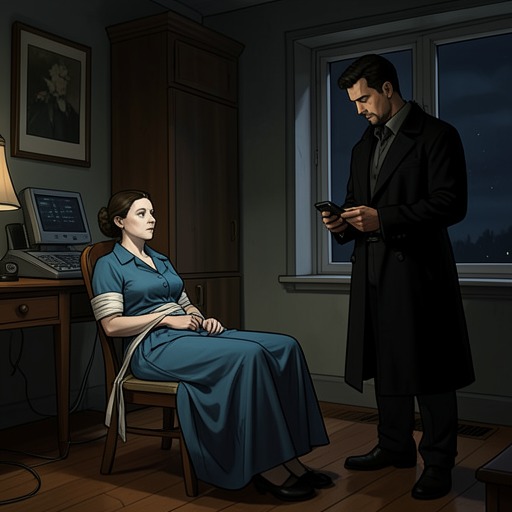
Timbre Simons Kidnapping
Hayden's TimbreTimbre Simons Kidnapping is the decisive rupture in Timbre Simons’s life with Hayden Devillier and Crew Devillier: a violent abduction that converts domestic security into captivity, forces Timbre into an imposed exile, and exposes the extent of Krissy Thompson’s threat to the Devillier household. The event is driven by control rather than negotiation, but Timbre’s submission is not consent; it is a survival response shaped by the danger directed at Crew and Hayden.
Causes and Background
The kidnapping grows out of Krissy Thompson’s hostility toward Timbre and the relationships Timbre has formed in Austin. Krissy treats Timbre as the person responsible for her own losses and uses that resentment to justify a campaign of removal. Ella Sullivan participates as her accomplice, making the attack a coordinated act rather than an isolated confrontation. The women’s objective is not merely to frighten Timbre or drive her temporarily away. They intend to erase her presence from the region and sever her access to Hayden Devillier and Crew Devillier.
The assault begins after Timbre collapses in a physically helpless state. Wearing the thick terry robe Hayden bought for her, she makes her way toward the kitchen while still wet, supporting herself against the walls. She cannot open the refrigerator, cannot locate or use her phone, and finally slides down beside the cabinet before losing consciousness. The scene places the ordinary object associated with Hayden’s care—the robe—against the sudden loss of bodily control, making the transition from intimacy to captivity immediate and stark.
When Timbre wakes, she is met with verbal abuse and physical handling. Someone strikes her in the face and demands that she wake up; a hand grips her arm roughly and pulls her upright, though she cannot remain standing. The attackers therefore establish control before presenting their demands. Timbre is not entering a disputed conversation with equal power: she is being revived, restrained, and confronted while disoriented and unable to defend herself.
Coercion and Forced Exile
Krissy states the central demand with explicit geographic terms. Timbre must vanish completely, leave the area, and go anywhere outside a thousand-mile radius of Austin; Krissy insists that Texas itself is no longer safe for her. The proposed solution is a bus to an unspecified, distant place, followed by continued surveillance until Timbre is well beyond the city limits. The threat is designed to make disappearance appear voluntary while leaving Timbre no meaningful choice.
The coercion depends on threats against Crew Devillier as well as Timbre. Krissy warns that any return to Austin or Texas, or even any attempt to make contact, will bring harm to Crew, whom she describes as the child at the center of her problems. Timbre understands that the attackers are capable of carrying out the threat. Her concern is therefore not limited to escaping her own physical danger; she is calculating how to prevent violence against an innocent child and against Hayden Devillier. The kidnapping weaponizes family attachment, using Timbre’s love for Crew and Hayden as the means of compelling her obedience.
The attackers also attack Timbre’s dignity, suggesting that she can survive only by using her body to obtain support from others. This sexualized humiliation is part of the control system: it attempts to redefine her as disposable and isolate her from the home and relationships she has built. Timbre nevertheless recognizes that she has started over before and could do so again. Her willingness to imagine rebuilding elsewhere does not lessen the violence of the demand; it shows her separating the practical problem of survival from the emotional necessity of protecting Crew and Hayden.
The physical threat becomes unmistakable when the larger woman drags a knife down Timbre’s robe. The blade travels along the sleeve and then across the opening at the front, between her breasts. At first it barely breaks the skin, drawing a line of blood, but the woman then pushes it in far enough to cause real pain. This staged escalation mirrors the verbal threats: the attackers demonstrate that they can increase the damage whenever Timbre resists. Timbre responds by agreeing to leave and asking only to be taken to a bank or an ATM so she can obtain the means to live.
Timbre’s Survival Strategy
Timbre’s compliance is presented as an active protective choice under coercion. She agrees to the conditions because she believes Krissy and Ella are sufficiently unstable and dangerous to injure Crew and Hayden. Her internal priority is clear: preserving their safety comes before preserving her own location, comfort, or relationship. The decision to leave therefore carries the tragic appearance of abandonment while functioning as self-sacrifice.
Soon afterward, Timbre boards the bus while Krissy and Ella watch. They plan to follow in their car until the bus is outside the city limits, confirming that the forced migration is part of the abduction rather than a release. Timbre experiences the journey as a nightmare and expects, impossibly, to wake from it. The bus becomes the mechanism of her removal and the visible proof that the attackers have converted their threat into action: Austin, Hayden, and Crew are behind her, while the destination remains imposed and unknown.
Discovery and Rescue
The kidnapping’s immediate aftermath is defined by uncertainty. After Krissy Thompson is taken into custody and Ella Sullivan is transported by ambulance with a gunshot wound to the shoulder, Krissy still refuses to say what happened to Timbre Simons. The household is therefore left with the most terrifying possibility unresolved: Timbre may be alive, but no one knows where she has been taken or whether the threats have become lethal. Hayden Devillier must continue searching even after the armed confrontation has ended, because the arrest of one perpetrator does not itself restore Timbre’s freedom.
The decisive break comes when a detective reports that Timbre is at a police station in Amarillo. She had called 911 when the bus stopped and identified the journey as a kidnapping, prompting police to take her in for questioning. The call reverses the attackers’ intended erasure. Krissy had tried to force Timbre into disappearance, but Timbre used the first available institutional point of contact to make the crime visible and secure her own recovery. Her action also confirms that boarding the bus had never been voluntary; the authorities understand the trip as forced removal rather than an ordinary departure.
Hayden immediately offers to travel for Timbre or arrange a flight, but Ryan Powell tells him that the Powell family plane will be sent instead. The response turns the family’s resources toward retrieval, replacing the kidnappers’ imposed transportation with a deliberate journey home. When the plane circles the small airport in Amarillo, Hayden sees Timbre standing beside a police car. The sight carries the emotional force of a return from uncertainty: she is no longer hidden, unreachable, or controlled by Krissy Thompson and Ella Sullivan.
Reunion and Restoration
Timbre moves toward the aircraft at first quickly and then at a dead run. Hayden meets her on the steps, kisses her, and checks her body for injuries, asking whether the attackers hurt her. Timbre answers that she is fine, though somewhat roughed up. The exchange acknowledges both survival and damage: the kidnapping has not left her untouched, but it has not destroyed her ability to return to the people who were threatened in order to control her.
Crew Devillier is present on the plane and waits until Hayden and Timbre have been reunited before revealing himself. When Timbre calls to him, he jumps from the top step and runs into her embrace. Hayden then wraps his arms around both of them. The physical arrangement matters because the kidnapping had attempted to separate the three members of their household by turning Crew into a hostage and Timbre into an exile. Their embrace visibly reverses that design, restoring the family unit through touch before any larger explanation can be given.
The return is completed in Hayden’s invitation to go home. Timbre, Hayden, and Crew do not merely leave the airport; they reclaim the meaning of home that the abduction had threatened to destroy. Their shared departure marks the movement from captivity back into chosen belonging, while the police presence behind Timbre preserves the legal reality that this restoration follows a crime, not a simple romantic reunion.
Consequences and Significance
The kidnapping produces legal consequences for both attackers. Krissy Thompson leaves in the back of a police car and faces a long prison sentence. Ella Sullivan leaves in an ambulance after being shot in the shoulder. Their fates establish that the assault has crossed from private hostility into criminal violence, and that the danger to Timbre, Hayden, and Crew has been answered by formal intervention rather than private retaliation alone.
For Crew, the event also changes the limits of what can remain hidden. He now knows that Krissy is his biological mother, the woman who gave birth to him, even though she has not acted as his mother and may never occupy that role in his life. The kidnapping therefore exposes a family truth at the same time that it demonstrates the destructive consequences of Krissy’s claim upon the past. Crew’s knowledge is painful, but it is no longer something Hayden and Timbre can preserve through silence.
At the level of plot, Timbre Simons Kidnapping combines captivity, forced migration, threatened family violence, and rescue. Its central value shift moves from safety and belonging to bodily danger, isolation, and uncertainty, then back toward security with a lasting cost. Timbre’s call to 911 is the event’s crucial assertion of agency: although the kidnappers control her body, route, and immediate choices, they do not control the story’s final direction. By naming the crime, she creates the path by which the police, Hayden Devillier, Ryan Powell, and the wider family can find her.
The event also clarifies the difference between obedience and surrender. Timbre obeys because Krissy Thompson threatens Crew, not because she accepts Krissy’s authority or abandons Hayden Devillier. Her forced departure is an act of protection under impossible conditions, and her return exposes the moral failure of interpreting survival behavior as consent. The final image of Timbre, Hayden, and Crew leaving together transforms the bus’s earlier movement away from Austin into its opposite: a passage back toward a home defended by family, law, and mutual attachment.