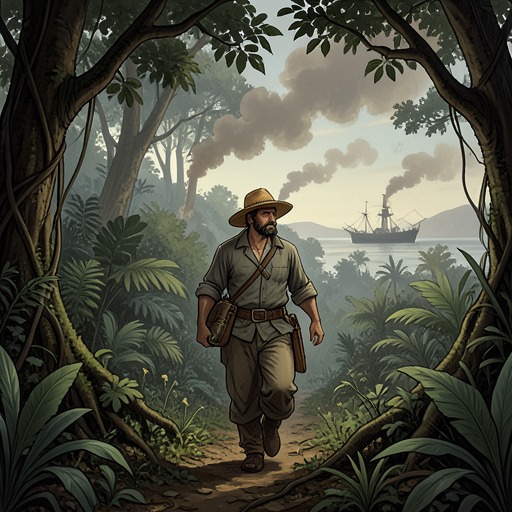
Africa
Heart of DarknessAfrica in Heart of Darkness is both a physical setting and a space repeatedly remade by Marlow’s imagination: the blank territory that once promised adventure becomes a mapped field of commerce and, on arrival, a landscape of colonial intrusion and oppressive uncertainty. The gap between those images gives the continent its narrative force, while the routes and settlements imposed upon it reveal how exploration and trade turn geography into a claim of possession.
Maps, Blankness, and Desire
As a child, Marlow spent hours studying maps of South America, Africa, and Australia, imagining their blank spaces as invitations to exploration. He marked places with his finger and promised himself he would go there. Africa held the largest remaining blank space in his imagination, and its mystery was part of its appeal. By the time he sought work there, however, the map had acquired rivers, lakes, and names. The change did not simply satisfy curiosity: to Marlow, Africa had lost the innocence of a white patch on which a boy might dream and become a place of darkness.
The Congo River focuses that desire. On a shop-window map it appears as a vast, uncoiled snake, its head at the sea and its tail disappearing into the land. Marlow finds the shape mesmerizing, and the thought that The Company trades on the river gives his fascination a practical route: he reasons that the trade must require steamboats and seeks command of one. The image of the snake makes the map seem to exert a power over him, even as the proposed journey is already tied to commercial access.
That double meaning appears in The Company’s office map. Its colored regions divide the continent into legible territories: red suggests work already done, other colors mark other areas of activity, and a purple patch on the East Coast signifies the presence of the so-called pioneers. Marlow says he is bound for the yellow region at the center, where the river lies. The map converts a continent of imagined blankness into a system of marked zones and routes; its bright distinctions make expansion look ordered, even while Marlow’s description of the river as deadly unsettles that appearance.
The Coast and Colonial Traffic
Marlow’s passage to Africa begins on a French steamer that calls at port after port to land soldiers and customs officers. From the ship, the coast appears almost featureless: dark-green jungle runs beside white surf, while scattered settlements remain tiny against the surrounding expanse. The repeated landings make colonial administration visible as movement along the shore—soldiers, officials, flags, and toll collection—without suggesting that this apparatus has transformed the landscape it claims to govern.
The stops also expose the human cost and indifference within that routine. Marlow hears that men on a lonely ship are dying of fever at a rate of three a day; at other stops, he hears that people have drowned in the surf, without any apparent concern from those around him. Trading places pass by under names that strike him as belonging to a farcical performance set against a sinister landscape. Rivers and streams appear as channels of decay, their banks rotting into mud and their waters spreading into mangroves. Because the ship rarely stays long enough for a detailed impression, the coast accumulates less as a sequence of fully known places than as a sustained sense of oppressive wonder.
Marlow’s account of the shore is not a view from nowhere. He describes African people through the perceptions of a European traveler, and his language can reduce them to spectacle. Yet the people paddling out from shore briefly interrupt the shipboard atmosphere of unreality: their shouting, singing, perspiration, and energetic movement seem to him more direct and natural than the colonial traffic around him. That moment offers a contrast within his perspective, not an escape from its limits; the landscape and its inhabitants are still being presented through his narration.
The River Route and the Interior
After more than thirty days, Marlow reaches the mouth of the Congo River and anchors off the seat of government. His work is still roughly two hundred miles farther inland, so he first travels to a place thirty miles upstream on a small seagoing steamer. The distances establish Africa not as a single destination but as a succession of thresholds: coast, river mouth, government station, and a further journey toward the place where his assignment will begin.
The river also joins the geographic journey to the map that first drew Marlow in. Its immense, serpentine course had seemed to promise access to a mysterious interior; the actual passage is embedded in a colonial system of trading stations, official landings, and movement upriver. The contrast between the river’s scale and the administrative footholds along its banks makes the reach of the enterprise seem both ambitious and precarious. Africa remains larger than the routes designed to make it traversable.
Narrative Frame and Significance
Africa’s meaning changes as Marlow recounts his journey. The boy’s blank space becomes the mapped territory that attracts his adult ambition, then the coast experienced from a ship, where repeated landings and reports of fever and drowning expose the harsh routine beneath the promise of trade. The Congo River links these stages, but does not resolve their contradictions: it is at once a compelling line on a map, a working route for commerce, and a passage into an increasingly oppressive landscape.
At the end of the frame narrative, Marlow falls silent as the waterway before his listeners darkens beneath a bank of clouds and seems to lead into immense darkness. This closing image carries the journey’s uncertainty back into the present of the telling. Africa is not reduced to a settled explanation: the maps name and color it, and colonial traffic crosses it, but Marlow’s narrative leaves the distance between those systems of knowledge and the lived world they claim to describe unresolved.