Attack on Marlow’s Steamer
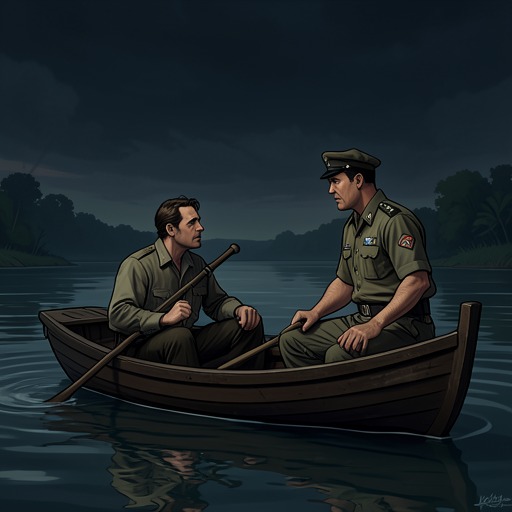
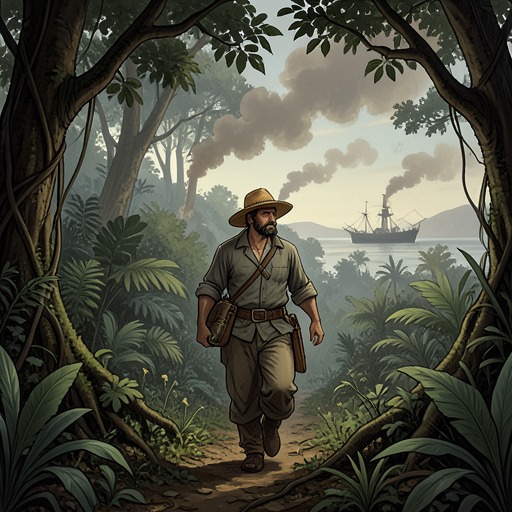
Heart of DarknessThe Attack on Marlow’s Steamer is a sudden river ambush on the approach to Kurtz’s station, but its meaning is less straightforward than its violence. Marlow first reads the cries from the shore as grief rather than hostility; after the attack, he insists that it was an attempt to repel the vessel, not an ordinary offensive. Only later does the Russian Trader disclose that Kurtz ordered the assault to make the steamer turn back and to discourage Marlow from searching for him.
Causes and Background
The approach takes place within a landscape already marked by the Company’s violence and neglect. At the Outer Station, Marlow has seen laborers marched under guard and encountered workers who, after falling ill and becoming unable to work, have been left to die. These scenes make official labels such as criminal or worker seem inadequate to what is happening around him: administrative order and human suffering occupy the same ground. They establish a context of exploitation, but the account does not identify them as a direct cause of the attack.
Marlow reaches the Central Station after a two-hundred-mile journey with a caravan of sixty men, on the fifteenth day of travel. His subsequent journey upriver brings the steamer into a more immediate uncertainty. In thick fog, cries from the forest strike him as an expression of sorrow, and he reasons that the people may be reacting to the sight of the vessel. He does not initially believe they intend to attack. The fog obscures the banks and makes both observation and movement difficult, so his interpretation rests on sounds and partial glimpses rather than a clear view of the people ashore.
The Ambush on the River
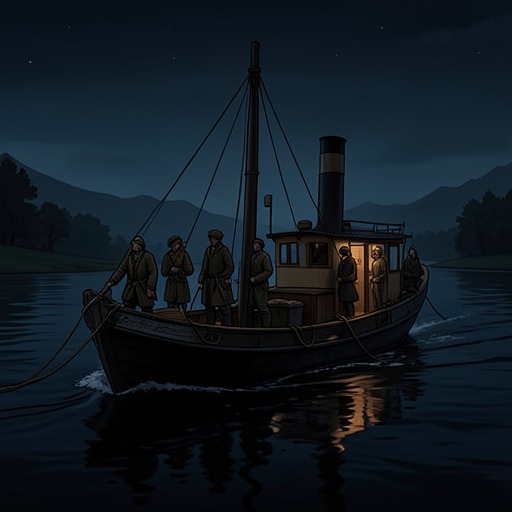
The attack begins about two hours after the fog lifts, roughly a mile and a half below Kurtz’s station. Marlow’s steamer has rounded a bend and is passing a chain of shallow patches beneath the water. Because he has been told that the station lies on the western side, he takes the western passage, though he knows neither channel. The danger is thus revealed while the vessel is already negotiating an unfamiliar stretch of river.
Marlow notices the poleman flatten himself on deck and the fireman duck near the furnace. Sticks fly past the pilot-house and strike it; only then does Marlow recognize them as arrows and understand that the vessel is under attack. Looking through the vegetation, he sees people moving among the branches. The Pilgrims respond with their Winchesters, firing into the bank. Smoke further obscures the water and the nearby shallows, while the steamer approaches a snag. With no safe time or room to turn, Marlow steers toward the bank, where he knows the water is deep, and guides the vessel along the overhanging growth.
The attack is not presented as a simple contest between two evenly matched groups. The hidden position of the people ashore, the fog’s lingering effects, the snag, and the Pilgrims’ gunfire all shape what happens aboard. Marlow’s immediate task is to keep the vessel moving through the danger. When the helmsman abandons the wheel to fire a rifle, Marlow takes over and corrects the steamer’s course. The episode turns on abrupt shifts of attention—from river navigation to incoming arrows, from the wheel to the people on the bank—and on how little any participant can see clearly.
Death and Immediate Aftermath
As the steamer passes the bank, the helmsman is struck by a spear and collapses beside Marlow. Marlow keeps control of the vessel and sounds the steam whistle repeatedly. The arrows stop, the people on shore fall silent, and the steamer clears the snag. The whistle’s effect marks a sudden change in the encounter: the noise of the exchange gives way to a prolonged cry from the forest and then quiet.
The General Manager’s agent arrives in the pilot-house and sees that the helmsman has died. Marlow asks the agent to steer while he attends to the immediate consequences aboard. The helmsman’s death is the attack’s clearest loss, but the scene also leaves Marlow confronting the uncertainty that had governed his passage: the people ashore have withdrawn, and the vessel continues upriver without resolving their intentions. For a moment, Marlow’s dominant thought is that Kurtz may also be dead. The attack has therefore endangered the journey while sharpening the importance Marlow has attached to reaching Kurtz.
Revelation and Significance
Marlow initially distinguishes the cries he heard from signs of straightforward aggression. In his later account, he describes the action as an attempt at repulse, undertaken in desperation and for protection. That interpretation complicates the conventional label of attack: the steamer’s presence may be experienced from shore as a threat, even as those aboard understand themselves to be navigating toward Kurtz. The narrative does not make the encounter harmless; it shows instead how sharply its meaning differs according to position and knowledge.
The decisive explanation comes after the immediate danger. The Russian Trader tells Marlow that Kurtz ordered the attack because he sometimes feared being taken away. Kurtz expected that an assault might frighten the steamer off and lead Marlow to conclude that he was dead. The disclosure changes the event from an unexplained ambush into part of Kurtz’s effort to retain control over his own removal. It also reveals that the assault was not merely a spontaneous response by people on the riverbank: Kurtz had directed it, while the Russian Trader says he could not stop him.
The revelation deepens the contrast between Marlow’s uncertain reading of the cries and the private purpose behind the violence. The attack both delays access to Kurtz and exposes how far Kurtz’s authority reaches beyond the station. Its consequence is not only the helmsman’s death or the danger to the steamer, but a changed understanding of Kurtz: the man Marlow has been trying to reach has actively tried to prevent that meeting. In the layered narration, the event is first encountered as a crisis of perception and navigation, then recalled with knowledge that alters its cause and stakes.