Attack on the Steamer
Heart of DarknessAttack on the Steamer is a confrontation on the Congo River that changes the meaning of Marlow’s approach to the Inner Station. First encountered as an unexplained assault from the forest, it costs Marlow’s Helmsman his life and threatens the steamboat’s passage through a dangerous channel. A later confession by the Russian Trader reveals that Kurtz ordered the attack to frighten the approaching party away. The episode thus joins immediate physical peril to the less visible conflict over whether Kurtz will be removed from the station.
Causes and Setting
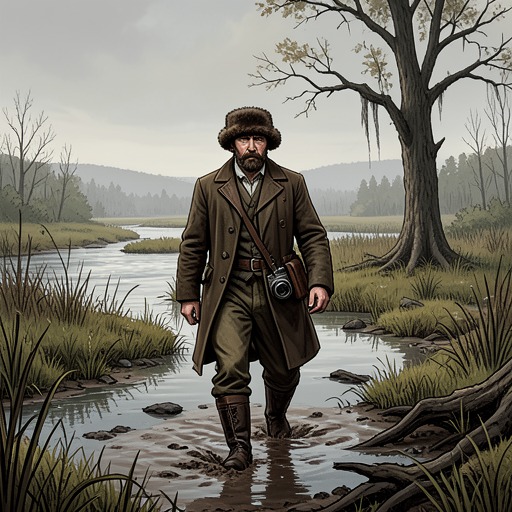
Marlow locates the attack about a mile and a half below the Inner Station, roughly two hours after the fog lifts. At a bend, he sees a grassy islet that marks the head of a chain of shallow patches running down the middle of the river. Since he has been told that the station is on the western side, he chooses the western passage, not knowing either channel. The choice brings the steamboat into narrower water between the shoal and a steep, bush-covered bank.
The passage is difficult to read and navigate. Trees crowd the bank, their branches extending above the current, while a strip of forest shadow lies across the water. Marlow keeps the vessel close inshore because the sounding pole indicates deeper water there. Shortly before the attack, he is already concerned that repeated soundings show less of the pole above the river. These details make the steamboat’s course a practical necessity as well as a vulnerability: the channel leaves little room to maneuver, and the bank that offers deeper water also conceals the attackers.
Marlow initially interprets the violence as an attempt to repel the steamboat rather than an unprovoked offensive. His account distinguishes the immediate appearance of an attack from what he takes to be its protective purpose. That judgment does not identify the attackers individually or establish what they themselves intended; its significance changes when the Russian Trader later supplies the order behind the assault.
The Attack and the Steamboat’s Response
The danger first becomes apparent through the crew’s movements. The poleman stops sounding and lies flat on deck, still holding the pole, while the fireman ducks beside the furnace. Marlow then sees small sticks flying around the vessel and striking the pilot-house. At first, the river and woods remain quiet apart from the stern-wheel and the projectiles. Only after the steamboat clears a snag does Marlow recognize that they are arrows and that the vessel is under attack.
Marlow tries to close the land-side shutter of the pilot-house while the steamboat is close to the bank. In the opening, he glimpses a face and then movement among the vegetation. He orders Marlow’s Helmsman to hold the course, but the helmsman is visibly alarmed. The Pilgrims below open fire with their Winchesters into the bush. Their volley produces smoke that advances across the steamboat’s route, obscuring both the water ahead and the snag Marlow has noticed. The firing therefore compounds the navigation problem: while the crew attempts to answer the arrows, Marlow must still guide the vessel through a constricted channel with an obstacle hidden from view.
Marlow’s Helmsman abandons the wheel to fire a Martini-Henry through the open pilot-house. Marlow takes over steering and, unable to turn safely with the snag close ahead, drives the steamboat against the bank, where he knows the water is deeper. The vessel scrapes along the overhanging bushes as the Pilgrims’ gunfire stops. In the confusion, Marlow’s Helmsman is struck by a spear and collapses at Marlow’s feet. The steamer clears the snag, but the helmsman dies without speaking. His death is the attack’s immediate human cost, and it leaves Marlow needing someone else to steer.
The End of the Encounter
Marlow sounds the steam whistle repeatedly. The hostile cries and arrows cease; from the woods comes a prolonged lament, followed by a few isolated shots and then silence. The abrupt change in sound marks the end of the exchange, while the vessel continues forward. The General Manager’s agent arrives in the pilot-house, sent to take the wheel. Marlow makes him steer and turns his attention to changing his wet shoes and socks, a practical task that sits starkly beside the death that has just occurred.
For a moment, Marlow assumes Kurtz may also be dead. His disappointment exposes how much of his anticipated meeting has centered on hearing Kurtz speak: he had imagined him chiefly as a voice, not simply as a person to see or greet. The attack consequently interrupts not only the steamboat’s journey but Marlow’s expectation of the encounter ahead. The possibility that Kurtz is gone seems to empty the journey of its purpose, even though Marlow soon learns that this assumption is wrong.
Later Disclosure and Significance
The explanation comes afterward, when the Russian Trader tells Marlow that Kurtz ordered the attack. According to the Trader, Kurtz sometimes could not bear the thought of being taken away; he expected the assault to frighten the approaching party into giving up and believing him dead. The disclosure makes the attack a deliberate attempt to obstruct the steamboat’s arrival, rather than simply a response whose purpose Marlow could infer from the riverbank. It also establishes that Kurtz was alive when the order was given and that his removal was at issue.
This knowledge changes the episode without undoing its immediate events. Marlow had steered through the danger believing that Kurtz might already be dead; he now knows that Kurtz himself arranged the threat meant to stop him. The scene’s reversal lies in that movement from uncertain violence to concealed agency: the attack first appears to come only from the woods, while the later account connects it to the man Marlow has traveled to meet. Its consequences are both practical and interpretive: Marlow’s Helmsman has died, the steamboat has survived the channel, and Kurtz’s resistance to being taken away has become part of Marlow’s understanding of him.