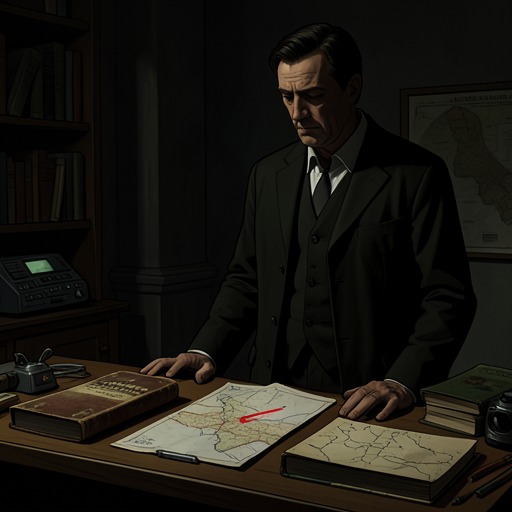
Charles Marlow
Heart of DarknessCharles Marlow is a seaman whose childhood attraction to maps matures into a journey toward a river-trading company in Africa. In his recollection, the river first exerts the fascination of an unexplored place; later, the expectation of meeting Kurtz narrows into a desire to hear him speak. Marlow’s importance lies in this double movement: he travels toward a distant encounter, then tells it as an experience that seemed to illuminate his thoughts without ever becoming entirely clear.
Identity and Background
Marlow tells his story to companions during a pause in the frame narrative. He introduces the experience cautiously, saying that its personal events matter because they explain what he saw and how he reached the place where he first met Kurtz. He calls that destination the farthest point of navigation and the culmination of his experience. Yet he resists presenting the journey as a neatly resolved revelation: it was somber and pitiful, he says, but not extraordinary, and not very clear. Its light is therefore uncertain, more an effect on his thoughts than a complete explanation.
Before setting out, Marlow has returned to London after roughly six years among the Indian Ocean, Pacific, and China Seas. He spends some time resting and visiting his companions, but grows tired of doing nothing and begins looking for a ship. The search proves frustrating: ships will not take him, and he eventually tires of that pursuit as well. This restless interval gives his next opportunity the shape of a renewed direction rather than a settled plan.
Maps, the River, and the Journey
Marlow traces his interest in exploration back to childhood, when he could spend hours studying maps of South America, Africa, and Australia. Blank spaces on the map invited him to imagine future journeys; he would point to one and promise himself that he would go there. By the time he revisits that childhood desire, the largest of those once-blank regions has acquired rivers, lakes, and names. The transformation does not dispel its attraction. Instead, he describes the place as having become one of darkness, while a particular river continues to hold him.
On a map in a shop window, the river resembles an immense snake: its head lies at the sea, its body curves across a vast country, and its tail disappears inland. Marlow says the image fascinates him like a snake captivating a bird. Remembering that The Company trades on the river, he reasons that its business must require vessels on the fresh water, and imagines taking charge of a steamboat. He cannot shake the idea as he walks along Fleet Street. The route into the story thus begins in a mixture of childhood wonder, visual fascination, and a practical thought about employment.
Marlow’s arrival is slower and more complicated than the map’s bold line suggests. More than thirty days pass before he sees the mouth of the Congo River. He anchors off the seat of government, but learns that his work will begin about two hundred miles farther on. As soon as he can, he sets out for a place thirty miles upriver, travelling aboard a small sea-going steamer. The difference between the distant, compelling shape on the map and this measured sequence of stops gives the journey its material scale: the imagined destination must be approached by stages.
Kurtz and the Power of a Voice
After a dying man on board has become the immediate concern, Marlow’s attention turns to the possibility that Kurtz may also be dead. He describes that possibility as an abrupt disappointment, almost as though the object of his efforts had proved insubstantial. His response reveals that he had been travelling toward something more specific than a meeting. He recognizes that what he had anticipated was a conversation: not shaking Kurtz’s hand, but hearing him.
Marlow’s imagined Kurtz is consequently defined above all by speech. He admits that he had pictured him discoursing rather than performing particular actions. This expectation coexists with reports of Kurtz’s extraordinary ivory gathering: Marlow has heard that he collected, bartered, swindled, or stole more ivory than all the other agents together. The contrast matters to Marlow. The reported commerce establishes Kurtz’s reach, but it is his gift of expression that gives him, in Marlow’s imagination, a compelling presence. Marlow sees that eloquence as capable of seeming illuminating and exalted, yet also contemptible and deceptive—a stream of language that might carry light or flow from darkness.
When Marlow thinks he has arrived too late and will never hear Kurtz, his disappointment becomes startlingly intense. He likens the loss to being deprived of a belief or missing his destiny in life, and is embarrassed by the extravagance of the feeling. The reaction does not establish a personal intimacy with Kurtz; rather, it shows how thoroughly the anticipated voice has acquired significance before Marlow can hear it for himself. The prospect of speech has become the journey’s emotional stake.
Narrative Role and Significance
Marlow’s account makes the act of telling part of the experience. He begins by warning his listeners that the story concerns what happened to him personally, then explains why that personal route is necessary to understand its effect. The journey proceeds through concrete measures—the long wait before the river’s mouth, the distance between the government seat and his work, the short upstream passage—while his retrospective narration repeatedly tests what those events meant. The result is not a simple report of travel but an account shaped by later recognition.
His fascination also changes its object. As a boy, Marlow reads blank spaces as invitations to imagine exploration; as an adult, he follows a river whose map-form suggests a living creature and whose trade draws him toward a steamboat. At the point when he fears Kurtz is dead, the expedition’s pull has become inseparable from the prospect of listening. The account therefore links geographical attraction, commercial movement, and the power of eloquence without making them equivalent: the ivory reports describe what Kurtz did, while Marlow’s anticipation of his voice explains what Kurtz has come to represent to him. Marlow’s uncertainty about what the experience finally showed is not an omission from his characterization; it is part of the way he presents its lasting force.