Congo River
Heart of DarknessThe Congo River is the central route of Marlow’s journey inland and one of the novel’s most powerful images of an unmapped, resistant world. First encountered on a shop-window map as a snake reaching from the sea into the continent, it draws Marlow toward his assignment; on the voyage, however, its difficult channels and vast, silent surroundings expose the distance between a line on a map and a place that can actually be navigated or mastered.
Map and Imperial Purpose
As a boy, Marlow had been fascinated by blank spaces on maps and imagined traveling to them. By the time he looked again at Africa, its map had acquired rivers, lakes, and names, yet the Congo still exerted a hold on him. Its winding shape seemed like a snake captivating a bird. Remembering that a trading company operated on the river, Marlow reasoned that it must need steamboats and sought command of one. The river thus enters the story both as a geographical feature and as the lure that directs his career.
At The Company’s offices, a large, vividly colored map turns territory into a pattern of imperial possessions and ambitions. Marlow says he is going into the yellow, in the map’s center, where the river lies. The contrast between the neatly bounded colors and the river’s unsettling, snake-like shape complicates the map’s promise of legibility: the route can be marked, but its fascination and danger are not contained by the marking. The expedition’s commercial purpose is present from the start, even as Marlow’s account gives the river an imaginative power beyond trade.
The Approach and the Inland Route
Marlow reaches the river’s mouth after more than thirty days on a French steamer that calls at ports to land soldiers and customs officers. He anchors at the seat of government, but his work is to begin farther inland; he then travels to a point thirty miles upriver. His approach along the coast has already made the colonial presence seem both persistent and ineffectual: officials are deposited at scattered settlements, while fever and dangerous surf accompany the traffic. The river is not an abstract destination but the next stage of a journey through an enterprise whose administration appears thin against the scale of the land.
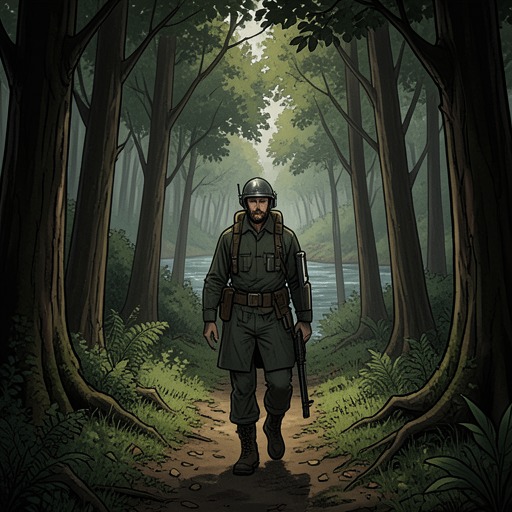
The inland passage grows longer and more demanding. It takes two months from the creek before Marlow and the steamer reach the bank below Kurtz’s station. The river winds among wooded islands and sandbanks, and its channels are hard to distinguish; Marlow must continually search for a navigable passage. He watches for submerged stones and snags that could tear open the steamer, and the crew must find dead wood to cut for the next day’s steaming. This work is not incidental to the river’s meaning: it keeps Marlow occupied with immediate, physical hazards even as the surrounding landscape presses upon him as an immense and inscrutable presence.
Landscape, Labor, and Perception
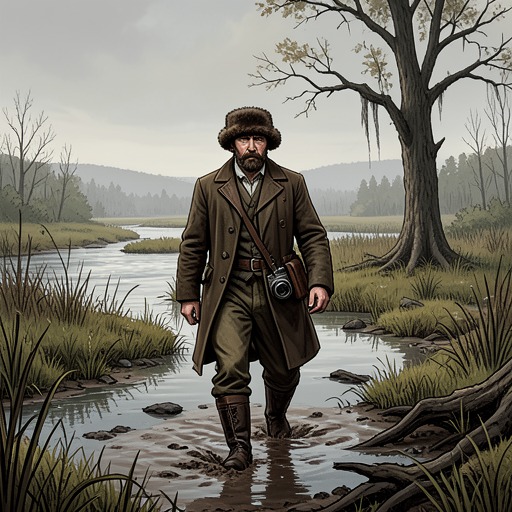
The Congo is presented as a place where scale disorients. Marlow describes stretches of empty water, heavy air, and forest that seems to close around the route. Hippos and alligators lie on silvery sandbanks; shoals repeatedly obstruct the steamer. The travelers can lose their way as if in a desert, and the river’s stillness does not feel peaceful to Marlow. It seems to him an implacable force, watchful and impossible to read. His descriptions make the waterway both a practical environment and a source of pressure on the limits of human knowledge.
The steamer’s labor gives the journey a counterpoint to the temptation to treat the landscape as mere spectacle. Marlow scrapes the bottom, struggles to avoid snags, and remembers the distress of grounding a vessel meant to float. When the ship does run aground, recruited cannibals help push it through the shallows. They also carry a supply of hippo meat, which rots and makes the wilderness’s strangeness bodily and unpleasant rather than merely picturesque. The vessel continues slowly toward Kurtz, while Ivory and commercial expectation recur at riverside stations. The river therefore binds together navigation, labor, trade, and the bodily costs of the expedition.
The River and the Limits of Understanding
As the steamer penetrates farther inland, the river becomes a setting for an encounter that Marlow cannot confidently interpret. Drums carry across the water at night, and, at a bend, the travelers glimpse people gathered by the shore, shouting and moving beneath the foliage. Marlow considers the disturbing possibility of their humanity and kinship with the travelers, rather than accepting an easy division between civilized observers and an alien world. Yet the steamer passes at a distance, and the scene remains partly unintelligible to those aboard. The river’s separation of vessel and bank is also a separation in knowledge: its passengers see and hear, but cannot claim full understanding of what they witness.
Near Kurtz’s station, a long, submerged chain of shallow patches divides the waterway. The steamer takes the western passage because Marlow has been told that the station is on that side; once committed, he finds the channel narrower than expected, with a shoal on one side and an overgrown bank on the other. This precise navigational danger shows how little a general direction guarantees safe passage. At the close of the frame narrative, the waterway under an overcast sky seems to lead toward an immense darkness. The Congo River has carried Marlow through the story’s physical geography, but its final image also gathers the novel’s uncertainties about what the journey has revealed and whether experience can be made fully clear in words.