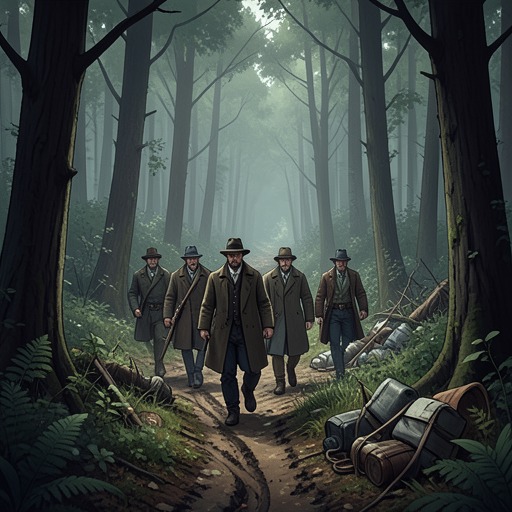
Eldorado Exploring Expedition
Heart of DarknessThe Eldorado Exploring Expedition is an expeditionary band that arrives at Central Station in a disorderly procession, promising no practical answer to the station’s urgent needs. Its appetite for treasure, lack of foresight, and eventual disappearance into the wilderness make it a concentrated portrait of extraction without responsibility or meaningful purpose.
Formation and Arrival
Marlow first encounters the expedition through its successive arrivals at Central Station. During the three weeks in which he expects rivets for his damaged steamboat, five installments instead come in, each led by a donkey carrying a white man dressed in new clothes and tan shoes. Footsore porters follow close behind, while tents, camp-stools, tin boxes, cases, and bales are unloaded into the courtyard. The repeated arrivals deepen the station’s existing muddle rather than relieving it.
The contrast with the station’s needs is pointed. Goods already pass through the station in a wasteful imbalance: manufactured wares flow inland while Ivory trickles outward, yet the rivets needed to repair Marlow’s vessel remain unavailable. Caravans arrive with trade goods while cases of rivets lie unused at the coast or scattered around the station. Against this background, the expedition’s bulky shipments look less like a purposeful supply operation than another burden on a system unable to distinguish useful work from accumulation.
Leadership and Aims
The expedition calls itself a devoted band and, as Marlow understands it, its members are sworn to secrecy. Its leader is the uncle of the General Manager, a fact that ties the venture to the station’s leadership without making it an official remedy for the station’s problems. Marlow describes the leader as a short-legged, paunchy man with sleepy, cunning eyes, who speaks to no one at the station except his nephew. The two are repeatedly seen walking together, their heads close as they confer.
Marlow’s moral assessment is severe: the expedition’s talk resembles that of sordid buccaneers, combining greed with neither courage nor audacity. He sees no foresight or serious intention in the party, and identifies its purpose as tearing treasure from the land without any moral aim beyond the act of taking. The leader’s connection to the General Manager sharpens the irony: the organization is not an isolated intrusion, but part of the same colonial world whose administrators speak of trade and method while allowing predatory ventures to proceed.
Departure and Reported Fate
A few days after the conversation in which the General Manager’s uncle gestures toward the forest, creek, mud, and river with apparent confidence, the Eldorado Exploring Expedition leaves for the wilderness. The image of the landscape closing over the party like the sea over a diver turns its departure into a quiet disappearance. The expedition does not return within Marlow’s account.
Much later, Marlow hears that all the donkeys have died. He has no information about the fate of the other animals and makes no inquiry. The limited report offers no account of the expedition’s human members or of what they achieved; instead, it leaves the venture suspended between its grandly acquisitive name and its largely unrecorded outcome. The wilderness absorbs the party from the narrative as well as from the station.
Narrative and Colonial Significance
The expedition’s disorder echoes the larger trading system around it. At Central Station, goods and people move through a muddle, the flow of manufactured wares inland is answered by a trickle of Ivory, and essential repair materials fail to reach the steamboat where they are needed. The expedition adds another conspicuous load of equipment to this traffic, but its stated purpose is not constructive work: it is the seizure of treasure. Its arrival therefore makes visible the distance between the language of enterprise and the actual priorities of extraction.
The episode also sits beside the later evidence of Kurtz’s immense store of Ivory and the General Manager’s concern that the trade may suffer while the district is closed. The narrative does not establish that the expedition produced that stock or caused the district’s condition. Rather, the two episodes expose related faces of the same acquisitive order: the expedition embodies a clumsy, collectively organized appetite for treasure, while Kurtz’s hoard makes possession and personal claim on a vast scale unmistakable. In both, the land is treated as a source of wealth, while practical responsibility and moral purpose recede.