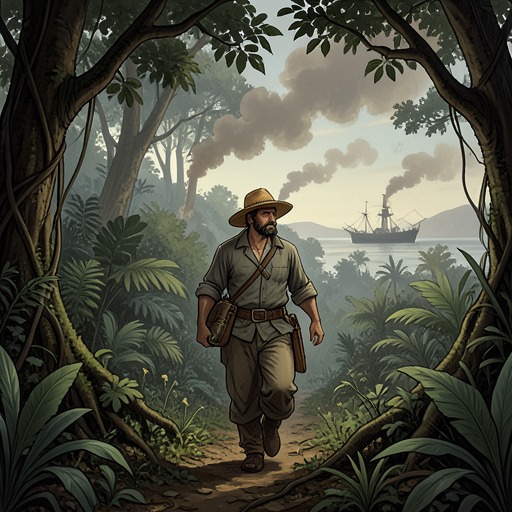
Fresleven incident
Heart of DarknessThe Fresleven incident is the fatal quarrel that preceded Marlow’s appointment as a river steamboat captain. Retold later as a story Marlow had pieced together from reports and his own visit to the village, it turns a minor disagreement over two hens into a chain of death, panic, and abandonment. The episode also gives an early, unsettling measure of the distance between the Company’s language of progress and the consequences of its presence.
Causes and Background
Fresleven, a Dane and the captain Marlow was to replace, had been killed in a quarrel with the people of a village. Marlow learned the fuller account only months later, when he attempted to recover what remained of his predecessor. The original disagreement, he was told, concerned two black hens: Fresleven believed he had been treated unfairly in the bargain and went ashore to confront the village chief.
The account also carried a contradiction. Fresleven had been described as an exceptionally gentle and quiet person, yet he had already spent a couple of years in the colonial enterprise. Marlow speculates that life there may eventually have made him feel compelled to assert his self-respect. That explanation does not excuse what followed; it makes the change in conduct part of the episode’s disturbing logic.
The Quarrel and Its Immediate Consequences
Fresleven assaulted the chief with a stick while the villagers watched in shock. When the chief cried out, his son intervened with a spear, and Fresleven died. The village population then fled into the forest, fearing further calamities. The steamer Fresleven had commanded also departed in panic, with the engineer apparently in charge.
The incident therefore ended not with a negotiated settlement but with the departure of the ship and the dispersal of the people who had witnessed the confrontation. The account identifies a small commercial disagreement as the beginning of a fatal clash, while showing how quickly violence and fear displaced any ordinary exchange between the parties.
Marlow’s Visit and the Abandoned Village
By the time Marlow reached the place, months had passed. He found Fresleven’s remains undisturbed, with grass grown high at the site, and the village deserted. Its huts stood rotting and askew within fallen enclosures. Men, women, and children had scattered through the bush in terror and had not returned.
Marlow’s attempted recovery of his predecessor thus brought him face to face with the aftermath rather than the quarrel itself. The deserted settlement and the uncollected remains make the consequences persist beyond the moment of violence: the people are gone, the village is left to decay, and Fresleven’s death has not been followed by any visible repair.
Appointment and Narrative Significance
Fresleven’s death created the vacancy that allowed Marlow to secure his appointment with the Company quickly. The incident is consequently both a story of what happened to the former captain and the immediate circumstance that opened Marlow’s route into the river service. Marlow also says he could not simply leave the matter alone and later took the opportunity to find his predecessor’s remains.
The hens’ fate remains unknown. Marlow ends with the wry suggestion that the cause of progress may have claimed them, linking a trivial object in the original bargain to the larger enterprise that brought the captain to the village. The irony does not resolve the villagers’ disappearance; instead, it sharpens the contrast between the rhetoric of progress and the fear, death, and abandonment left in its wake.