General Manager
Heart of DarknessThe General Manager runs the Central Station through routine, composure, and an opaque authority that unsettles more than it inspires. Marlow presents him as an undistinguished Company trader whose apparent lack of ability coexists with unusual staying power: in a place where illness lays others low, he endures, holds his position, and turns caution into power. His dealings with Kurtz expose the station’s practical and moral conflict over ivory, methods, and control.
Identity and Character
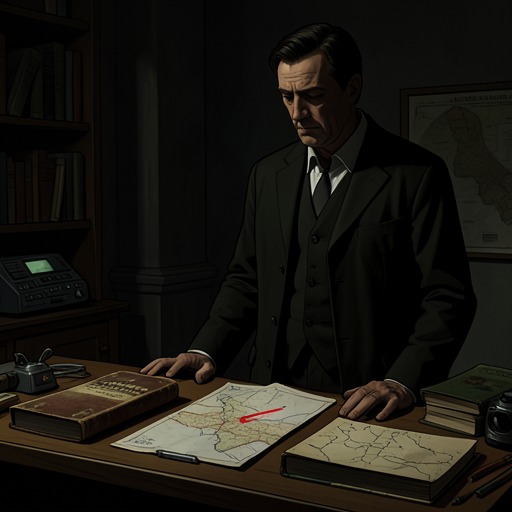
The General Manager is a common trader who has worked in the region since youth. Marlow finds nothing striking in his height, build, features, manners, or voice; the exception is his cold blue glance, which can fall on someone with the weight of an axe. His mouth carries a faint, stealthy expression that is not quite a smile. It intensifies at the ends of his speeches, seeming to seal even an ordinary phrase against interpretation. Marlow remembers the effect but admits he cannot explain it: the man produces uneasiness without offering a definite reason for mistrust.
He is obeyed, but inspires neither affection, fear, nor respect. Marlow judges him incapable of organization, initiative, and even order, and takes the neglected condition of the station as visible evidence. The General Manager originates nothing and can keep routine going; his advancement seems to owe much to the fact that he is rarely ill. He has served three terms of three years in the region, where, amid widespread sickness, robust health becomes a kind of authority in itself. Marlow also hears that on leave in Europe he behaves extravagantly, though this comes from casual talk rather than a close acquaintance with him.
Arrival at the Central Station
When Marlow reaches the Central Station after fifteen days on the road, a station employee tells him that his steamer lies at the bottom of the river. The vessel had set out upriver two days earlier with the General Manager aboard and a volunteer skipper in command; within three hours it struck stones, tore open its bottom, and sank near the south bank. Marlow initially sees the wreck as an infuriating practical setback, not as a revealing act. Recovering the steamer and repairing it will occupy months.
The General Manager receives Marlow after his twenty-mile walk but does not ask him to sit. He launches at once into explanations: he had to depart without Marlow, the upriver stations needed relief, and delays had left him uncertain who was alive or how the stations fared. While handling a stick of sealing-wax, he repeats that the situation is “very grave, very grave.” Rumor has placed an important station in jeopardy, and its chief, Kurtz, is ill. The General Manager calls Kurtz his best agent, exceptional and important to the Company, and presents his own anxiety as concern for that valuable officer.
Marlow is hungry, tired, and irritated by the talk, and tells the General Manager that he cannot estimate the repair time before seeing the wreck. He answers that it will take some months; the General Manager proposes three months. Marlow initially dismisses the estimate as futile managerial chatter, but later recognizes how exactly it anticipates the time required. The episode complicates his first impression: the General Manager may lack initiative, yet he can calculate the practical duration of an operation with striking precision.
Authority and Methods
The General Manager’s power is quiet rather than charismatic. He has no evident gift for leadership, but Marlow cannot determine what, if anything, governs him internally; the suspicion that there may be nothing there makes the absence of external restraints especially troubling. During an epidemic that laid low almost every Company agent at the station, he was heard to say, “Men who come out here should have no entrails.” The line makes physical endurance sound like a qualification for colonial service, while his sealed smile leaves its meaning unsettlingly open.
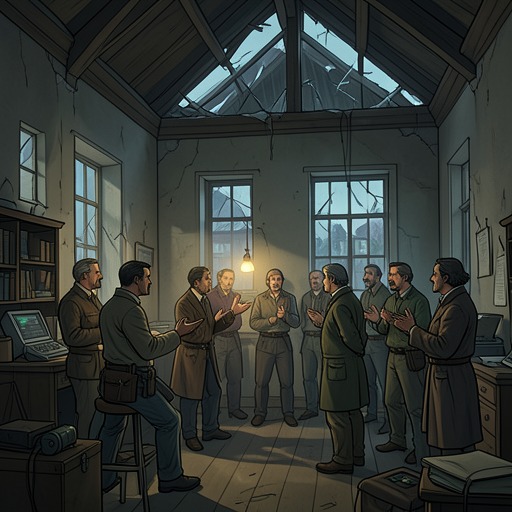
His managerial style also turns hierarchy into a matter of arrangement. When white employees quarrel over precedence at meals, he orders an immense round table and has a special house built to contain it. The place where he sits becomes the first place; the others count for nothing. He is neither civil nor uncivil, Marlow observes, and quietly allows his overfed young attendant from the coast to treat the white men with provoking insolence in his presence. Such details make his authority less a display of personal excellence than an accepted fact of station life.
Conflict with Kurtz
Marlow overhears the General Manager speaking with his uncle while the two walk beside the steamer. The General Manager says he is harmless but resents being dictated to, and complains that he was instructed to send Kurtz upriver after Kurtz asked the Administration for the assignment. He calls Kurtz’s influence frightening. He also recounts that Kurtz sent his assistant downriver more than a year earlier with a message rejecting the men the Company could send him and preferring solitude. The General Manager’s account adds that Kurtz has produced large quantities of fine ivory, but no invoice. The conversation links Kurtz’s commercial success to the very independence and lack of supervision that unsettle the station’s leadership.
After Kurtz returns gravely ill, the General Manager tells Marlow that Kurtz has done more harm than good to the Company. He faults him for acting vigorously before the time was ripe, insists on caution, notes that the district is temporarily closed to the Company, and emphasizes the damage to trade and the need to save the ivory. He calls Kurtz’s approach an “unsound method” and says it is his duty to report the matter through the proper channels. Marlow counters that Kurtz’s failure was not an unsound method but “No method at all,” and refuses to join the managerial indictment. The General Manager responds that Kurtz “was” remarkable, then turns his back on Marlow. Marlow understands that his brief favor has ended and that he has been classed with Kurtz as a partisan of methods the General Manager considers premature.
Narrative Role and Significance
The General Manager is not shown as a commanding villain or a capable reformer. His importance lies in the contrast between his modest competence and the institutional power he wields: he can maintain routine, survive the climate, and judge repair time, yet the station around him remains neglected and his principal language is caution. In Marlow’s account, the slight smile and the unspoken secret it seems to guard make this ordinary official part of the landscape of obscurity and unease.
His conflict with Kurtz is also a conflict over what the Company will recognize as success. Kurtz’s ivory is abundant, but the absence of an invoice and the danger his actions pose to trade and control make that abundance politically troublesome. The General Manager’s response is to distinguish profitable results from acceptable procedure and to preserve the institution by restraint. Marlow’s resistance exposes the narrowness of that calculation without making him a simple ally of Kurtz: he has turned to the wilderness as much as to the dying man for relief. The General Manager consequently embodies a bureaucratic order whose caution can function as self-protection, even while its routines depend on the extraction it claims to manage.