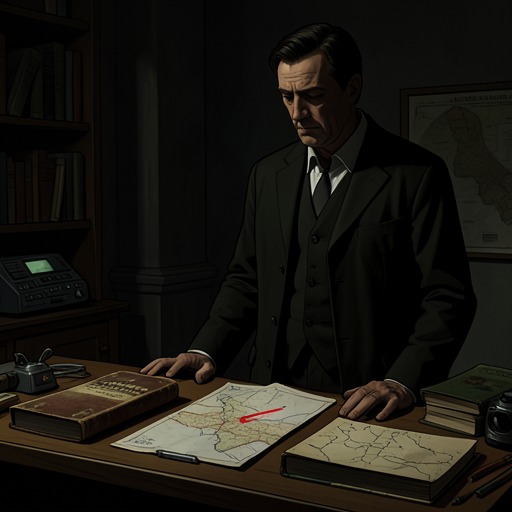
Kurtz
Heart of DarknessKurtz is the central absent presence in Marlow’s account: a celebrated figure encountered through anticipation, remembered scenes, and the consequences of his death. His career in the wilderness joins eloquence to the pursuit of ivory, while his final recognition of horror survives as a private truth that Marlow cannot bring himself to tell the Intended.
Identity and Reputation
Before meeting Kurtz, Marlow knows him chiefly as a name associated with ivory and the distant interior. At the Central Station, Kurtz’s expected arrival unsettles both the manager and a man who had hoped to become assistant manager. Marlow recognizes that his own preconceptions are thin: Kurtz has no definite human shape in his imagination, and seems scarcely more real than an angel or a fiend. Yet Marlow allows the would-be assistant manager to believe that he has influence in Europe, hoping the pretense might somehow help Kurtz. The irony is sharp: Marlow acts on behalf of a man he has not yet seen and does not yet understand.
That gap between reputation and knowledge persists in the telling. Marlow reflects that the experience of a particular period of life cannot be transmitted intact; its truth and meaning resist narration, and people ultimately live their experience alone. Kurtz is therefore never presented as a fully available portrait. He reaches the reader through Marlow’s later memories, fragments of speech, and the effects he has left on other people.
The Journey into the Interior
The approach to Kurtz’s station takes two months from the day Marlow’s party leaves the creek. The Congo River seems to carry the travelers backward into the earliest beginnings of the world: the channel is difficult to find among shoals and wooded islands, and the steamer must avoid hidden banks and submerged snags while its crew watches for dead wood to fuel the next day’s steaming. This labor keeps Marlow occupied with immediate dangers even as the forest’s immense silence presses upon him.
As the steamer travels farther inland, sounds and sights along the bank resist easy interpretation. Drums carry through the trees at night; at a bend, people gather amid yells, clapping, stamping, and movement. Marlow admits that the travelers cannot understand what they witness, yet he rejects the comforting certainty that the people are inhuman. What troubles him is the recognition of a shared humanity and the possibility that the noise contains meanings beyond his comprehension. Kurtz’s station lies within this landscape of distance and uncertainty, but the evidence of Marlow’s journey does not make the wilderness a simple explanation for Kurtz’s conduct. Instead, it establishes the pressure of an environment that exceeds the travelers’ knowledge while leaving their choices consequential.
Ivory, Eloquence, and the Claim of Justice
In Marlow’s later vision, Kurtz appears on a stretcher with his mouth open voraciously, as though he might consume the whole earth and its people. The image gathers together the reach of his desires and the terrible mismatch between his eloquence and the realities attached to it. Even after death, Marlow sees him as a shadow of splendid appearances and frightful realities, clothed in magnificent speech. The remembered figure is not merely a failed public reputation: his words remain powerful enough to return with disturbing force.
One memory makes the contradiction concrete. Kurtz speaks of a lot of ivory as his own because he collected it at personal risk, and worries that The Company will claim it. He asks whether he should resist, insisting that he wants no more than justice. Marlow repeats the appeal to justice in his recollection, but the insistence does not settle the question in Kurtz’s favor. Set beside the voracious image and the remembered scale of his desires, the claim makes self-justification part of his legacy: the language of fairness accompanies possession of ivory obtained through his own collecting, while leaving the larger moral account unresolved.
Final Recognition and Marlow’s Silence
Kurtz’s last words return to Marlow in the Intended’s drawing room. As she asks for a word of his to live with, Marlow hears again the cry that had come back to him in memory: “The horror! The horror!” Rather than repeat it to her, he says that Kurtz’s last word was her name. She accepts the answer as confirmation of what she already believed, and her grief finds in it a consoling final attachment.
Marlow’s account presents this answer as a deliberate concealment, not a failure to remember. He considers whether he has denied Kurtz the justice he claimed to want, but says he could not tell the Intended the truth because it would have been too dark. The lie protects her belief in the man she loved, while leaving Marlow burdened with the knowledge of what he actually heard. Kurtz’s final cry thus has two afterlives: a judgment that returns in Marlow’s private memory, and a different last word preserved for the Intended.
Narrative Role and Afterlife
Kurtz’s influence outlasts his body, station, plans, ivory, and career; Marlow describes memory and the Intended as what remained with him. Even when Marlow goes to return Kurtz’s portrait and letters, he cannot approach the Intended without the memories of the stretcher, the forest, the crowd, the drumbeat, and Kurtz’s desperate speech. The past enters the domestic visit with him, making the effort to surrender Kurtz to oblivion impossible.
The novel’s framing intensifies that persistence. After Marlow falls silent, the Frame Narrator observes that the listeners remain still; the darkening river and cloud bank seem to lead toward an immense darkness. Kurtz’s story therefore ends not with his body alone, but with a voice remembered, a truth withheld, and an atmosphere that extends beyond the scene. His eloquence gives him reach, yet it cannot make his actions or his final judgment disappear.