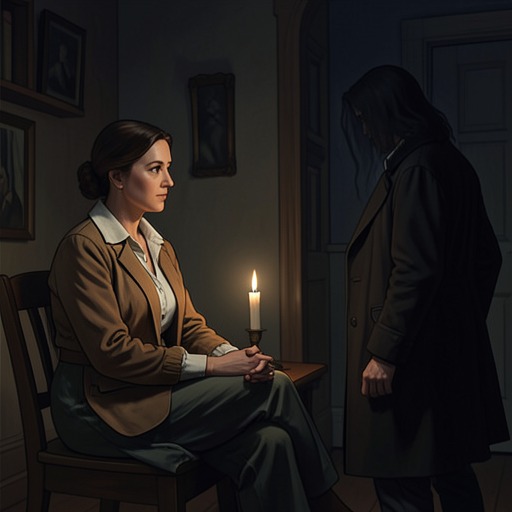
Kurtz and the Intended
Heart of DarknessKurtz and the Intended are connected by an intimate bond that the narrative reveals indirectly: Kurtz invokes her while dying, and she later watches over his mother. Their relationship is also defined by absence. The Intended remains outside the African experience that has transformed Kurtz, while Marlow controls how much of his final words and papers can travel back to her world.
Naming and Possession
As Marlow recalls Kurtz’s last days, the name My Intended emerges among the possessions Kurtz claims as his own. Marlow groups it with Kurtz’s ivory, station, and river, making the declaration sound at once like a personal attachment and an extension of his possessive claim over everything around him. The intimate name is therefore not presented as a private exchange between the pair; it reaches the reader through Marlow’s account of a dying man whose sense of ownership has become boundless.
Marlow sets this attachment against the wilderness’s hold over Kurtz. He describes Kurtz as its favored object, consumed and changed by it, while the Intended belongs to a protected world he says women should be allowed to inhabit. The contrast does not establish what the Intended herself thinks of Kurtz or their relationship. Instead, it shows how Marlow’s explanation places her at a distance from the experiences that have remade him, and how her image becomes part of his attempt to interpret Kurtz’s divided belonging.
The Intended’s Place in Kurtz’s Aftermath
The Intended appears again in the account of Kurtz’s family after Marlow returns to the Company’s European city. Kurtz’s mother had recently died, and Marlow is told that the Intended watched over her. This concrete act of care connects the Intended to Kurtz’s family even after his death, while also showing her continuing presence in the domestic world from which his final African experience is separated.
Marlow, by contrast, holds Kurtz’s papers and faces requests for them from people associated with the Company and Kurtz’s family. The evidence does not say that he gives the Intended the papers or recounts Kurtz’s final words to her. It does establish a sharp difference between her care for Kurtz’s mother and Marlow’s custody of the documents through which Kurtz’s public and private legacies might be understood.
Marlow’s Mediation and the Limits of the Record
Marlow describes having laid the ghost of Kurtz’s gifts with a lie, then insists that the girl is outside the story of what happened in Africa. He generalizes that women should remain in a beautiful world of their own, lest the world of men become worse. His explanation makes the Intended’s exclusion an explicit part of his account, but it also exposes the limits of what that account offers: she is spoken about and interpreted by Marlow, rather than given a voice of her own in these passages.
The relationship consequently reaches the reader through two acts of mediation: Kurtz’s dying invocation as remembered by Marlow, and Marlow’s later decision to lie while explaining his handling of Kurtz’s legacy. The Intended’s care for Kurtz’s mother gives her a role in the aftermath, but the available account leaves her own understanding of Kurtz unstated. The bond is thus both emotionally marked and narratively incomplete: Kurtz names her, Marlow decides what can be said, and her perspective remains beyond the account.