Kurtz's terminal illness
Heart of DarknessKurtz's terminal illness is the bodily crisis that shadows his growing power at the Inner Station and finally brings that power to an end. Reports of partial recovery give way to sudden relapses, months without medicine or proper food, and a final journey in which he is carried from the wilderness barely able to move. Yet his weakness never makes him simply passive: he continues to pursue ivory, resist others' plans for him, and speak with a force that seems to exceed the failing body. His death closes that contradiction without resolving it.
Reports and an Uncertain Course
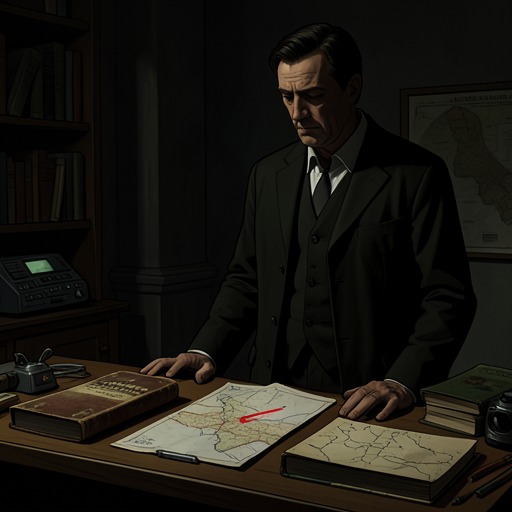
Before Charles Marlow meets Kurtz, the General Manager and his uncle discuss the possibility that the climate may remove the difficulty Kurtz poses. Their conversation makes illness sound at once like a medical danger and a convenient solution to an institutional problem. Kurtz has asked to be sent to the Inner Station, and the General Manager says he was instructed to comply. The same discussion reveals that Kurtz's assistant had reported him very ill and only imperfectly recovered. His condition is already serious, but its course remains uncertain: the report does not describe a steady convalescence so much as a recovery that has failed to restore him.
That uncertainty accompanies the news of the ivory. Kurtz had apparently intended to return from the station, which was bare of goods and stores, but after travelling three hundred miles he turned back alone in a small dugout with four paddlers. The half-caste clerk continued downriver with the ivory. The General Manager and his uncle cannot make sense of this reversal, and illness is one circumstance in the wider account rather than a complete explanation for Kurtz's choices. Marlow imagines him turning away from relief and homeward thoughts toward his desolate station; that image gives the reported physical decline a setting of deliberate return, not simple withdrawal.
Relapse at the Inner Station
By the time Kurtz's illness becomes immediate to Marlow, the Russian Trader says that Kurtz has lately come down to the river after months away. He brought the fighting men of a lake tribe with him, apparently intending to raid across the river or downstream. The Russian supposes that the appetite for more ivory had overtaken less material aspirations. Then Kurtz suddenly became much worse. Hearing that he was helpless, the Russian risked coming upriver to see him. The account links a sharp physical deterioration to the return from an extended absence, while leaving the precise cause and timing unexplained.
Kurtz's surroundings sharpen the sense of abandonment. The Russian says that for months there has been neither a drop of medicine nor a mouthful of invalid food. He insists that Kurtz has been shamefully left without care and says he has spent ten nights without sleep trying to keep him alive. This testimony comes from a devoted but compromised witness: the Russian admires Kurtz and has followed him, yet he also admits that Kurtz sometimes threatened him and demanded ivory. His account makes the illness concrete through the missing necessities of treatment, while showing how completely the men around Kurtz are drawn into his authority and its consequences.
Carried from the Wilderness
Kurtz's arrival is a spectacle of bodily collapse. Men carry him on an improvised stretcher from the ruined house, while armed Pilgrims follow with two shotguns, a heavy rifle, and a revolver-carbine. Laid in a small cabin, he reaches feebly among the belated correspondence spread across his bed. Marlow sees the cage of his ribs moving and the bones of his arm waving beneath a body stripped of its covering. The scene makes the scale of the illness unmistakable: the man who has commanded the station and its surrounding camps is now borne by others and can barely handle the papers brought to him.
But the first view of him is not a picture of pain alone. Marlow says Kurtz does not seem to be suffering, and that his expression has a composed, languid calm, as if the shadow of disease has for the moment had its fill of emotion. The contrast between extreme physical debility and apparent inward composure prevents the scene from becoming a simple account of helplessness. When Kurtz looks directly at Marlow and says he is glad, the sound of his voice astonishes the listeners: it is grave, profound, and vibrating, though the speaker seems scarcely capable of whispering. His body has almost failed, but his voice still makes his presence felt.
The General Manager describes Kurtz as very low and argues that he has done more harm than good to The Company. He frames the crisis in terms of trade, lost ivory, and an unsound method; Marlow, by contrast, sees no method at all. That disagreement does not lessen the evidence of Kurtz's condition. It shows instead how his illness is interpreted through competing interests: as a human emergency by the Russian Trader, as a commercial liability by the General Manager, and as part of the moral catastrophe surrounding the station by Marlow.
Defiance and the Final Decline
Even after being carried from the station, Kurtz resists the idea that his illness has ended his ambitions. Behind the cabin curtain, Marlow hears him accuse others of wanting to save the ivory rather than him, insist that he is not as sick as they would like to believe, and declare that he will carry out his ideas and return. The speech is broken and fevered in its circumstances, but it retains the pattern visible earlier: physical weakness does not immediately displace the will to control events. The General Manager, meanwhile, speaks of the damage to The Company and the need to save the ivory. Kurtz's illness thus unfolds amid a struggle over what is to be preserved—his life, his plans, or the profits associated with his station.
The final phase comes after the steamer breaks down and must stop for repairs at the head of an island. The delay shakes Kurtz's confidence. He gives Marlow a packet of papers and a photograph, tied together with a shoestring, and asks him to keep them from the General Manager's scrutiny. Later, Marlow hears him mutter fragments about living rightly and dying. The failing body is still surrounded by plans for his ideas and papers, but those claims now coexist with the awareness that he is dying. One evening, as Marlow enters with a candle, Kurtz says that he is lying in the dark waiting for death. The light is close to his eyes; the words make the distance between bodily fact and the surrounding darkness suddenly explicit.
Marlow watches Kurtz's face change. He sees pride, power, terror, and despair pass across it, but does not claim to know precisely what Kurtz experiences in that moment. Kurtz cries out twice, almost in a breath, and Marlow leaves the cabin. The next announcement comes from the General Manager's boy: Kurtz is dead. The Pilgrims hurry out, while Marlow stays at dinner and eats little. He does not go near Kurtz again; the voice that had filled the cabin and commanded attention is gone. The following day, the Pilgrims bury what remains in a muddy hole.
Meaning of the Illness in the Narrative
Kurtz's decline is related through reports, glimpses, gestures, and a final witnessed scene rather than through a continuous medical account. The narrative supplies no diagnosis and offers no clear explanation for the cycles of grave illness and incomplete recovery. Instead, it sets the Russian Trader's testimony about months without medicine or invalid food beside Marlow's direct observations: the feeble movement among letters, the ribs and bones, the astonishing voice, and the final words about waiting for death. The limits of what can be known remain part of the portrayal.
The illness also changes the scale at which Kurtz can act. At the station he can return to ivory raids and gather armed followers; on the stretcher he can barely reach for correspondence; aboard the steamer he can still speak of returning, but can no longer carry out those plans. His death makes that loss irreversible. For Marlow, who has approached Kurtz as a name and then become attached to the dying man, the extinguishing of the voice turns the physical ending into a lasting narrative burden. Kurtz's illness is therefore not a detached subplot: it is the process through which the force of his authority is reduced to a body, a voice, a final utterance, and the papers entrusted to another man.