Kurtz’s Attempted Flight Back to the Forest
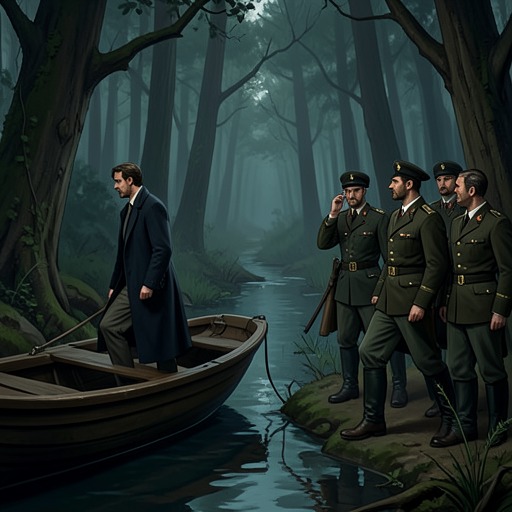
Heart of DarknessKurtz’s attempted flight back into the forest is a turning point in Marlow’s account: he finds Kurtz moving away from the Inner Station and persuades him to return, not by appealing to conventional authority but by confronting him with the life and ambitions he is abandoning. The episode makes Kurtz’s attraction to the wilderness visible as an immediate struggle, while Marlow’s decision to follow him alone begins an intimacy that he later describes as lasting beyond the encounter itself.
Warning and Discovery
During the night, a warning Marlow had heard earlier returns to mind. From the station he can see fires in the forest, where Kurtz’s followers are keeping watch, and hear drumming and chanting. After a sudden burst of shouting, the sound settles again. Marlow looks into the cabin and discovers that Kurtz is gone. The commotion has not awakened a nearby agent, and Marlow chooses not to raise an alarm or summon help.
The discovery first produces a shock that Marlow distinguishes from fear of an attack. He experiences it as a moral disturbance, as if he had unexpectedly encountered something he could neither accept nor explain. The prospect of ordinary physical danger then seems almost reassuring by comparison. Although he says that he had been ordered not to betray Kurtz, he also frames his silence as a personal loyalty to the strange, disturbing experience he believes he must meet alone. He does not explain why he guards that experience from other witnesses; the decision itself makes his pursuit private from the outset.
Marlow’s Pursuit
On the bank, Marlow finds a broad track through the grass and follows it. He assumes Kurtz may be crawling, though this is his own conjecture, not something he has yet seen. His thoughts move erratically: he recalls the knitting old woman with a cat, imagines Pilgrims firing their weapons, and pictures himself stranded in the forest without arms. He also mistakes the beat of the drum for his own heartbeat, taking comfort in its steadiness. These disconnected impressions register the strain of the night without turning the pursuit into a clear or measured operation.
Marlow then thinks he sees movement ahead. Leaving the track, he runs in a wide semicircle in an attempt to get in front of it; he admits that he is not certain he saw anything at all. At this point he feels unusually confident, and the maneuver strikes him as almost a game. That confidence breaks when he reaches Kurtz. Kurtz rises unsteadily, while fires and voices remain close behind him. Marlow estimates that the nearest fire is only thirty yards away. A figure wearing what appear to be antelope horns moves near the glow, a reminder that Kurtz is within reach of the people gathered in the forest.
Confrontation and Return
Kurtz tells Marlow to go away and hide. Despite his physical weakness, his voice remains forceful enough to make Marlow fear that a shout could draw the crowd’s attention. Marlow warns him that he will be lost if he continues. He considers threatening physical force, although he has no stick or stone at hand, and then invokes Kurtz’s assured success in Europe. The appeal redirects the confrontation from immediate force to the future Kurtz may still claim.
Kurtz speaks of immense plans and of having stood on the threshold of great things; he also complains about the interruption. Marlow understands that he is trying to break what he sees as the wilderness’s hold over Kurtz. In Marlow’s interpretation, the forest has drawn Kurtz toward its fires and sounds and awakened impulses that no ordinary appeal to duty, status, or shared moral standards can reach. He believes there is no higher principle to invoke against Kurtz: the man has become answerable only to himself. Yet Marlow insists that Kurtz’s intelligence remains clear, even as his inner life has become profoundly disordered. This combination makes the encounter difficult to reduce to simple madness or to a rational disagreement.
Marlow eventually gets Kurtz back to the couch. He has supported him with Kurtz’s arm around his neck, and afterward his legs shake from the exertion, although Kurtz is slight. The physical effort is small beside the inward ordeal Marlow describes: he has been forced to witness a person struggling against himself without restraint, faith, or fear. Marlow presents the return not as a final cure or resolution but as the immediate outcome of a confrontation in which Kurtz is brought back from the edge of the forest.
Departure and Significance
The following day, the steamer leaves at noon. As it moves away, the crowd emerges from the woods and fills the clearing and slope. Several men at the river’s edge perform gestures and call out toward the departing vessel; the crowd’s responses accompany the steamer’s departure. The attempted flight therefore ends in a separation from the forest, but the scene does not establish that Kurtz’s attachment to it has been overcome.
For Marlow, the encounter also marks the beginning of a bond with Kurtz that he understands as enduring. He recalls telling Kurtz that he would be utterly lost, then recognizes the irony: Kurtz already seems irretrievably lost, yet their intimacy is being founded in that moment. The scene binds rescue to witness. Marlow intervenes to bring Kurtz back, but he also sees the encounter as a passage into Kurtz’s inner collapse, one that leaves him carrying a knowledge he says no eloquence could make easy to bear.