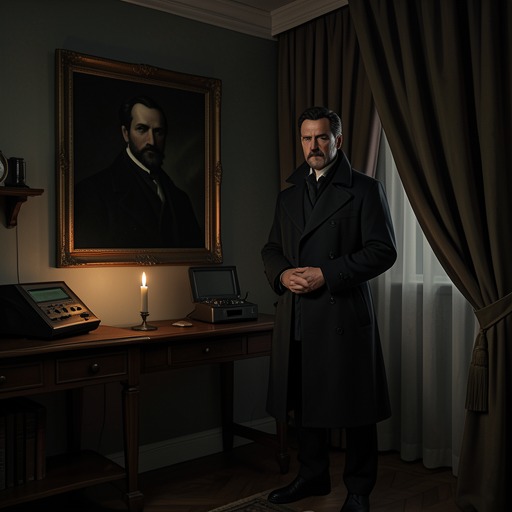
Kurtz’s death
Heart of DarknessKurtz’s death is not shown as a direct scene of dying; it reaches the reader through Marlow’s retrospective account of what the death leaves behind. More than a year after the news, the Intended mourns as though the loss were immediate, while Marlow’s vision binds her sorrow to Kurtz’s condemnation. His account ends with a consequential deception: he tells her that Kurtz’s last word was her name, sparing her the truth he cannot bear to disclose.
Death Recalled Through Grief
When Marlow visits the Intended, dusk has fallen in a lofty drawing room. She appears in mourning, and more than a year has passed since the news of Kurtz’s death. Yet Marlow sees in her face a desolation so powerful that Kurtz seems to have died only the previous day—or at that very moment. The narrative makes grief a force that collapses elapsed time: Marlow imagines Kurtz’s death and the Intended’s sorrow together, as if he can witness both at once.
This perception unsettles Marlow. He feels that he has stumbled into cruel mysteries beyond what a human being should behold. The death is therefore more than the fact of Kurtz’s absence: in Marlow’s account, it remains present in the Intended’s mourning and in his own troubled recollection of Kurtz’s final condemnation.
The Gesture of Absence
When the Intended says she cannot believe she will never see Kurtz again, she stretches her arms across the fading light at the window, as if reaching after a retreating figure. Marlow says the image of Kurtz becomes clear to him in that instant and that he will see the vision for the rest of his life. The gesture gives the loss a lasting visual form: she reaches toward someone who cannot return, and Marlow becomes the witness who carries that image forward.
Her pose also recalls the African Woman with Kurtz, whom Marlow remembers stretching her bare arms over the river. The comparison links two figures separated by circumstance but joined in an image of powerless longing. The river is described as a stream of darkness; through this echo, the Intended’s private bereavement becomes entangled with the darkness surrounding Kurtz’s life in Africa.
The Last Words and Marlow’s Choice
The death’s most consequential aftereffect comes when the Intended asks about Kurtz’s final words. Marlow tells her that Kurtz’s last word was her name. Her sigh gives way to a cry of triumph and pain: she takes his answer as confirmation of what she already believed and weeps with her face hidden in her hands. The exchange leaves her idealized understanding of Kurtz intact, but it rests on Marlow’s deliberate falsehood.
Marlow measures that choice against the justice he believes Kurtz was due. He imagines the heavens falling if he had told her the truth, then admits that he could not reveal it because it would have been too dark. His concealment turns the death into a moral conflict that survives the moment itself: Marlow must choose between truth about Kurtz’s end and the Intended’s consoling belief. After his account, the frame narrative falls silent; the waterway beneath the overcast sky seems to lead into immense darkness.